
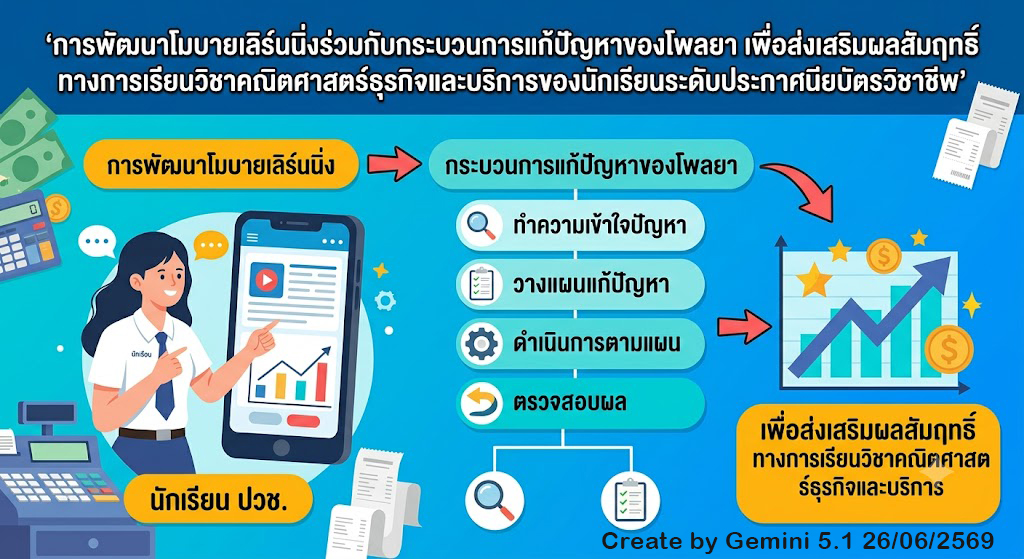
The Development of Mobile Learning Integrated with Polya’s Problem-Solving Process to Enhance Learning Achievement in Business and Service Mathematics for Vocational Certificate Students
Article Sidebar
Main Article Content
Abstract
The objectives of this research were 1) to develop mobile learning integrated with Polya’s problem-solving process on the topic of setting selling prices for Vocational Certificate students to achieve an efficiency of 80/80, and 2) to compare students' learning achievement in the Business and Service Mathematics course before and after learning through mobile learning integrated with Polya’s problem-solving process on the topic of setting selling prices. The sample group in this study consisted of 30 vocational certificate students from Thonburi Commercial College, under the Office of the Vocational Education Commission, during the second semester of the 2024 academic year. The sample was selected by simple random sampling, using the classroom as the sampling unit. The research instruments consisted of 1) a mobile learning program integrated with Polya’s problem-solving process on the topic of setting selling prices in the Business and Service Mathematics course for Vocational Certificate students, 2) three lesson plans for mathematics instruction using mobile learning integrated with Polya’s problem-solving process on the topic of setting selling prices, and, 3) a 20-item multiple-choice achievement test on the topic of setting selling prices in the Business and Service Mathematics course. The test had a difficulty index ranging from 0.21 to 0.64, a discrimination index ranging from 0.21 to 0.76, and a reliability coefficient of 0.68. The results showed that 1) the mobile learning integrated with Polya’s problem-solving process had an efficiency of E1/E2 = 83.69/83.85, and, the post-test learning achievement scores of the students were significantly higher than before learning at the .05 level.
Article Details

This work is licensed under a Creative Commons Attribution-NonCommercial-NoDerivatives 4.0 International License.
References
กระทรวงศึกษาธิการ. (2560). ตัวชี้วัดและสาระการเรียนรู้แกนกลาง กลุ่มสาระการเรียนรู้คณิตศาสตร์. โรงพิมพ์ชุมนุมสหกรณ์การเกษตรแห่งประเทศไทย.
สำนักมาตรฐานการอาชีวศึกษาและวิชาชีพ. (2567). หลักสูตรประกาศนียบัตรวิชาชีพ พุทธศักราช 2567 หมวดวิชาสมรรถนะแกนกลาง. กรุงเทพฯ.
วันชัย น้อยวงค์. (2565). การจัดการเรียนรู้เพื่อส่งเสริมทักษะการคิดอย่างมีวิจารณญาณและการแก้ปัญหาของผู้เรียนในศตวรรษที่ 21. วารวิจัยเพื่อการปฏิรูปการเรียนรู้ สถาบันวิจัย พัฒนา และสาธิตการศึกษามหาวิทยาลัยศรีนครินทรวิโรฒ, 5(2), 54-69.
สืบวงศ์ ชื่นสมบัติ และสิริกัญญา มณีนิล. (2563). การออกแบบการเรียนการสอนบนโมบายเลิร์นนิง. วารสารเทคโนโลยีและสื่อสารการศึกษา มหาวิทยาลัยสุโขทัยธรรมาธิราช, 15(18), 45-59.
ธมลวรรณ การัดเสนา, ณัฏฐชัย จันทชุม และวนิดา ผาระนัด. (2565). การพัฒนาผลสัมฤทธิ์ทางการเรียนวิชาคณิตศาสตร์ เรื่อง สมการเชิงเส้นตัวแปรเดียว โดยใช้การเรียนรู้แบบร่วมมือเทคนิค STAD ประกอบ M - Learning ของนักเรียนชั้น มัธยมศึกษาปีที่ 1. วารสารวิชาการศึกษาศาสตร์ ศรีนครินทรวิโรฒ, 22(2), 94-112.
Polya G. (1957). How to solve it (2nd ed.). Prentice University Press.
มลธิกา ยานะสาร และ วิชยา โยชิดะ. (2566). การพัฒนาความสามารถในการแก้โจทย์ปัญหาคณิตศาสตร์ และผลสัมฤทธิ์ ทางการเรียนของนักเรียนชั้นประถมศึกษาปีที่ 4 โดยใช้กิจกรรมการเรียนรู้กระบวนการแก้โจทย์ปัญหาของโพลยาร่วมกับเกม. วารสารมหาวิทยาลัยราชภัฏมหาสารคาม, 17(2), 107-116.
Branch, R. M. (2009). Instructional Design: The ADDIE Approach. Springer.
บุญชม ศรีสะอาด. (2565). การวิจัยเบื้องต้น (พิมพ์ครั้งที่ 7). สุวีริยาสาสน์การพิมพ์.
สมนึก ภัททิยธนี. (2565). การวัดผลการศึกษา (พิมพ์ครั้งที่ 3). ประสานการพิมพ์.
ชัยยงค์ พรหมวงศ์. (2556). การทดสอบประสิทธิภาพสื่อหรือชุดการสอน. วารสารศิลปากรศึกษาศาสตร์วิจัย, 5(1), 7-20. เอกสารอ้างอิง (ต่อ)
ชูศักดิ์ จรูญสวัสดิ์. (2563). การวิเคราะห์ข้อมูลและการใช้สถิติในงานวิจัย (พิมพ์ครั้งที่ 2). คิสุกะ (ประเทศไทย).
ณัฐรดา ธรรมเวช. (2565). การพัฒนาความสามารถในการแก้ปัญหาโจทย์คณิตศาสตร์ เรื่อง ดอกเบี้ยและมูลค่าของเงินโดยใช้กระบวนการแก้ปัญหาของโพลยา. Journal of Roi Kaensarn Academi, 7(11), 324–339.
ธีรโชติ โลกธาตุ, ธิดาพร ผันผ่อน, วรัญญา ดอนแสง และปิยนันท์ ศรีวรกุล. (2567). ศึกษาการสร้างและหาประสิทธิภาพบทเรียนคณิตศาสตร์ผ่านอุปกรณ์ไร้สายแบบพกพา เรื่อง เศษส่วนและทศนิยม สำหรับนักเรียนชั้นประถมศึกษาปีที่ 5. วารสารคอมพิวเตอร์และเทคโนโลยีสร้างสรรค์ มหาวิทยาลัยราชภัฏสุรินทร์, 2(1), 17-25.
พรรณิภา อนันทสุข, และ พรรณราย เทียมทัน. (2566). ผลการจัดการเรียนรู้แบบร่วมมือด้วยเทคนิคทีจีทีร่วมกับแอปพลิเค ชันเพื่อการศึกษาที่มีต่อ ผลสัมฤทธิ์ทางการเรียนและเจตคติต่อการเรียนวิชาคณิตศาสตร์ของนักเรียนชั้นมัธยมศึกษาปีที่ 4. Silpakorn Educational Research Journal.,15(1), 231–245.
จารุวรรณ สวนจันทร์, และ วีระศักดิ์ ชมภูคำ. (2567). การจัดการเรียนรู้โดยใช้กระบวนการเรียนรู้ 5 ขั้นตอน ร่วมกับกระบวนการแก้ปัญหาของโพลยา เพื่อพัฒนาความสามารถแก้โจทย์ปัญหาคณิตศาสตร์ของนักเรียนชั้นมัธยมศึกษาปีที่ 1.วารสารครุศาสตร์ มหาวิทยาลัยราชภัฏเชียงใหม่, 3(3), 1–16.
