
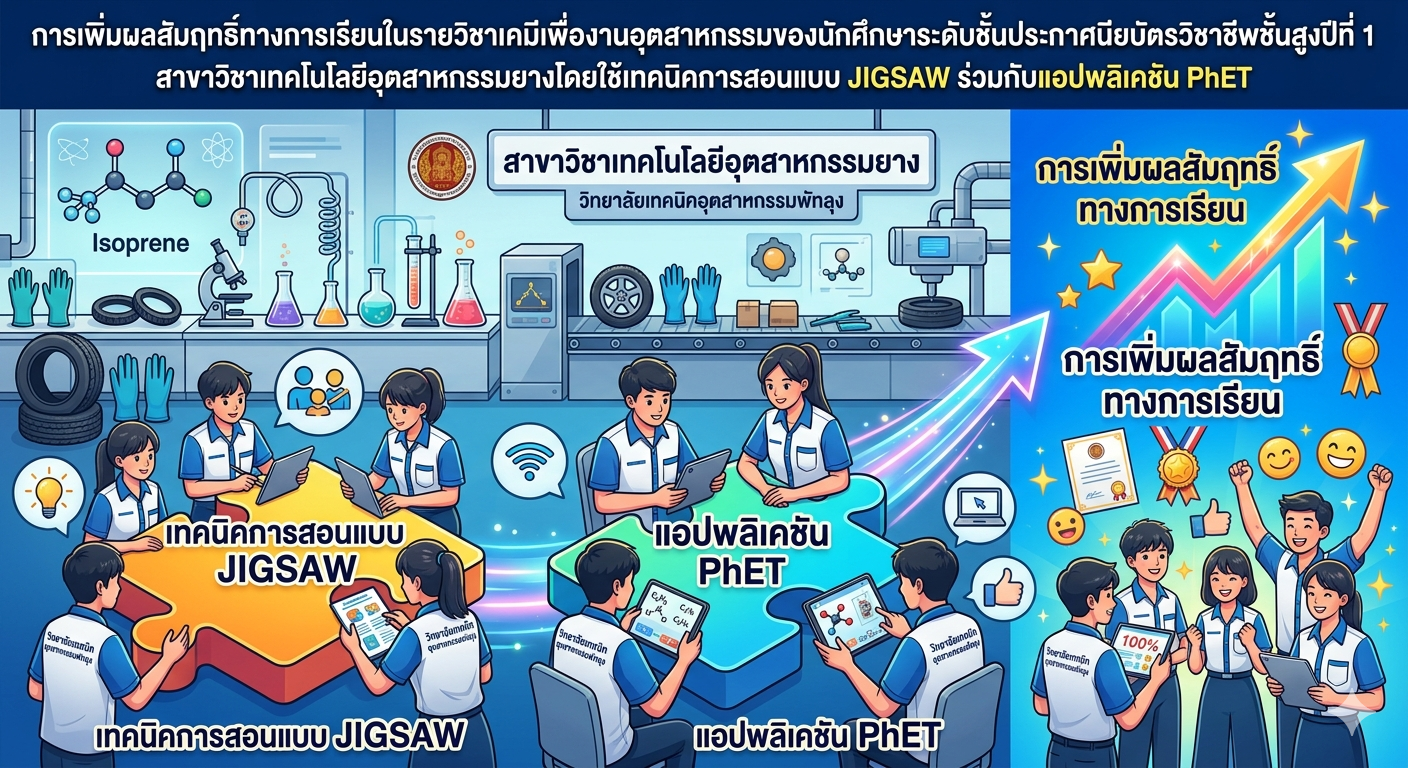
Enhancing Learning Achievement in Industrial Chemistry for the First-Year High Vocational Certificate Students in Rubber Industrial Technology Using the Jigsaw Teaching Technique with the PhET Application
Article Sidebar
Main Article Content
Abstract
This research aimed to 1) compare pre- and post-instructional learning achievement using the Jigsaw technique combined with the PhET application and 2) study student satisfaction with cooperative learning using the Jigsaw technique combined with the PhET application. The population and sample used in this research consisted of 23 first-year High Vocational Certificate students in the Rubber Industrial Technology program, Semester 1, Academic Year 2025, at Surat Thani Technical College. The sample was selected using purposive sampling. The research tools included a lesson plan for Industrial Chemistry for the first-year High Vocational Certificate students, an achievement test in Industrial Chemistry for the first-year High Vocational Certificate students, and a questionnaire on student satisfaction with cooperative learning using the Jigsaw technique combined with the PhET application. The statistics used for data analysis included content validity, difficulty level, discrimination index, and reliability coefficient. The descriptive statistics included the mean and standard deviation, and the dependent t-test. The research findings showed that 1) cooperative learning achievement using the jigsaw technique combined with the PhET application was significantly higher after the intervention than before, supporting the hypothesis at the 0.05 statistical significance level. The post-intervention mean (=24.65) was higher than the pre-intervention mean (
= 13.43). 2) The students' satisfaction towards collaborative learning using the jigsaw technique combined with the PhET application was at the highest level, with an average score (
) of 4.61 and a standard deviation (S.D.) of 0.08.
Article Details

This work is licensed under a Creative Commons Attribution-NonCommercial-NoDerivatives 4.0 International License.
References
กระทรวงศึกษาธิการ. (2565). นโยบายและจุดเน้นการจัดการศึกษาของกระทรวงศึกษาธิการปีงบประมาณ พ.ศ 2565. https://www.moe.go.th/backend/wp-content/uploads/2020/11/จุดเน้น2565.pdf
OECD. (2019). Innovation in green chemistry: Reducing environmental impact and increasing resource efficiency. OECD Publishing.
National Science Board. (2021). The role of chemistry in economic development and sustainability. National Science Foundation. https://www.nsf.gov/nsb
UNESCO. (2022). Exploring chemistry education: Abstract concepts and barriers to learning. UNESCO Publishing.
National Research Council. (2021). Challenges in chemistry education: Laboratory resources and teaching strategies. National Academies Press.
สถาบันทดสอบทางการศึกษาแห่งชาติ (องค์การมหาชน). (2566). รายงานการวิเคราะห์ผลการทดสอบทางการศึกษาระดับชาติด้านอาชีวศึกษา (V-NET) ปีการศึกษา 2566. https://rngpeo.moe.go.th/wp-content/uploads/2024/03/66VNET.pdf
ศิริวรรณ ฉัตรมณีรุ่งเจริญ, และ มัลลิกา ดารากัย. (2567). การพัฒนาแนวคิดวิทยาศาสตร์ เรื่อง แสงและการมองเห็นของนักศึกษาระดับชั้นมัธยมศึกษาปีที่ 3 โดยใช้การจัดการเรียนรู้แบบสืบเสาะหาความรู้ (5E) ร่วมกับ โปรแกรมสถานการณ์จำลอง PhET . วารสารวิจัยทางการศึกษา คณะศึกษาศาสตร์ มหาวิทยาลัยศรีนครินทรวิโรฒ, 19(1), 199-212.
Aronson, E., & Patnoe, S. (2021). Collaboration in the classroom: The jigsaw approach (4th ed.). Pinter & Martin.
Gömleksiz, M. N. (2021). The impact of jigsaw technique on students’ academic achievement and attitudes towards science education. Journal of Education and Learning, 10(3), 45–56.
Rahman, M., Yusof, R., & Ismail, H. (2021). Enhancing student collaboration through the jigsaw method in higher education. Journal of Educational Research, 15(1), 33–49.
Musa, S. M., Ahmad, N., & Latif, R. A. (2021). The impact of the jigsaw learning method on student academic achievement. International Journal of Teaching, 14(2), 78–92.
Nasution, A. S. (2020). Application of the jigsaw learning model to develop students understanding of physics concepts. Asian Journal of Education and Training, 6(4), 12–21.
ชุติกาญจน์ เปียงใจ. (2562). การจัดการเรียนรู้แบบร่วมมือด้วยเทคนิคจิ๊กซอว์เพื่อส่งเสริมทักษะการทำงานกลุ่มในสาระการเรียนรู้คณิตศาสตร์ของนักศึกษาชั้นมัธยมศึกษาปีที่ 2 [วิทยานิพนธ์ครุศาสตรมหาบัณฑิต, มหาวิทยาลัยเชียงใหม่]. https://archive.lib.cmu.ac.th/full/T/2562/emath10762cpan_full.pdf
ชาญวิทย์ คำเจริญ, และ ขวัญหทัย กวดนอก. (2563). การตรวจสอบการใช้แบบจำลองโต้ตอบเสมือนจริงสำหรับการสอนไฟฟ้ากระแสตรง. วารสารศึกษาศาสตร์ มหาวิทยาลัยสงขลานครินทร์ วิทยาเขตปัตตานี, 31(2), 25–37.
บุญชม ศรีสะอาด. (2551). พื้นฐานการวิจัยการศึกษา (พิมพ์ครั้งที่ 4). ประสานการพิมพ์.
สุวิทย์ มูลคำ, และ อรทัย มูลคำ. (2545). 21 วิธีการจัดการเรียนรู้เพื่อพัฒนากระบวนการคิด (พิมพ์ ครั้งที่ 10). ภาพพิมพ์.
กนกพร บุญธรรม. (2563). การใช้สื่อ PhET เพื่อส่งเสริมการเรียนรู้วิทยาศาสตร์ของนักศึกษาชั้นมัธยมศึกษาตอนต้น [วิทยานิพนธ์ครุศาสตรมหาบัณฑิต, มหาวิทยาลัยเชียงใหม่].
ชุติกาญจน์ เปียงใจ. (2562). การจัดการเรียนรู้แบบร่วมมือด้วยเทคนิคจิ๊กซอว์เพื่อส่งเสริม ทักษะการทำงานกลุ่ม ในสาระการเรียนรู้คณิตศาสตร์ ของนักศึกษาชั้นมัธยมศึกษาปีที่ 2 [วิทยานิพนธ์ศึกษาศาสตรมหาบัณฑิต, มหาวิทยาลัยเชียงใหม่].
ศิริวรรณ ฉัตรมณีรุ่งเจริญ, และ มัลลิกา ดารากัย. (2567). การพัฒนาแนวคิดวิทยาศาสตร์ เรื่อง แสงและการมองเห็นของนักศึกษาระดับชั้นมัธยมศึกษาปีที่ 3 โดยใช้การจัดการเรียนรู้แบบสืบเสาะหาความรู้ (5E) ร่วมกับโปรแกรมสถานการณ์จำลอง PhET . วารสารวิจัยทางการศึกษา คณะศึกษาศาสตร์ มหาวิทยาลัยศรีนครินทรวิโรฒ, 19(1), 199-212.
สุกันดา พรหมนิล. (2563). การพัฒนากิจกรรมการเรียนรู้วิชาชีววิทยา เรื่อง การสังเคราะห์ด้วยแสง โดยใช้รูปแบบวัฏจักรการสืบเสาะหาความรู้ (5E) ร่วมกับการเรียนรู้แบบร่วมมือสำหรับนักศึกษา ชั้นมัธยมศึกษาปีที่ 5 [วิทยานิพนธ์ครุศาสตรมหาบัณฑิต, มหาวิทยาลัยราชภัฏสกลนคร].
ภาณุพงศ์ แก้วบุญเรือง. (2563). การจัดการเรียนรู้แบบร่วมมือโดยใช้เทคนิคจิกซอว์เพื่อพัฒนาผลสัมฤทธิ์และความคงทนในการเรียนรู้ เรื่องกฎหมายในชีวิตประจำวัน สำหรับนักศึกษาชั้นมัธยมศึกษาปีที่ 4. วารสารเทคโนโลยีและสื่อสารการศึกษา, 3(8), 118–129.
กฤตนัย เจริญสุข. (2565). การศึกษาผลสัมฤทธิ์และความพึงพอใจต่อการใช้ชุดการสอนวิทยาศาสตร์ เรื่องไฟฟ้าแสนสนุก ร่วมกับสถานการณ์จำลองแบบมีปฏิสัมพันธ์ของ PhET ของนักศึกษาที่ขาดเรียนต่อเนื่องจากการติดเชื้อโควิด-19 ระดับชั้นประถมศึกษาปีที่ 6 โรงเรียนวิชากร สำนักงานเขตดินแดง กรุงเทพมหานคร [รายงานการวิจัยในชั้นเรียน]. โรงเรียนวิชากร สำนักงานเขตดินแดง กรุงเทพมหานคร.
