
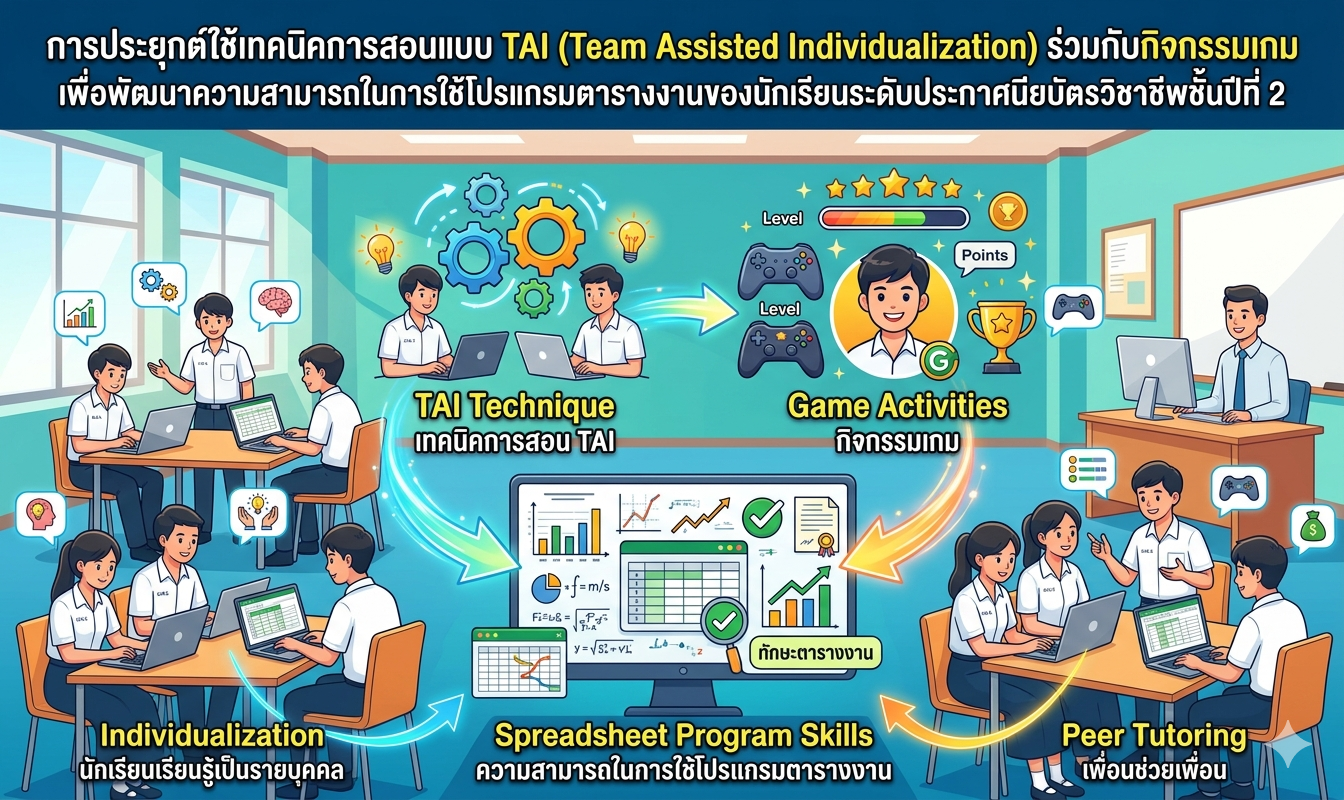
The Application of TAI (Team-Assisted Individualization) Teaching Technique Combined with Game Activities to Develop Spreadsheet Program Ability of the 2nd Year Vocational Certificate Students
Article Sidebar
Main Article Content
Abstract
This research aimed to 1) compare students' ability to use spreadsheet programs before and after learning with the TAI technique combined with game activities, and 2) study students' satisfaction towards learning with the TAI technique combined with game activities. The population consisted of 58 second-year vocational certificate students in Business Computer at Chaiya Vocational College. The sample consisted of 29 second-year vocational certificate students from Class 2/1, selected using simple random sampling by lottery. The research tools included a lesson plan using the TAI technique combined with game-based activities, a spreadsheet program proficiency test, and a student satisfaction questionnaire regarding learning with the TAI technique combined with game-based activities. Data analysis employed statistical methods including content validity, difficulty index, discrimination index, and reliability coefficient. Descriptive statistics included mean and standard deviation, and the dependent t-test.
The research findings revealed that 1) students' ability to use spreadsheet programs was significantly higher after the intervention than before (p < .05), with a post-intervention mean (= 24.31) compared to a pre-intervention mean (
= 19.72), and 2) students' satisfaction with the TAI technique combined with game activities was at the "highest" level (
= 4.61, S.D. = 0.083). This demonstrates that the instructional technique was highly effective in promoting spreadsheet program skills and fostering student learning satisfaction.
Article Details

This work is licensed under a Creative Commons Attribution-NonCommercial-NoDerivatives 4.0 International License.
References
กระทรวงศึกษาธิการ. (2560). แผนการศึกษาแห่งชาติ พ.ศ. 2560–2579. กระทรวงศึกษาธิการ.
สำนักงานคณะกรรมการการศึกษาขั้นพื้นฐาน. (2561). ตัวชี้วัดและสาระการเรียนรู้แกนกลาง กลุ่มสาระการเรียนรู้การงานอาชีพและเทคโนโลยี. สกสค.
บุญชม ศรีสะอาด. (2560). การวิจัยเบื้องต้น (พิมพ์ครั้งที่ 10). สุวีริยาสาส์น.
Slavin, R. E. (1990). Cooperative Learning: Theory, Research, and Practice. Prentice-Hall.
กรแก้ว อินทรมงคล. (2564). ผลการจัดกิจกรรมการเรียนรู้แบบร่วมมือด้วยเทคนิค TAI ร่วมกับกระบวนการแก้ปัญหาของโพลยา ที่มีต่อความสามารถในการแก้ปัญหาทางคณิตศาสตร์และทักษะการทำงานร่วมกัน เรื่องเลขยกกำลังของนักเรียนชั้นมัธยมศึกษาปีที่ 1 [วิทยานิพนธ์ศึกษาศาสตรมหาบัณฑิต]. มหาวิทยาลัยสุโขทัยธรรมาธิราช.
Prensky, M. (2001). Digital game-based learning. McGraw-Hill.
Malone, T. W., & Lepper, M. R. (1987). Making learning fun: A taxonomy of intrinsic motivations for learning. In R. Snow & M. Farr (Eds.), Aptitude, learning, and instruction: Cognitive and affective process analyses (Vol. 3). Lawrence Erlbaum.
สิรินทร์รดา จุฑามณีพงษ์. (2566). รูปแบบการเรียนการสอนตามแนวคิดการเรียนแบบร่วมมือและเกมเป็นฐานโดยใช้เกมกระดานเพื่อส่งเสริมความสามารถในการสื่อสารภาษาอังกฤษของนักเรียนระดับชั้นมัธยมศึกษาตอนปลาย [ปริญญานิพนธ์ดุษฎีบัณฑิต , มหาวิทยาลัยศรีนครินทรวิโรฒ].
บุญชม ศรีสะอาด. (2553). สถิติสำหรับงานวิจัยทางการศึกษา. สำนักพิมพ์วิชาการ.
ล้วน สายยศ, และ อังคณา สายยศ. (2558). หลักการวิจัยทางการศึกษา. คณะศึกษาศาสตร์ มหาวิทยาลัย ศรีนครินทรวิโรฒ.
Likert, R. (1970). A technique for the measurement of attitudes. In G. F. Summers (Ed.), Attitude measurement (pp. 149–158). Rand McNally.
Slavin, R. E. (1984). Team-assisted individualization: Combining cooperative learning and individualized instruction in mathematics. Johns Hopkins University, Center for Social Organization of Schools.
ศรีนิล, พ. (2550). การจัดการเรียนรู้แบบร่วมมือเพื่อส่งเสริมผลสัมฤทธิ์ทางการเรียน. สำนักพิมพ์ทางการศึกษา.
อัจจิมา บรรพต. (2565). การเปรียบเทียบผลสัมฤทธิ์ทางการเรียนวิชาคณิตศาสตร์ เรื่องลำดับและอนุกรม ของนักเรียนชั้นมัธยมศึกษาปีที่ 5 โดยใช้การเรียนแบบร่วมมือเทคนิค TAI. [ปริญญานิพนธ์วิทยาศาสตรมหาบัณฑิต, มหาวิทยาลัยมหาสารคาม].
จุฑามาศ มีสุข, สนิท ตีเมืองซ้าย, และ พงศ์ธร โพธิ์พูลศักดิ์. (2558). การจัดกิจกรรมการเรียนรู้เพื่อเสริมสร้างพฤติกรรมการมีส่วนร่วมของนักเรียนโดยใช้เทคนิคเกมมิฟิเคชัน สำหรับนักเรียนห้องเรียนพิเศษวิทยาศาสตร์ ชั้นมัธยมศึกษา ปีที่ 4 โรงเรียนอนุกูลนารี. ใน การประชุมวิชาการระดับชาติและนานาชาติ “ราชภัฏวิจัย ครั้งที่ 3” (น. 81–90). มหาวิทยาลัยราชภัฏนครศรีธรรมราช.
เกียรติสุดา สมนา. (2563). การประยุกต์ใช้รูปแบบกิจกรรมผ่านเกมส์สำหรับการเรียนในรายวิชาการเขียนโปรแกรมคอมพิวเตอร์. คณะครุศาสตร์ มหาวิทยาลัยราชภัฏอุดรธานี.
สุรดา พุฒิกุลพัฒนา. (2562). การพัฒนาการจัดการเรียนรู้แบบกลุ่มร่วมมือ เทคนิค TAI (Team-Assisted Individualization) โดยใช้ชุดกิจกรรมการเรียนรู้ เรื่องการใช้โปรแกรมตารางคำนวณ Microsoft Excel 2010 รายวิชาคอมพิวเตอร์ 1 รหัสวิชา ง20201 ของนักเรียนชั้นมัธยมศึกษาปีที่ 1.
