
Development of Academic Achievement in the Analysis of Problems of Diesel and Gasoline Fuel Injection Systems Controlled Electronically by Vocational Certificate Students 1 Using the Electude Simulator Application
Article Sidebar
Main Article Content
Abstract
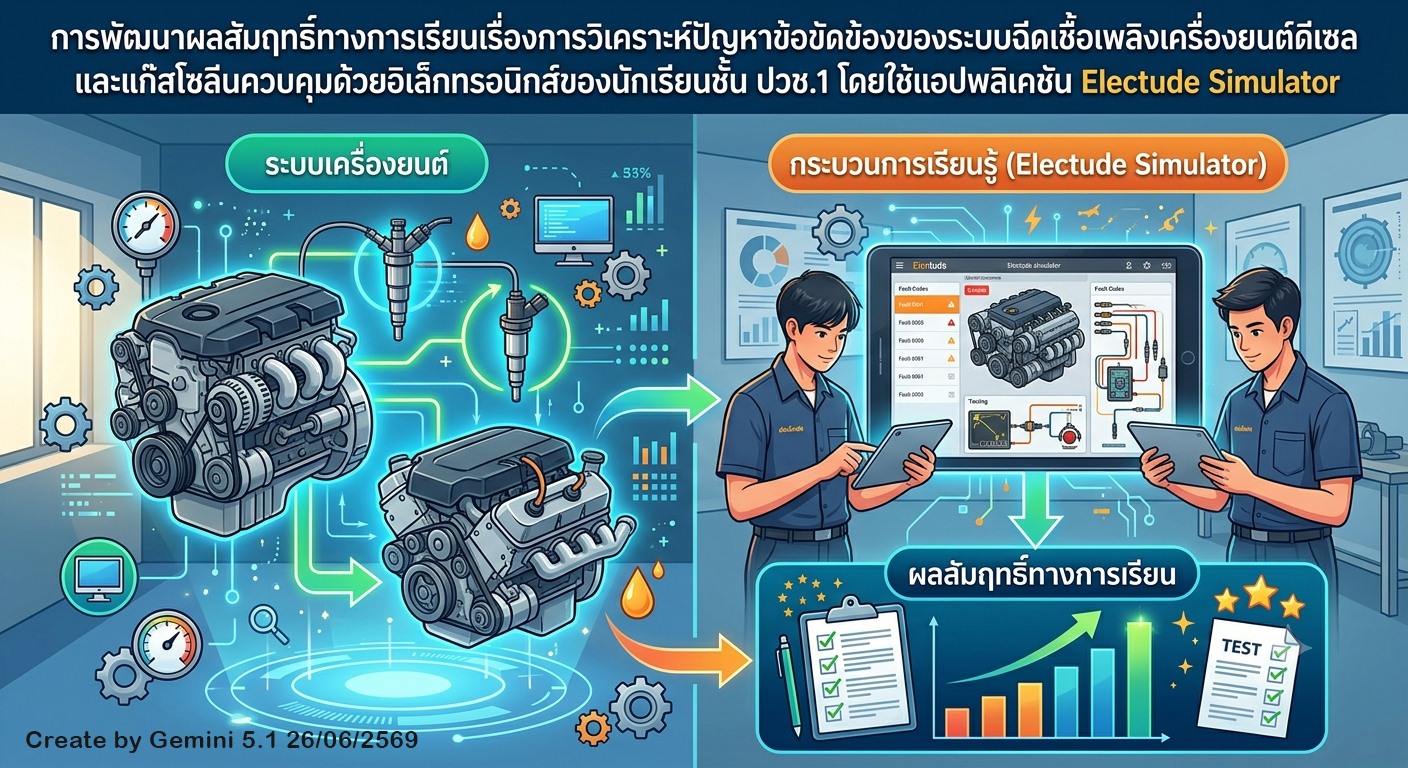
This research aimed to 1) compare the academic achievement of Vocational Certificate 1 students on the analysis of malfunctions of electronically controlled gasoline fuel injection systems using the Electude Simulator application before and after learning, and 2) examine the satisfaction of Vocational Certificate 1 students with learning using the Electude Simulator application. The sample consisted of 20 first-year vocational certificate students in the automotive engineering department, selected through purposive sampling. The research instruments included gasoline work lesson plans, gasoline work achievement tests, and student satisfaction questionnaires using the Electude Simulator application. This quasi-experimental research utilized a one-group pretest–posttest design. Data analysis were mean, standard deviation and T-Test Dependent. The research results revealed that: 1) The academic achievement of vocational certificate 1 students using the Electude Simulator application after learning management was significantly higher than before learning at the .05 level. The average after learning ( = 25.50) and the average before learning (
= 18.30), and 2) students were satisfied with the learning management using the Electude Simulator application at the “most” level
= 4.52 and S.D. = 0.53, which reflects the appropriateness of virtual media in teaching automotive mechanics.
Article Details

This work is licensed under a Creative Commons Attribution-NonCommercial-NoDerivatives 4.0 International License.
References
กรมการขนส่งทางบก. (2562). รายงานสถานการณ์ยานยนต์ในประเทศไทย. กรมการขนส่งทางบก.
Electude. (n.d.). Automotive curriculum and learning solutions. https://www.electude. com/learning-solutions/automotive-curriculum.
Rutten, N., van Joolingen, W. R., & van der Veen, J. T. (2012). The learning effects of computer simulations in science education. Computers & Education, 58(1), 136–153.
Wieman, C. E., Adams, W. K., & Perkins, K. K. (2008). PhET: Simulations that enhance learning. Science, 322(5902), 682–683.
Electude International. (2014).Cloud-based engine management simulator. https://www.ratchetandwrench.com.
Ingerea. (n.d.). Electude e-learning platform. https://www.ingerea.com/en_ GB/electude
Electude. (n.d.). Automotive curriculum and learning solutions. https://www.electude. com/learning-solutions/automotive-curriculum.
Autocast. (n.d.). Why Autocast? E-learning solution for automotive technicians and engineers. https://autocast.ro/en/about/
Piaget, J. (1972). The psychology of the child. Basic Books.
บุญชม ศรีสะอาด. (2553). การวิจัยเบื้องต้น (พิมพ์ครั้งที่ 8). สุวีริยาสาส์น.
Kolb, D. A. (1984). Experiential learning: Experience as the source of learning and development. Prentice-Hall.
Mayer, R. E. (2009). Multimedia learning (2nd ed.). Cambridge University Press.
Chamorro-Atalaya, O., Morales-Romero, G., Quispe-Andía, A., Trinidad-Loli, N., León-Velarde, C., Lezama-Gonzales, P., & Mendoza-Daza, J. (2021). Analysis of satisfaction in the use of technological simulation tools in the learning of the automatic process control course. International Journal of Engineering Pedagogy (iJEP), 11(6), 132–140. https://doi.org/10.3991/ijep.v11i6.24911
