
Lifelong Learning Experiences of Coastal Fishing Communities in Career Development through Fishery Waste Utilization: A Phenomenological Study under the Vocational Education Innovation Driving Project, Office of the Vocational Education Commission
Article Sidebar
Main Article Content
Abstract
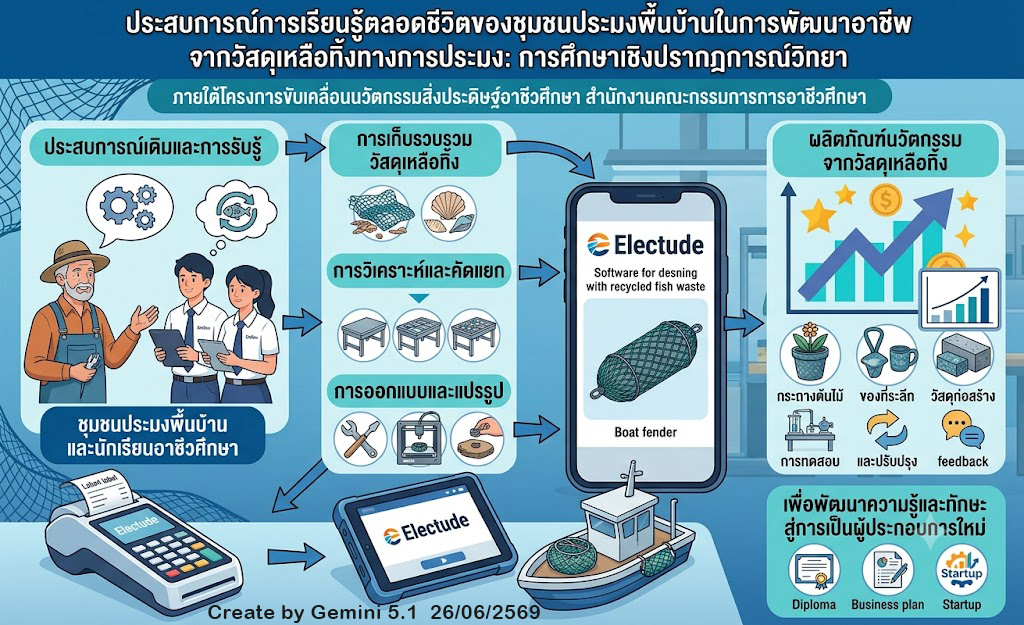
This study aimed to examine the lifelong learning experiences of coastal fishing communities in developing careers through fishery waste utilization, supported by the Office of the Science Research and Innovation Promotion Fund under the Vocational Education Innovation Driving Project, Office of the Vocational Education Commission, Fiscal Year 2025, Round 1. A descriptive phenomenological research design was employed following the framework of Moustakas. Data were collected from seven key informants comprising three fishing community representatives who had completed training and applied the knowledge in practice, two community leaders, and two vocational education teachers responsible for knowledge transfer from Thonburi Vocational College, in Tha Sala District, Nakhon Si Thammarat Province. Data were analysed using Colaizzi's seven-step method, and trustworthiness was established through triangulation and member checking.
The findings revealed four essential themes. The first theme, Learning from Roots, demonstrated that community members learned most effectively when new knowledge was meaningfully connected to their existing local wisdom and lived experiences. The second theme, Learning through Practice, indicated that the most powerful learning occurred during hands-on engagement with the product development process, subsequently generating informal learning networks that extended organically beyond the formal training setting. The third theme, Inner Transformation, revealed a profound shift in learners' self-perception from passive recipients to active creators of knowledge, consistent with Mezirow's Transformative Learning Theory. The fourth theme, Pathways to Sustainability, showed that the learning experiences generated concrete visions and collective motivation for group production and community-driven sustainable development. The findings demonstrate that effective lifelong learning within coastal fishing communities requires the integration of local wisdom, experiential practice, and deep internal transformation, with vocational education institutions serving as genuine and sustained learning partners for the community.
Article Details

This work is licensed under a Creative Commons Attribution-NonCommercial-NoDerivatives 4.0 International License.
References
สำนักงานเลขาธิการสภาการศึกษา. (2568). การเรียนรู้ไร้พรมแดน: เชื่อมโยงทุกช่วงวัยสู่การเรียนรู้ตลอดชีวิต The Learning Link Forum: Designing Learning Ecosystems across All Ages. กระทรวงศึกษาธิการ.
สำนักงานคณะกรรมการกฤษฎีกา. (2562). พระราชบัญญัติการศึกษาแห่งชาติ พ.ศ. 2542.
ปองเพชร ธาราสุข, สมยศ ทุ่งหว้า,อภิญญา รัตนไชย. (2560). การเสริมสร้างความมั่นคงทางอาหาร และความยั่งยืนในอาชีพของครัวเรือนประมงพื้นบ้านชายฝั่งในจังหวัดตรัง. วารสารหาดใหญ่.,15(2), 125–145.
Wani, A. K., Akhtar, N., Mir, T. u. G., Rahayu, F., Suhara, C., Anjli, A., Chopra, C., Singh, R., Prakash, A., & El Messaoudi, N. (2023). Eco-friendly and safe alternatives for the valorization of shrimp farming waste. Environmental Science and Pollution
Research. https://doi.org/10.1007/s11356-023-27819-z
Amiri, H., Aghbashlo, M., Sharma, M., Gaffey, J., Manning, L., Moosavi Basri, S. M., Kennedy, J. F., Gupta, V. K., & Tabatabaei, M. (2022). Chitin and chitosan derived from crustacean waste valorization streams can support food systems and the UN sustainable development goals. Nature Food, 3, 822–828. https://doi.org/10.1038/s43016-022-00591-y
Gasper, D., Shah, A., & Tankha, S. (2019). The framing of sustainable consumption and production in SDG 12. Global Policy, 10, 83-95.
วิทยาลัยอาชีวศึกษาธนบุรี. (2567). ประกาศวิทยาลัยอาชีวศึกษาธนบุรี เรื่องมาตรฐานการศึกษาของวิทยาลัยอาชีวศึกษาธนบุรี พ.ศ. 2567.
สำนักวิจัยและพัฒนาการอาชีวศึกษา (2568). ทุนส่งเสริมวิทยาศาสตร์ วิจัยและนวัตกรรม ภายใต้โครงการขับเคลื่อนนวัตกรรมสิ่งประดิษฐ์อาชีวศึกษาเพื่อการนำไปใช้ประโยชน์และเข้าสู่ระบบอุตสาหกรรมและพาณิชยกรรม ประจำปีงบประมาณ พ.ศ.2568. สำนักงานคณะกรรมการการอาชีวศึกษา.
Billett, S. (2011). Vocational education: Purposes, traditions and prospects. Springer. https://doi.org/10.1007/978-94-007-1954-5
หัฏฐพล อำภารส. (2568). ศิลปประดิษฐ์เชิงปรัชญา: นัยยะทางศิลปวัฒนธรรมส่งเสริมคุณค่าชีวิต.Suan Sunandha Asian Social Science Journal, 19(1), 183–209.
สำนักงานคณะกรรมการการอาชีวศึกษา. (2567). นโยบายการพัฒนาอาชีวศึกษา ของสำนักงานคณะกรรมการการอาชีวศึกษา ประจำปีงบประมาณ พ.ศ. 2567-2579. กระทรวงศึกษาธิการ.
Moustakas, C. (1994). Phenomenological research methods. Sage publications.
Creswell, J. W., & Poth, C. N. (2018). Qualitative inquiry and research design: Choosing among five approaches (4th ed.). SAGE Publications.
Spradley, J. P. (2016). Participant observation. Waveland Press.
Denzin, N. K. (2017). The research act: A theoretical introduction to sociological methods. Routledge.
Lincoln, Y. S., & Guba, E. G. (1988). Criteria for Assessing Naturalistic Inquiries as Reports.
Colaizzi, P. F. (1978). Psychological research as the phenomenologist views it.
Clarke, V., & Braun, V. (2017). Thematic analysis. The journal of positive psychology, 12(3), 297-298.
Knowles, M. S., Holton, E. F., & Swanson, R. A. (2015). The adult learner: The definitive classic in adult education and human resource development (8th ed.). Routledge.
นฤเบศร์ บุญเกษม. (2568). การศึกษาชุมชนและการประยุกต์ใช้ภูมิปัญญาท้องถิ่นของชุมชนในตําบลรัตนวารีอําเภอหัวตะพาน จังหวัดอํานาจเจริญ. วารสารวิชาการและการวิจัยทางสังคมศาสตร์. 1(3), 1–10.
Esteban-Guitart, M., Lalueza, J. L., Zhang-Yu, C., & Llopart, M. (2019). Sustaining students’ cultures and identities. A qualitative study based on the funds of knowledge and identity approaches. Sustainability, 11(12), 3400.
Kolb, D. A. (1984). Experiential learning: Experience as the source of learning and development. Prentice-Hall.
จุฑามาศ พีรพัชระ, พัชรนันท์ ยังวรวิเชียร, ชนิดา ประจักษ์จิตร, จอมขวัญ สุวรรณรักษ์. (2565). แนวทางการจัดอบรมวิชาชีพด้านอาหาร สำหรับผู้สูงอายุบ้านห้วยทรายเหนือจังหวัดเพชรบุรี. วารสารสันติศึกษาปริทรรศน์ มจร. 10(2), 538–552.
Tait, K. (2021). Reflecting on how to optimize tertiary student learning through the use of work based learning within inclusive education courses. International Journal of Teaching and Learning in Higher Education.
Mezirow, J. (2008). An overview on transformative learning. Lifelong learning, 40-54.
จิรานุช โสภา, พรรณี สวนเพลง, ธัญชนก บุญเจือ, จันทร์จนา ศิริพันธ์วัฒนา, ธนพัฒนา แสงรุ่งเรือง, พิรมาลยา บุญธรรม, ธีรนุช ฉายศิริโชติ, บุษราคัม สีดาเหลือง. (2565). การพัฒนาทุนมนุษย์เพื่อรองรับการท่องเที่ยวเชิงวัฒนธรรมอาหารไทยของชุมชนในเขตพัฒนาการท่องเที่ยวเมืองรองชายฝั่งทะเลตะวันออก. วารสารศรีปทุมปริทัศน์. 22(2), 129–142.
Taylor, E. W. (2008). Transformative learning theory. New Directions for Adult and Continuing Education, 2008(119), 5–15. https://doi.org/10.1002/ace.301
Wani, A. K., Akhtar, N., Mir, T. u. G., Rahayu, F., Suhara, C., Anjli, A., Chopra, C., Singh, R., Prakash, A., & El Messaoudi, N. (2023). Eco-friendly and safe alternatives for the valorization of shrimp farming waste. Environmental Science and Pollution Research. https://doi.org/10.1007/s11356-023-27819-z
พงศ์เทพ แก้วเสถียร. (2564). แนวทางการพัฒนาศักยภาพของกลุ่มประมงพื้นบ้านสู่การสร้างเครือข่ายชุมชนการจัดการทรัพยากรบึงขุนทะเล ตำบลขุนทะเล อำเภอเมืองจังหวัดสุราษฎร์ธานี. วารสารสังคมศาสตร์และวัฒนธรรม. 5(2), 19–35.
หัฏฐพล อําภารส.(2568). ความสนใจและความต้องการในการประกอบอาชีพเสริม ของชุมชนบ้านเอื้ออาทร จังหวัดนครศรีธรรมราช. วารสารวิจัยและนวัตกรรม สถาบันการอาชีวศึกษากรุงเทพมหานคร. 8(1), 181–198.
Moll, L. C., Amanti, C., Neff, D., & Gonzalez, N. (1992). Funds of knowledge for teaching: Using a qualitative approach to connect homes and classrooms. Theory into Practice, 31(2), 132–141. https://doi.org/10.1080/00405849209543534
Wenger, E. (1998). Communities of practice: Learning, meaning, and identity. Cambridge University Press. https://doi.org/10.1017/CBO9780511803932
Kretzmann, J. P., & McKnight, J. L. (1993). Building communities from the inside out: A path toward finding and mobilizing a community's assets. ACTA Publications.
