
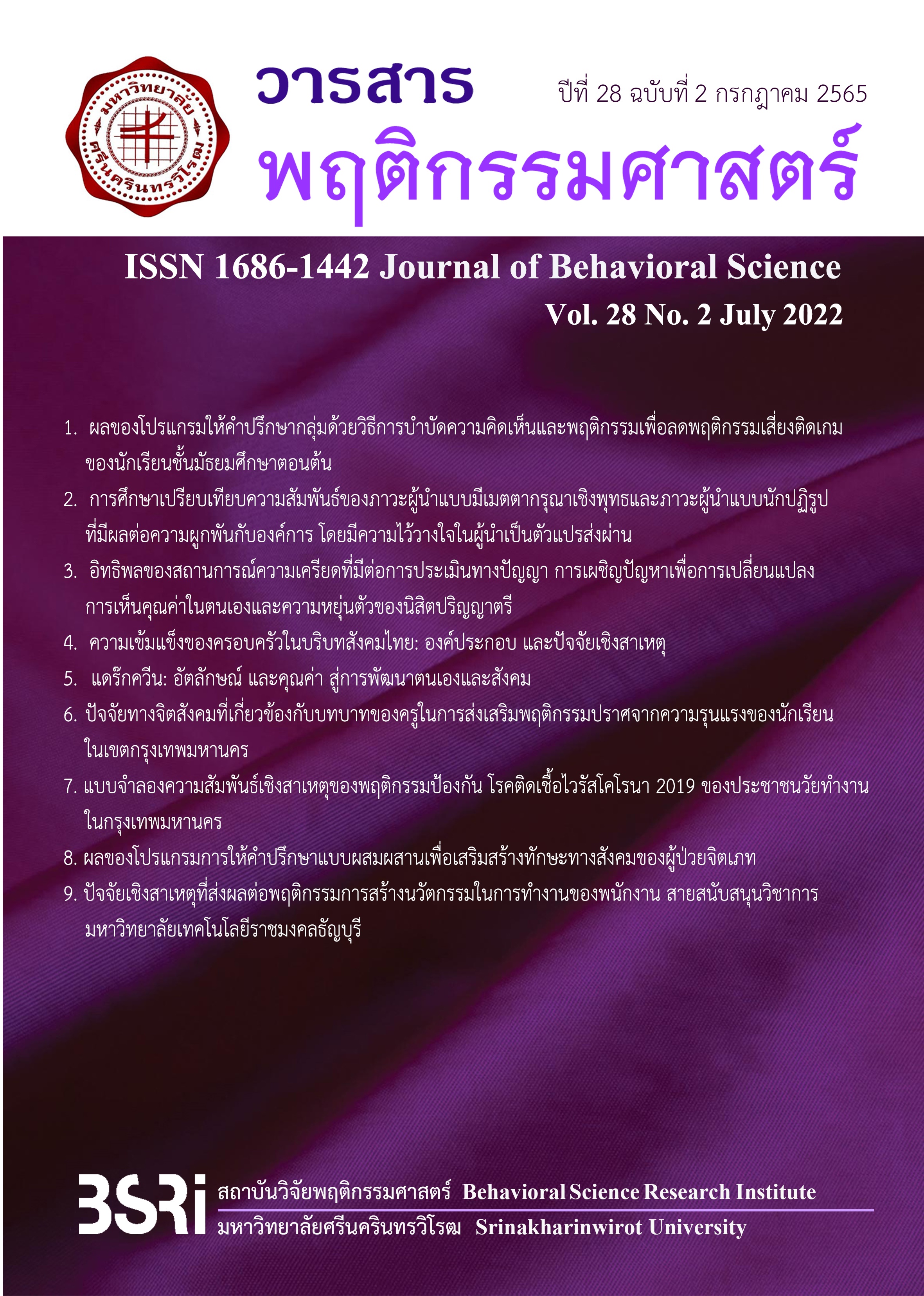
การศึกษาเปรียบเทียบความสัมพันธ์ของภาวะผู้นำแบบมีเมตตากรุณาเชิงพุทธและภาวะผู้นำแบบนักปฏิรูป ที่มีผลต่อความผูกพันกับองค์การ โดยมีความไว้วางใจในผู้นำเป็นตัวแปรส่งผ่าน
คำสำคัญ:
ภาวะผู้นำแบบมีเมตตากรุณาเชิงพุทธ, ภาวะผู้นำแบบนักปฏิรูป, ความไว้วางใจในผู้นำ, ความผูกพันกับองค์การบทคัดย่อ
ภาวะผู้นำแบบมีเมตตากรุณาเชิงพุทธกับภาวะผู้นำแบบนักปฏิรูป เป็นโมเดลภาวะผู้นำที่มีความคล้ายคลึงกัน ขณะเดียวกันยังมีคุณลักษณะจำเพาะ จึงอาจทำนายผลลัพธ์องค์การผ่านความไว้วางใจในผู้นำแตกต่างกัน การศึกษานี้มีวัตถุประสงค์เพื่อศึกษาเปรียบเทียบความสัมพันธ์ระหว่างภาวะผู้นำแบบมีเมตตากรุณาเชิงพุทธและแบบนักปฏิรูป ที่มีผลต่อความผูกพันกับองค์การ ผ่านความไว้วางใจในผู้นำ กลุ่มตัวอย่าง คือ พนักงานจากสถาบันการเงินจำนวน 229 คน ใช้การตอบแบบสอบถามกระดาษ เครื่องมือที่ใช้มี 4 ฉบับ ได้แก่ มาตรวัดภาวะผู้นำแบบมีเมตตากรุณาเชิงพุทธ มาตรวัดภาวะผู้นำแบบนักปฏิรูป มาตรวัดความไว้วางใจในผู้นำ และมาตรวัดความผูกพัน วิเคราะห์ข้อมูลด้วยค่าสัมประสิทธิ์สหสัมพันธ์แบบเพียร์สันและการวิเคราะห์เส้นทาง ผลการวิจัยพบว่า ภาวะผู้นำแบบมีเมตตากรุณาเชิงพุทธและภาวะผู้นำแบบนักปฏิรูป มีสหสัมพันธ์ทางบวกกับความไว้วางใจในผู้นำ (r = .75, .22 ตามลำดับ) และความผูกพันกับองค์การ (r = .25, .17 ตามลำดับ) อย่างมีนัยสำคัญทางสถิติที่ระดับ .01 ผลการวิเคราะห์อิทธิพลส่งผ่าน แสดงให้เห็นว่า ความไว้วางใจในผู้นำเป็นตัวแปรส่งผ่านแบบบางส่วนระหว่างภาวะผู้นำทั้งสองรูปแบบและความผูกพันกับองค์การ โดยความไว้วางใจในผู้นำจากโมเดลภาวะผู้นำแบบมีเมตตากรุณา เชิงพุทธมีค่าอิทธิพลทางอ้อม (β = .253) สูงกว่าโมเดลภาวะผู้นำแบบนักปฏิรูป (β = .056)
Downloads
เอกสารอ้างอิง
Anderson, H. J., Baur, J. E., Griffith, J. A., & Buckley, M. R. (2017). What works for you may not work for (Gen)Me: Limitations of present leadership theories for the new generation. The Leadership Quarterly, 28(1), 245-260. https://doi.org/10.1016/j.leaqua.2016.08.001
Bass, B. M. (1985). Leadership and performance beyond expectations. Free Press.
Bass, B. M., & Avolio, B. J. (1992). Multifactor leadership questionnaire-Short Form 6S. Center for Leadership Studies.
Bass, B. M., & Avolio, B. J. (1994). Improving organizational effectiveness through transformational leadership. Sage.
Blau, P. W. (1964). Exchange and power in social life. Wiley.
Brockner, J., Siegel, P. A., Daly, J. P., Tyler, T., & Martin, C. (1997). When trust matters: The moderating effect of outcome favorability. Administrative Science Quarterly, 42(3), 558-583. https://doi.org/10.2307/2393738
Burke, C. S., Sims, D. E., Lazzara, E. H., & Salas, E. (2007). Trust in leadership: A multi-level review and integration. The Leadership Quarterly, 18(6), 606-632. https://doi.org/10.1016/j.leaqua.2007.09.006
Chalermpolyothin, L., Kittisaknawin, C., & Deesawadi, N. (2017). phāwa phū bō̜kā raphat nā ʻongkān dōi chai lak phromwihān sī [Leadership and organization development by using principles of four Brahmavihara]. Journal of Thonburi University, 11(26), 162-171.
Cheng, B. S., Chou, L. F., Wu, T. Y., Huang, M. P., & Farh, J. L. (2004). Paternalistic leadership and subordinate responses: Establishing a leadership model in Chinese organizations. Asian Journal of Social Psychology, 7(1), 89-117. https://doi.org/10.1111/j.1467-839X.2004.00137.x
Colquitt, J. A., Scott, B. A., & LePine, J. A. (2007). Trust, trustworthiness, and trust propensity: A meta-analytic test of their unique relationships with risk taking and job performance. Journal of Applied Psychology, 92(4), 909-927. https://doi.org/10.1037/0021-9010.92.4.909
DeVellis, R. F. (1991). Scale development: Theory and application. Sage.
Dirks, K. T., & Ferrin, D. L. (2002). Trust in leadership: Meta-analytic findings and implications for research and practice. Journal of Applied Psychology, 87(4), 611-628. https://doi.org/10.1037/0021-9010.87.4.611
Engelbrecht, A. S., Heine, G., & Mahembe, B. (2017). Integrity, ethical leadership, trust and work engagement. Leadership & Organization Development Journal, 38(3), 368-379. https://doi.org/10.1108/LODJ-11-2015-0237
Fornell, C., & Larcker, D. F. (1981). Evaluating structural equation models with unobservable variables and measurement error. Journal of Marketing Research, 18(1), 39-50.
Gillespie, N. A., & Mann, L. (2004). Transformational leadership and shared values: The building blocks of trust. Journal of Managerial Psychology, 19(6), 588-607. https://doi.org/10.1108/02683940410551507
Gouldner, A. W. (1960). The norm of reciprocity: A preliminary statement. American Sociological Review, 25(2), 161-178.
Hair, J. F. J., Black, W. C., Babin, B. J., & Anderson, R. E. (2010). Multivariate data analysis: A global perspective (7th ed.). Pearson Education.
Han, G., & Jekel, M. (2011). The mediating role of job satisfaction between leader-member exchange and turnover intentions. Journal of nursing management, 19(1), 41-49. https://doi.org/10.1111/j.1365-2834.2010.01184.x
Hayes, A. F. (2017). Introduction to mediation, moderation, and conditional process analysis: A regression-based approach (2nd ed.). The Guilford Press.
Khattak, M. N., Zolin, R., & Muhammad, N. (2020). Linking transformational leadership and continuous improvement: The mediating role of trust. Management Research Review, 43(8), 931-950. https://doi.org/10.1108/MRR-06-2019-0268
Klein, H. J., Cooper, J. T., Molloy, J. C., & Swanson, J. A. (2014). The assessment of commitment: Advantages of a unidimensional, target-free approach. Journal of Applied Psychology, 99(2), 222-238. https://doi.org/10.1037/a0034751
Klein, H. J., Molloy, J. C., & Brinsfield, C. T. (2012). Reconceptualizing workplace commitment to redress a stretched construct: Revisiting assumptions and removing confounds. The Academy of Management Review, 37(1), 130-151. https://doi.org/10.5465/amr.2010.0018
Konovsky, M. A., & Pugh, S. D. (1994). Citizenship behavior and social exchange. Academy of Management Journal, 37(3), 656-669. https://doi.org/10.2307/256704
Kouzes, J. M., & Posner, B. Z. (2007). The leadership challenge (4th ed.). Jossey-Bass.
Kramer, R. M. (1999). Trust and distrust in organizations: Emerging perspectives, enduring questions. Annual review of psychology, 50, 569-598. https://doi.org/10.1146/annurev.psych.50.1.569
Legood, A., van der Werff, L., Lee, A., & Den Hartog, D. (2021). A meta-analysis of the role of trust in the leadership- performance relationship. European Journal of Work and Organizational Psychology, 30(1), 1-22. https://doi.org/10.1080/1359432X.2020.1819241
Mayer, R. C., Davis, J. H., & Schoorman, F. D. (1995). An integrative model of organizational trust. Academy of Management Review, 20(3), 709-734. https://doi.org/10.2307/258792
Mayer, R. C., & Gavin, M. B. (2005). Trust in management and performance: Who minds the shop while the employees watch the boss? Academy of Management Journal, 48(5), 874-888. https://doi.org/10.5465/amj.2005.18803928
McAllister, D. J. (1995). Affect- and cognition-based trust as foundations for interpersonal cooperation in organizations. The Academy of Management Journal, 38(1), 24-59. http://www.jstor.org/stable/256727
Meyer, J. P., & Allen, N. J. (1991). A three-component conceptualization of organizational commitment. Human Resource Management Review, 1(1), 61-89. https://doi.org/10.1016/1053-4822(91)90011-Z
Neubert, M., Wu, C., & Roberts, J. (2013). The influence of ethical leadership and regulatory focus on employee outcomes. Business Ethics Quarterly, 23(2), 269-296. https://www.jstor.org/stable/41968852
Pillai, P., Schriesheim, C. A., & Williams, E. S. (1999). Fairness perceptions and trust as mediators for transformational and transactional leadership: A two-sample study. Journal of Management, 25(6), 897-933. https://doi.org/10.1177/014920639902500606
Porter, L. W., Steers, R. M., Mowday, R. T., & Boulian, P. V. (1974). Organizational commitment, job satisfaction, and turnover among psychiatric technicians. Journal of Applied Psychology, 59(5), 603-609. https://doi.org/10.1037/h0037335
Prilianti, R., Sutarto, J., Heriyanto, Prihatin, T., & Kardoyo. (2021). Did transformational leadership, trust, psychological well-being and organizational culture influence organizational commitment? Evidence from government education and training centers in Semarang. European Journal of Molecular & Clinical Medicine, 7(1), 4245-4262. https://ejmcm.com/article_5976_1149bac8b9f628dae6bcd81f79ae154d.pdf
Ribeiro, N., Duarte, A. P., Filipe, R., & Torres de Oliveira, R. (2020). How authentic leadership promotes individual creativity: The mediating role of affective commitment. Journal of Leadership & Organizational Studies, 27(2), 189-202. https://doi.org/10.1177/1548051819842796
Savolainen, T. I., & Lopez-Fresno, P. (2012). Trust in renewing human intellectual capital intangible asset creating vitality and innovativeness. Proceedings of the ICICKM, Bogotá, Colombia.
Spector, P. E., & Jex, S. M. (1998). Development of four self-report measures of job stressors and strain: Interpersonal conflict at work scale, organizational constraints scale, quantitative workload inventory, and physical symptoms inventory. Journal of Occupational Health Psychology, 3(4), 356-367. https://doi.org/10.1037//1076-8998.3.4.356
Tan, X. J., Zawawi, D., & Aziz, Y. A. (2016). Benevolent leadership and its organisational outcomes: A social exchange theory perspective. International Journal of Economics and Management, 10(2), 343-364.
Walumbwa, F. O., Avolio, B. J., Gardner, W. L., Wernsing, T. S., & Peterson, S. J. (2008). Authentic leadership: Development and validation of a theory-based measure. Journal of Management, 34(1), 89-126. https://doi.org/10.1177/0149206307308913
Yang, J., & Mossholder, K. W. (2010). Examining the effects of trust in leaders: A bases-and-foci approach. The Leadership Quarterly, 21, 50-63. https://doi.org/10.1016/j.leaqua.2009.10.004
Yuan, Y., Kong, H., Baum, T., Liu, Y., Liu, C., Bu, N., Wang, K., & Yin, Z. (2021). Transformational leadership and trust in leadership impacts on employee commitment. Tourism Review, ahead-of-print(ahead-of-print). https://doi.org/10.1108/TR-10-2020-0477
ดาวน์โหลด
เผยแพร่แล้ว
รูปแบบการอ้างอิง
ฉบับ
ประเภทบทความ
สัญญาอนุญาต
ลิขสิทธิ์ (c) 2022 วารสารพฤติกรรมศาสตร์

อนุญาตภายใต้เงื่อนไข Creative Commons Attribution-NonCommercial-NoDerivatives 4.0 International License.
สถาบันวิจัยพฤติกรรมศาสตร์ มหาวิทยาลัยศรีนครินทรวิโรฒ
114 ซอยสุขุมวิท 23 ถนนสุขุมวิท แขวงคลองเตยเหนือ เขตวัฒนา กรุงเทพฯ 10110
โทร 02-649-5000 ต่อ 17600


