
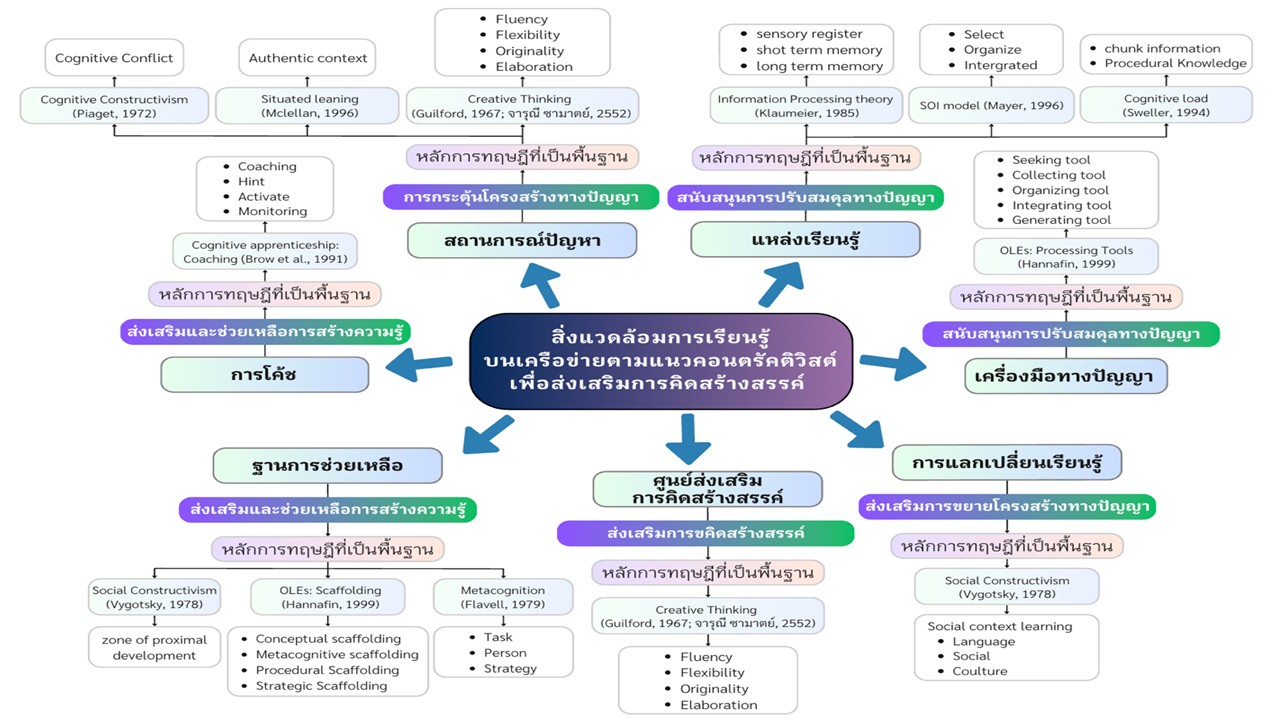
ผลของสิ่งแวดล้อมการเรียนรู้บนเครือข่ายตามแนวคอนสตรัคติวิสต์ เพื่อส่งเสริม การคิดสร้างสรรค์ เรื่องสัญลักษณ์โน้ตและการปฏิบัติขลุ่ยรีคอร์เดอร์ สำหรับนักเรียนชั้นมัธยมศึกษาปีที่ 2
Article Sidebar
Main Article Content
บทคัดย่อ
การวิจัยนี้มีวัตถุประสงค์เพื่อ 1) ศึกษาผลการคิดสร้างสรรค์ และ 2) ศึกษาผลสัมฤทธิ์ทางการเรียนของผู้เรียนที่เรียนด้วยสิ่งแวดล้อมการเรียนรู้บนเครือข่ายตามแนวคอนสตรัคติวิสต์ ก่อนและหลังเรียน กลุ่มเป้าหมายคือนักเรียนชั้นมัธยมศึกษาปีที่ 2 โรงเรียนสาธิตมหาวิทยาลัยขอนแก่น (ศึกษาศาสตร์) จำนวน 15 คน เครื่องมือในการทดลองคือ สิ่งแวดล้อมการเรียนรู้บนเครือข่ายตามแนวคอนสตรัคติวิสต์ เครื่องมือเก็บข้อรวบรวมมูล ประกอบด้วย แบบวัดการคิดสร้างสรรค์ แบบสัมภาษณ์การคิดสร้างสรรค์ และแบบวัดผลสัมฤทธิ์ทางการเรียน วิเคราะห์ข้อมูลโดยใช้ค่าเฉลี่ย ส่วนเบี่ยงเบนมาตรฐาน และร้อยละ ผลการวิจัยพบว่า 1) คะแนนเฉลี่ยการคิดสร้างสรรค์หลังเรียนสูงกว่าก่อนเรียน มีผู้เรียนร้อยละ 86.67 ที่มีคะแนนสูงกว่าเกณฑ์ร้อยละ 80 การวิเคราะห์โปรโตคอลพบการคิดสร้างสรรค์ คือ (1) การคิดคล่อง ระบุสัญลักษณ์โน้ตได้ 15 ตัวใน 2 นาที และออกแบบทำนอง 14 รูปแบบใน 3 นาที (2) การคิดยืดหยุ่น ปรับเปลี่ยนโน้ตความยาวเสียงเท่ากันในรูปแบบต่างกัน (3) การคิดริเริ่ม ประยุกต์ความรู้เดิมสร้างทำนองแปลกใหม่ (4) การคิดละเอียดลออ สร้างเกณฑ์ประเมินและตกแต่งทำนองได้ และ 2) ผลสัมฤทธิ์ทางการเรียนหลังเรียนสูงกว่าก่อนเรียน มีผู้เรียนร้อยละ 93.34 ที่มีคะแนนสูงกว่าเกณฑ์ร้อยละ 80
คำสำคัญ: คอนสตรัคติวิสต์, เครือข่ายการเรียนรู้, สิ่งแวดล้อม, การคิดสร้างสรรค์ ผลสัมฤทธิ์ทางการเรียน
Article Details

อนุญาตภายใต้เงื่อนไข Creative Commons Attribution-NonCommercial-NoDerivatives 4.0 International License.
เอกสารอ้างอิง
Chaicharoen, S. (2016). Instructional design: Principles, theories to practice (2nd ed.). Khon Kaen: Educational Technology Program, Faculty of Education, Khon Kaen University.
Ernawati, M. D. W., Rusdi, M., Asrial, A., Muhaimin, M., Wulandari, M., & Maryani, S. (2022). Analysis of problem-based learning in the scaffolding design: Students' creative-thinking skills. Cypriot Journal of Educational Sciences, 17(7), 2333–2348. https://orcid.org/0000-0001-9908-2373
Good, C. V. (1973). Dictionary of education (3rd ed.). New York: McGraw-Hill.
Guilford, J. P. (1967). The nature of human intelligence. McGraw-Hill. https://gwern.net/doc/iq/1967-guilford-thenatureofhumanintelligence.pdf
Hassan, G. M. A. A. (2020). The Effect of a Suggested Program Based on the Constructivist Learning Model on Developing the Creative Thinking Skills of Students of the Faculty of Art Education. https://journal.moripublishing.com/index.php/jdle/article/view/441
Kaewkanha, O., Srichumnong, J., & Pawanlanchakorn J. (2018). Action Research on Creative Thinking Development of Computer Subject in Prathomsuksa 5 Student at Bannumque School Under the Office of Loei Primary Educational Service Area Office 1. Journal of Education and Innovation, 19(2), 289–304. https://doi.nrct.go.th//ListDoi/listDetail?Resolve_DOI=10.14456/jil.2020.3
Kanjanawasee, S. (2009). Thitsadi kan thotsop baep dangdoem [Classical test theory] (6th ed.). Chulalongkorn University Press.
Karwowski, M., Jankowska, D. M., & Szumski, I. (2021). Teaching creativity: A meta-analysis of the effectiveness of instructional interventions. Psychology of Aesthetics, Creativity, and the Arts, 15(3), 365–376.
Kwangmuang, P. (2018). The resul to flearner's critical thinking development used with constructivist learning innovation to enhance knowledge construction and critical thinking for undergraduate student. Panyapiwat Journal, 10(1), 175-184.
Office of the Basic Education Commission. (2020). Raingan phonsamrit thang kan rian khong nakrian radap matthayomsuksa ton ton pi kansuksa 2563 [Report on the academic achievement of lower secondary school students for the academic year 2020]. https://backoffice.onec.go.th/uploads/Book/2057-file.pdf
Puratep, P., & Chaijaroen, S. (2020, November). Designing Framework of Constructivist Web-Based Learning Environment Model to Enhance Creative Thinking in Engineering Design Process for Grade 8th. In International Conference on Innovative Technologies and Learning (pp. 385-390). Springer, Cham. https://link.springer.com/chapter/10.1007/978-3-030-63885-6_43
Samat, C. (2009). Design of scaffolding for promote creative thinking. Journal of Education Khon Kaen University, 33(4), 1-9. https://so02.tci-thaijo.org/index.php/EDKKUJ/article/view/49864/41263
Samat, C. (2016). Design and Development of Constructivist Flipped Classroom to Enhance Creative Thinking on Basic Principles for Educational Software Development Subject for Computer Education Learners. Rajabhat Maha Sarakham University Journal (Humanities and Social Sciences). 10(3), 55-66. https://so05.tci-thaijo.org/index.php/rmuj/article/view/99933
Samat, C., & Chaijaroen, S. (2009). Design and development of constructivist Web-Based Learning Environment Model to enhancecreative thinking for higher education students. The 2009 Academic Conference on Education (pp. 24-25). Khon Kaen:Education Technology, Khon Kaen University. https://link.springer.com/chapter/10.1007/978-3-030-35343-8_13
Sritrakul, P. (2010). Rabieb witi wijai thang kan sueksa [Research methodology in education]. Kasetsart University Press. https://so05.tci-thaijo.org/index.php/suedureasearchjournal/article/view/252702/171210
Supphokin, S. (2019). Phon khong kan chat kan rianru baep long mue patibat to kan khit sangsan khong nakrian matthayomsuksa [The effects of hands-on learning management on creative thinking of secondary school students]. Warasan Kharusat [Journal of Education], 46(4), 87–99.
Taweerat, P. (1987). Kan sang lae phatthana baep thotsop wat phon samrit [Construction and development of achievement tests]. Office of Educational and Psychological Testing, Srinakharinwirot University, Prasarnmit.
The Institute for the Promotion of Teaching Science and Technology (IPST). (2024). Creativity Assessment Results of PISA 2022. https://www.ipst.ac.th/news/73892/20240712-pisa2022.html
Wattanachai, S. (2010). Development of constructivist web-based learning environment model to foster problem solving and transfer of learning. [Doctoral dissertation, Khon Kaen University]. Khon Kaen University. https://so02.tci-thaijo.org/index.php/EDKKUJ/article/view/250768/181995
Yeh, Y. C., & Hung, C. H. (2019). Effects of a cooperative digital game-based learning environment on students’ creativity, problem-solving, and learning motivation. Educational Technology & Society, 22(4), 58–69. https://link.springer.com/article/10.1007/s40692-014-0008-8
Yodsalee, C., & Bootsong, K. (2016). Psychology for teachers (in Thai). Bangkok: Ramkhamhaeng University.
