
The Development of Reading Comprehension Skills and Learners’ Satisfaction toward English Using Content and Language Integrated Learning (CLIL) with Canva Application for Grade 12 Learners at Thammakhositwittaya School
Article Sidebar
Main Article Content
บทคัดย่อ
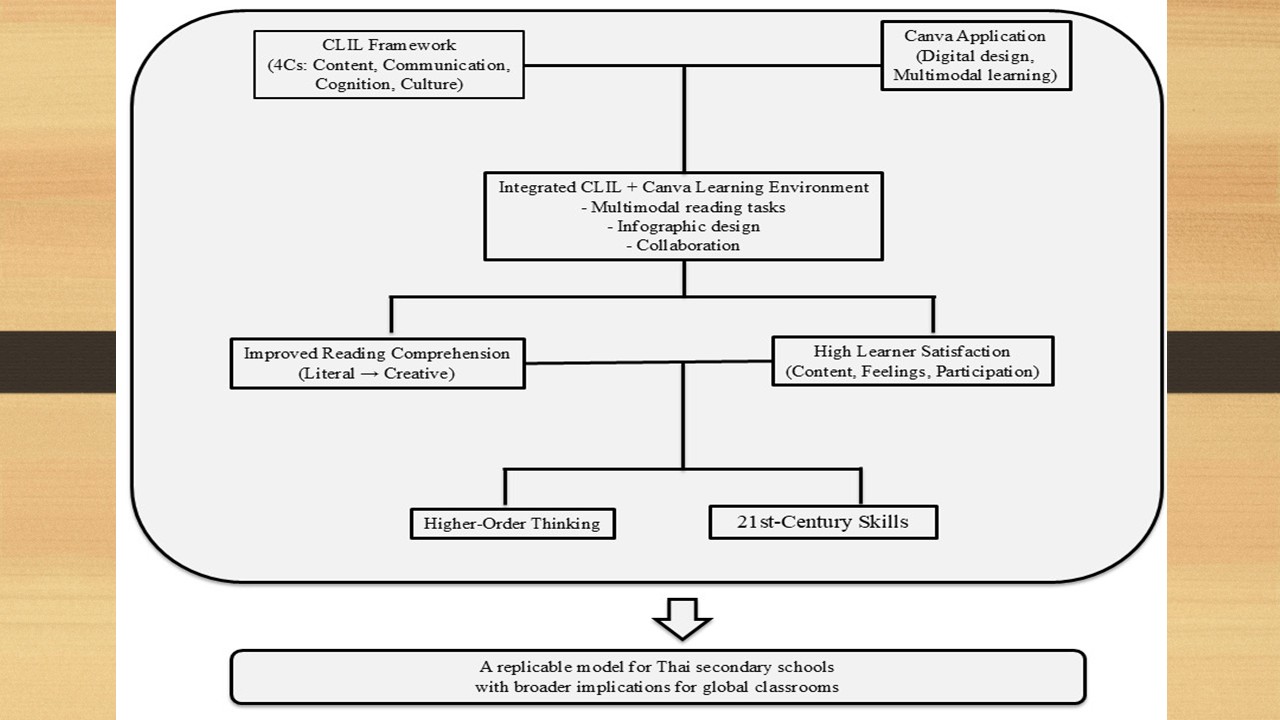
Reading comprehension is an important skill for academic success. However, many Thai learners struggle to read English due to limited vocabulary and overreliance on memorization. To tackle this issue, this research examined the enhancement of Grade 12 learners' reading comprehension skills and their satisfaction with English learning through the incorporation of Content and Language Integrated Learning (CLIL) with the Canva application. The study aimed to investigate (1) the effects of CLIL with Canva on learners’ reading comprehension skills, (2) the level of learners’ reading comprehension, and (3) their satisfaction with this integrated intervention. A quasi-experimental one-group pretest and posttest design was used with 20 purposely chosen Grade 12 learners at Thammakhositwittaya School during the first semester of 2025. The tools included a reading comprehension test (20 questions covering literal, interpretive, critical, and creative levels), a satisfaction questionnaire (15 items on a 5-point Likert scale), and semi-structured interviews. Descriptive statistics, paired-sample t-tests, effect size calculations, and thematic analysis were utilized to analyze the data. The results indicated a substantial improvement, with mean scores rising from 10.20 (SD = 1.79) to 14.85 (SD = 3.03). The effect size (Cohen’s d = 1.88) is deemed to be significant according to Cohen’s (1988) standards. Across the four comprehension levels, the greatest gain was found in critical, followed by notable progress in creative, literal, and interpretive levels. Learners were extremely satisfied with CLIL and Canva, giving a mean score of 4.62 (SD = 0.27). Qualitative findings corroborated these results, indicating that Canva's visual and creative features deepened engagement and encouraged self-expression. The study indicates that integrating CLIL with Canva fosters an effective, innovative learning environment that improves English proficiency and higher-order skills. These results demonstrate a practical and replicable model for integrating CLIL with digital design tools to improve English instruction in Thailand and beyond.
Keywords: CLIL, Canva, Reading Comprehension, Learner Satisfaction, EFL
Article Details

อนุญาตภายใต้เงื่อนไข Creative Commons Attribution-NonCommercial-NoDerivatives 4.0 International License.
เอกสารอ้างอิง
Banegas, D. L., & del Pozo Beamud, M. (2020). Content and language integrated learning: A pluriliteracies approach. Language Teaching Research, 24(1), 1–9. https://doi.org/10.1177/1362168820905805
Boone, H. N., & Boone, D. A. (2012). Analyzing Likert data. Journal of Extension, 50(2), 1–5.
Boonaree, C., Goulding, J., & Calvert, P. (2017). Assessing Thai secondary school learners’ English reading comprehension. PASAA, 53(1), 53–82.
Braun, V., & Clarke, V. (2006). Using thematic analysis in psychology. Qualitative Research in Psychology, 3(2), 77–101. https://doi.org/10.1191/1478088706qp063oa
Burns, P. C., Roe, B. D., & Ross, E. P. (1988). Teaching reading in today’s elementary schools (4th ed.). Houghton Mifflin.
Charunsri, T. (2019). CLIL in Thai secondary schools: Opportunities and challenges. LEARN Journal, 12(2), 112–126.
Charunsri, T., & Sripicharn, P. (2023). The effects of CLIL training on Thai pre-service teachers’ knowledge and opinions. PASAA, 65(1), 31–60. https://eric.ed.gov/?id=EJ1409171
Chawwang, N. (2021). Thai university learners’ reading problems in English. English Language Teaching, 14(6), 92–101. https://doi.org/10.5539/elt.v14n6p92
Christiana, A. T., & Anwar, K. (2021). Canva application in English teaching: Improving student engagement and confidence. Journal of English Language Teaching and Linguistics, 6(2), 379–389. https://doi.org/10.21462/jeltl.v6i2.620
Cohen, J. (1988). Statistical power analysis for the behavioral sciences (2nd ed.). Lawrence Erlbaum Associates.
Coyle, D., Hood, P., & Marsh, D. (2010). CLIL: Content and language integrated learning. Cambridge University Press.
Febriyanti, E., & Haryanto, H. (2024). The effectiveness of Canva application in fun English learning. Journal of Education, 5(1), 45–52. https://jonedu.org/index.php/joe/article/download/5870/4760
Garcia, C., McGee, A., & Thomas, R. (2024). Reading comprehension and strategy instruction for EFL learners. Journal of Applied Linguistics and Language Research, 11(1), 45–62.
Hamidavi, N., Amiz, H., & Gorjian, B. (2016). Effects of CLIL on EFL learners’ reading comprehension. International Journal of English Language Teaching, 4(2), 15–28.
Kewara, P., & Prabjandee, D. (2018). CLIL in Thai secondary schools: A study of teacher practices. Asian EFL Journal, 20(12), 96–118.
Kurokami, T. (2018). The effectiveness of graphic organizers in EFL reading. Asian EFL Journal, 20(3), 211–227.
Lakens, D. (2013). Calculating and reporting effect sizes to facilitate cumulative science. Frontiers in Psychology, 4, 863. https://doi.org/10.3389/fpsyg.2013.00863
Ministry of Education. (2008). Basic Education Core Curriculum B.E. 2551 (A.D. 2008). Bangkok: The Ministry.
Nipakornkitti, C., & Adunyarittigun, D. (2018). Thai learners’ difficulties in English reading comprehension: A case study. Journal of English Language Teaching, 11(3), 14–25.
Nhi, N. V. B., & Anh, N. T. H. (2024). The Utilization of Canva Application for Enhancing Learners’ English Skills. Journal of Knowledge and Learning in Science and Technology, 5(2), 60–70. https://jklst.org/index.php/home/article/download/200/172
Nirattisai, S. (2017). Problems in English reading comprehension: A study of Thai EFL learners. PASAA, 53(2), 71–89.
Puspitasari, D. (2020). CLIL and reading comprehension: An Indonesian study. Journal of English Teaching and Learning Issues, 3(1), 1–14.
Rahman, A., & Alfiyani, L. (2022). Enhancing learners’ engagement through Canva-based learning. International Journal of Instructional Media, 49(1), 15–26.
Rahman, A., & Alzahrani, A. (2023). Digital design platforms in EFL classrooms: Learners’ perceptions and outcomes. International Journal of Emerging Technologies in Learning, 18(2), 120–135.
Rajendran, R., Din, R., & Othman, N. (2023). A critical review on using Canva as a visual media platform English language learning. International Journal of Academic Research in Business and Social Sciences, 13(6), 631 – 641.
Sanad, A., & Ahmed, S. (2017). The impact of CLIL on EFL learners’ reading comprehension. Journal of Language Teaching and Research, 8(4), 654–662.
Sepesiova, M., & Strakova, Z. (2018). Developing reading comprehension through CLIL: A Slovak study. Journal of Language and Cultural Education, 6(2), 25–39.
Sirbu, A. (2015). The significance of language as a tool of communication. Scientific Bulletin of the Petru Maior University of Targu Mures, 12(1), 15–19.
Thomas, M. (2016). Thai learners’ reading comprehension difficulties. LEARN Journal, 9(1), 54–68.
Wahyuni, F. (2018). Visual media for EFL reading comprehension. Journal of English Language Studies, 3(1), 1–8.
Wahidah, I. (2012). Levels of reading comprehension: A theoretical perspective. Indonesian Journal of Applied Linguistics, 2(1), 1–10.
Wangmanee, S. (2024). Enhancing English and soft skills through CLIL in Thailand. Journal of Studies in English Language, 19(2), 35–54. https://so04.tci-thaijo.org/index.php/jsel/article/view/268808
Yundayani, A., Utami, R., & Musthafa, B. (2021). Canva-based multimodal teaching for EFL learners. International Journal of Language Education, 5(4), 432–445. https://doi.org/10.26858/ijole.v5i4.20093
