
มาตรการทางกฎหมายในการกำกับดูแลการใช้ปัญญาประดิษฐ์ในกระบวนการ ยุติธรรมของไทย
Article Sidebar
Main Article Content
บทคัดย่อ
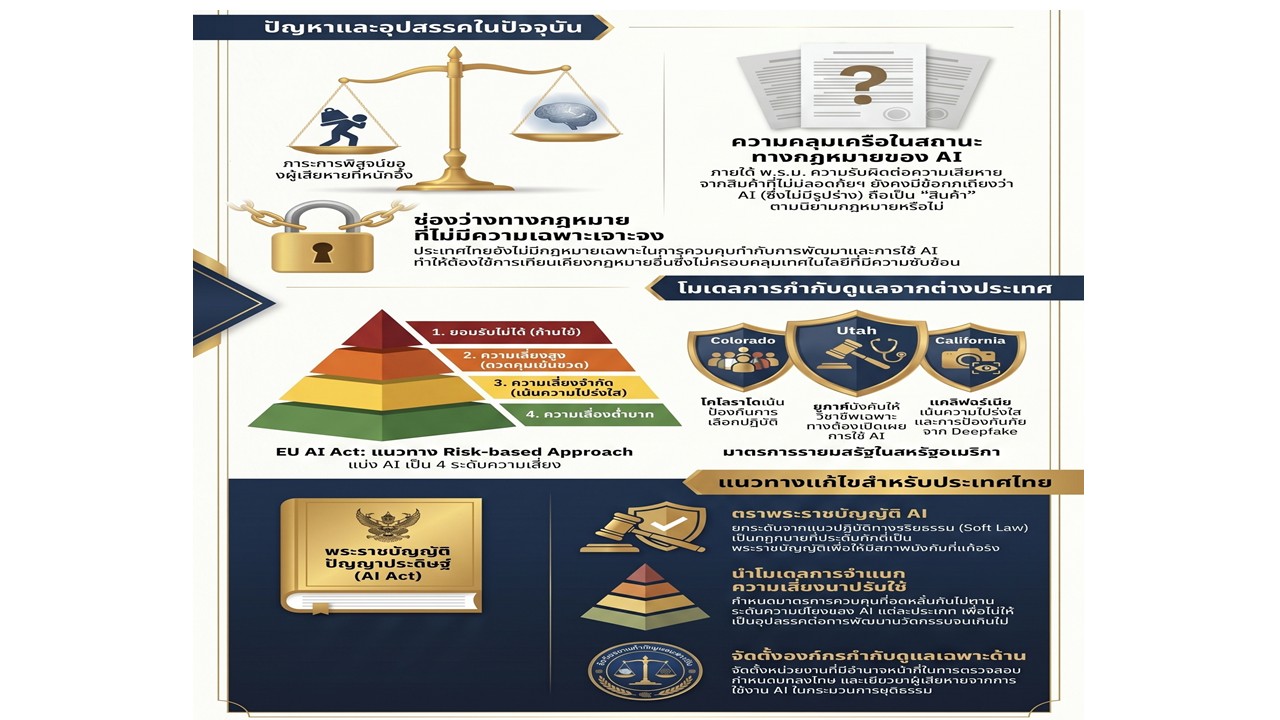
บทความนี้มีวัตถุประสงค์เพื่อศึกษาบทบาทและการประยุกต์ใช้ปัญญาประดิษฐ์ (AI) ในกระบวนการยุติธรรม เช่น การนำระบบ Machine Learning และการประมวลผลภาษาธรรมชาติ (NLP) มาช่วยสืบค้นข้อกฎหมาย ตรวจร่างสัญญา และคาดการณ์ผลคดี อย่างไรก็ตาม การใช้งานดังกล่าวก่อให้เกิดปัญหาทางกฎหมายที่สำคัญ โดยเฉพาะกรณีที่ AI ทำงานผิดพลาดหรือสร้างข้อมูลเท็จ (AI Hallucinations) ซึ่งส่งผลกระทบต่อความเชื่อมั่นและก่อให้เกิดความเสียหายแก่ผู้เกี่ยวข้อง จากการศึกษาพบว่า ปัจจุบันประเทศไทยยังไม่มีกฎหมายเฉพาะในการควบคุมกำกับการใช้ปัญญาประดิษฐ์ การต้องอาศัยการเทียบเคียงปรับใช้ พ.ร.บ. ความรับผิดต่อความเสียหายที่เกิดขึ้นจากสินค้าที่ไม่ปลอดภัย พ.ศ. 2551 ก่อให้เกิดปัญหาในการตีความสถานะทางกฎหมายว่า AI ถือเป็น "สินค้า" หรือไม่ รวมถึงปัญหาภาระการพิสูจน์ของผู้เสียหายที่เป็นบุคคลภายนอก เมื่อเปรียบเทียบกับต่างประเทศ พบมาตรการทางกฎหมายที่น่าสนใจ ได้แก่ กฎหมายของสหภาพยุโรป (EU AI Act) ที่ใช้แนวทางจำแนก AI ตาม "ระดับความเสี่ยง" (Risk-based approach) เป็น 4 ระดับ พร้อมมาตรการควบคุมที่ลดหลั่นกันไป และกฎหมายระดับมลรัฐของสหรัฐอเมริกา เช่น รัฐโคโลราโดที่มุ่งควบคุม AI ความเสี่ยงสูงเพื่อป้องกันการเลือกปฏิบัติ รัฐยูทาห์ที่บังคับให้ผู้ประกอบวิชาชีพเปิดเผยการใช้ AI ต่อผู้บริโภค, และรัฐแคลิฟอร์เนียที่มีกฎหมายคุ้มครองความโปร่งใสและป้องกันภัยจาก Deepfake บทความนี้จึงเสนอแนะให้ประเทศไทยเร่งตรากฎหมายระดับพระราชบัญญัติเพื่อกำกับดูแล AI เป็นการเฉพาะ โดยนำโมเดลการจำแนกความเสี่ยงมาปรับใช้ ควบคู่กับการจัดตั้งองค์กรกำกับดูแลที่มีอำนาจกำหนดบทลงโทษทางกฎหมายเพื่อให้มีสภาพบังคับที่แท้จริง ซึ่งจะเป็นกลไกสำคัญในการคุ้มครองสิทธิประชาชนและยกระดับกระบวนการยุติธรรมไทยสู่มาตรฐานสากล
คำสำคัญ: ปัญญาประดิษฐ์, กระบวนการยุติธรรม, กฎหมายปัญญาประดิษฐ์, ความรับผิดต่อความเสียหายจากสินค้าที่ไม่ปลอดภัย
Article Details

อนุญาตภายใต้เงื่อนไข Creative Commons Attribution-NonCommercial-NoDerivatives 4.0 International License.
เอกสารอ้างอิง
ไกรพล อรัญรัตน์.(2563). ข้อจำกัดของการใช้ปัญญาประดิษฐ์ในระบบงานตุลาการ. ดุลพาห, 67(1),
-23.
ภูมินทร์ บุตรอินทร์. (2561). กฎหมายกับปัญญาประดิษฐ์. วารสารนิติศาสตร์, 47(3), 491-511.
พระราชบัญญัติความรับผิดต่อความเสียหายที่เกิดขึ้นจากสินค้าที่ไม่ปลอดภัย พ.ศ. 2551. (2551, 20
กุมภาพันธ์). ราชกิจจานุเบกษา. เล่ม 125 ตอนที่ 36 ก. หน้า 20-30.
พัชรพร ลีพิพัฒน์ไพบูลย์, และ ณัฐพล เลิศเมธาพัฒน์. (2562). การใช้ปัญญาประดิษฐ์ในไทย กรณีตัวอย่างใน
ภาคการเงิน. ธนาคารแห่งประเทศไทย.
ยุทธศาสตร์ชาติ (พ.ศ. 2561-2580). (2561). ราชกิจจานุเบกษา. เล่ม 135 ตอนที่ 82 ก. หน้า 25.
http://www.ratchakitcha.soc.go.th/DATA/PDF/2561/A/082/T_0001.PDF
ราชบัณฑิตยสภา. (2562). artificial intelligence (AI) ปัญญาประดิษฐ์ (เอไอ). สืบค้นจาก
https://www.facebook.com/RatchabanditThai/posts/2527567403968006
ร่างพระราชบัญญัติว่าด้วยการส่งเสริมและสนับสนุนนวัตกรรมปัญญาประดิษฐ์แห่งประเทศไทย
พ.ศ. ..... (ม.ป.ป.).
สำนักงานพัฒนารัฐบาลดิจิทัล (องค์การมหาชน). (2562). AI เทคโนโลยีปัญญาประดิษฐ์. สืบค้น
จาก https://www.dga.or.th/th/profile/2157/
สำนักเลขาธิการคณะรัฐมนตรี. (ม.ป.ป.). แนวปฏิบัติจริยธรรมปัญญาประดิษฐ์ (Thailand AI
Ethics Guideline).
Alvarez, D. K. (2024). U.S. state AI update: Utah enacts first state generative AI
transparency law – California, Colorado and Connecticut are close behind.
Retrieved from https://www.willkie.com/media/files/publications/2024/05/
European Commission. (2021). Proposal for a regulation of the European
Parliament and of the Council laying down harmonised rules on artificial
intelligence (Artificial Intelligence Act) and amending certain union
legislative acts. Retrieved from
https://eur-lex.europa.eu/legal-content/EN/TXT/?uri=CELEX:52021PC0206
Faridian v. DoNotPay, Inc., No. 3:23-cv-01692 (N.D. Cal. 2023).
https://dockets.justia.com/docket/california/candce/3:2023cv01692/410868
Gartner. (2023). What is artificial intelligence?. Retrieved from https://www.gartner.com/en/topics/artificial-intelligence
Gentile, G. (2023). LawGPT? How AI is reshaping the legal profession. LSE.
iApp Technology. (ม.ป.ป.). ทนอย AI ผู้ช่วยทนาย กฎหมายไทย (Thanoy). สืบค้นเมื่อ 17 พฤษภาคม
, จาก https://iapp.co.th/th/products/thanoy
Kern, J. (2025, January 5). AI in law: Transforming legal practices. Retrieved from https://www.clio.com/blog/lawyer-ai/
Lau, J. (2019). Artificial intelligence, machine learning, technology and the legal
profession-perspective of an Asian chief legal officer. International In-House
Counsel Journal.
Levi, S. D., Kumayama, K. D., Ridgway, W. E., Ghaemmaghami, M., & Neal, M. M.
(2024, June 24). Colorado's landmark AI act: What companies need to
know. Skadden, Arps, Slate, Meagher & Flom LLP.
Levi, S. D., Ridgway, W. E., Simon, D. A., Slawe, M. C., & Oh, A. (2024, April 5). Utah
becomes first state to enact AI-centric consumer protection law. Skadden,
Arps, Slate, Meagher & Flom LLP.
Niiler, E. (2019, March 25). Can AI be a fair judge in court? Estonia thinks so. Wired.
https://www.wired.com/story/can-ai-be-fair-judge-court-estonia-thinks-so/.
Papp, D., Krausz, B., & Gyuranecz, F. Z. (2022). The AI is now in session – The impact of
digitalisation on courts. Cybersecurity and Law, 7(1), 272-296.
https://doi.org/10.35467/cal/151833
Putnam, S., & Sen, R. (2024, December). Surge of California laws alters AI
regulatory landscape. PwC.
Sharma, B. (2025, January 6). Law firm sues “world's first robot lawyer” for not
having a degree. Retrieved from https://www.indiatimes.com/technology/news/law-firm-sues-worlds-first-robot-lawyer-595686.html
Socol de la Osa, D. U., & Remolina, N. (2024). Artificial intelligence at the bench:
Legal and ethical challenges of informing—or misinforming—judicial
decision-making through generative AI. Data & Policy, 6, e59.
https://doi.org/10.1017/dap.2024.53
Taylor, L. (2023, February 2). Colombian judge says he used ChatGPT in ruling. The Guardian.
https://www.theguardian.com/technology/2023/feb/03/colombia-judge-chatgpt-ruling
The European Union. (2024). Artificial Intelligence Act latest developments and
key takeaways 2 February 2024. Retrieved from https://assets.ey.com/content/dam/ey-sites/ey-com/en_gl/topics/ai/eyeu-ai- act-political-agreement-overview-february-2024.pdf
The Law Library of Congress. (2023, August). Regulation of artificial intelligence
around the world. Retrieved from http://www.law.gov
Verma, P. (2023, May 18). A professor accused his class of using ChatGPT, putting
diplomas in jeopardy. The Washington Post. Retrieved from
Workpoint TODAY. (2566, 29 ธันวาคม). ศาลลุยศึกษาระบบ AI ถอดเสียงให้การบันทึกคำพยาน หลัง ‘e-
Hearing’ เวิร์ก. https://workpointtoday.com/e-hearing/
