
แนวทางบริหารจัดการเพื่อส่งเสริมความอยู่ดีมีสุขของนักศึกษาในสังคมพหุวัฒนธรรม: การวิเคราะห์บทบาทความตระหนักรู้โดยมีการรับรู้ตนเองเป็นตัวแปรส่งผ่าน
Article Sidebar
Main Article Content
บทคัดย่อ
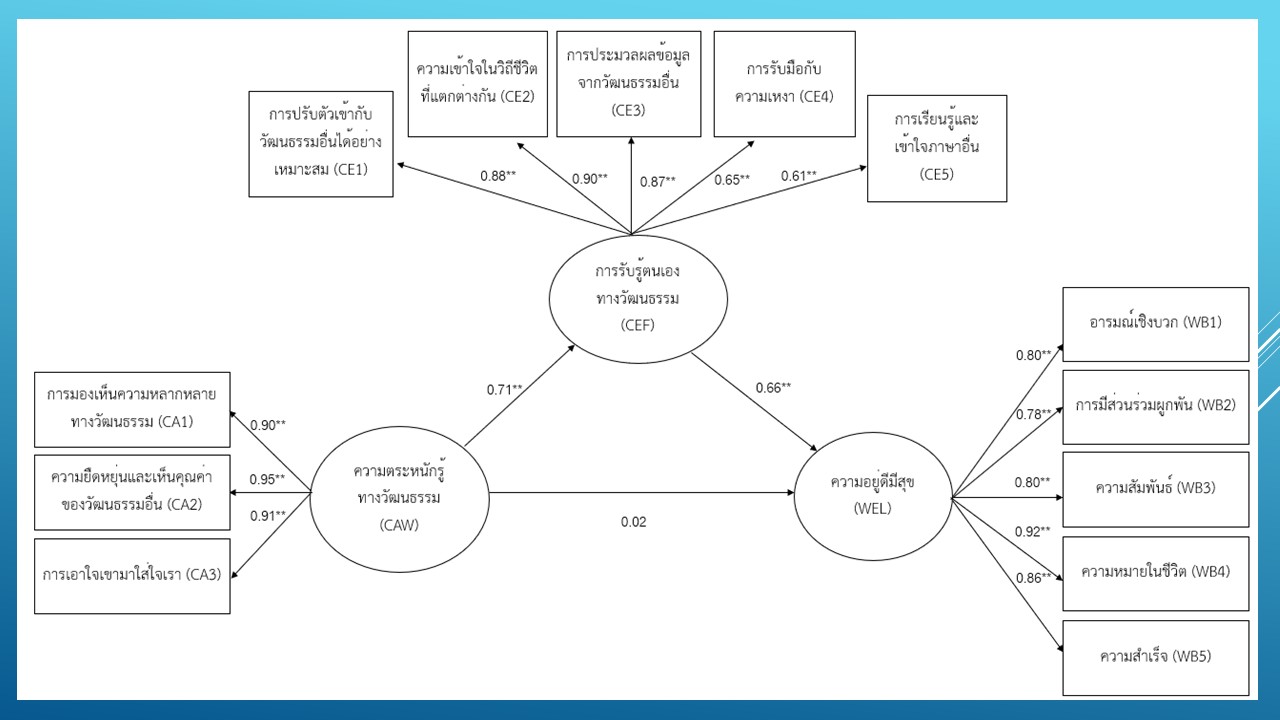
การวิจัยเรื่องนี้มีวัตถุประสงค์เพื่อศึกษาความสัมพันธ์ระหว่างความตระหนักรู้ทางวัฒนธรรมกับความอยู่ดีมีสุขของนักศึกษา มหาวิทยาลัยสงขลานครินทร์ วิทยาเขตปัตตานี โดยมีการรับรู้ตนเองทางวัฒนธรรมเป็นตัวแปรส่งผ่าน และเพื่อนำเสนอแนวทางบริหารจัดการเพื่อส่งเสริมความอยู่ดีมีสุขของนักศึกษาในสังคม พหุวัฒนธรรม ตัวอย่างวิจัยเป็นนักศึกษาระดับปริญญาตรี จำนวน 531 คน เครื่องมือที่ใช้เป็นมาตรวัดแบบประเมินค่า 5 ระดับ ที่ผ่านการตรวจสอบคุณภาพด้านความตรงจากผู้เชี่ยวชาญ มีผลการวิเคราะห์โมเดลการวัดที่เหมาะสมกลมกลืนกับข้อมูลเชิงประจักษ์ในระดับดี วิเคราะห์ข้อมูลด้วยโมเดลสมการโครงสร้าง และการสังเคราะห์เนื้อหา ผลการวิจัยพบว่า โมเดลความสัมพันธ์มีค่าอิทธิพลรวมเท่ากับ 0.519 อย่างมีนัยสำคัญทางสถิติที่ระดับ .01 โดยความตระหนักรู้ทางวัฒนธรรมไม่มีอิทธิพลทางตรงต่อความอยู่ดีมีสุข มีค่าอิทธิพลทางตรงเท่ากับ 0.022 แต่ส่งอิทธิพลทางอ้อมผ่านการรับรู้ตนเองทางวัฒนธรรมอย่างมีนัยสำคัญ มีค่าอิทธิพลทางอ้อมเท่ากับ 0.497 ซึ่งคิดเป็นสัดส่วนอิทธิพลส่งผ่านสูงถึงร้อยละ 95.7 ของอิทธิพลรวมทั้งหมด สะท้อนให้เห็นว่าความตระหนักรู้ทางวัฒนธรรมเป็นปัจจัยพื้นฐานที่ส่งผลต่อการรับรู้ตนเองทางวัฒนธรรม และการรับรู้ตนเองจะส่งผลต่อความอยู่ดีมีสุขอย่างมีนัยสำคัญ ผู้วิจัยจึงนำเสนอแนวทางบริหารจัดการในลักษณะนโยบายที่มุ่งเน้นการสร้างระบบนิเวศการเรียนรู้ที่ไม่เพียงแต่สร้างความตระหนักรู้ถึงความต่างทางวัฒนธรรมของนักศึกษา แต่ต้องมีกระบวนการส่งเสริมให้นักศึกษาเกิดการรับรู้และเข้าใจอัตลักษณ์ตนเองทางวัฒนธรรม เพื่อลดความวิตกกังวลในการปฏิสัมพันธ์ข้ามวัฒนธรรม อันจะนำไปสู่ความอยู่ดีมีสุขในการใช้ชีวิตในสังคมพหุวัฒนธรรมอย่างแท้จริง
คำสำคัญ: ความตระหนักรู้ทางวัฒนธรรม, การรับรู้ตนเองทางวัฒนธรรม, ความอยู่ดีมีสุข, สังคมพหุวัฒนธรรม, แนวทางบริหารจัดการสถาบันอุดมศึกษา
Article Details

อนุญาตภายใต้เงื่อนไข Creative Commons Attribution-NonCommercial-NoDerivatives 4.0 International License.
เอกสารอ้างอิง
กมลชนก ชำนาญ และอวยพร เรืองตระกูล. (2557). การพัฒนาแบบวัดและการวิเคราะห์ระดับความสามารถทางวัฒนธรรมของครู. วารสารอิเล็กทรอนิกส์ทางการศึกษา, 9(2), 534–548. https://so01.tci-thaijo.org/index.php/OJED/article/view/43786/36237
กองยุทธศาสตร์และพัฒนาวิทยาเขตปัตตานี. (2567). รายงานการวิเคราะห์นักศึกษาใหม่มหาวิทยาลัยสงขลานครินทร์ วิทยาเขตปัตตานี ปีการศึกษา 2567. https://planning.pn.psu.ac.th/web/files/doc/pdf_file_110924_154026.pdf
ชุตินันท์ จันทรเสนานนท์. (2553). การพัฒนาแบบวัดสมรรถนะเชิงวัฒนธรรมสําหรับนักเรียนมัธยมศึกษา [วิทยานิพนธ์ดุษฎีบัณฑิต จุฬาลงกรณ์มหาวิทยาลัย]. https://dric.nrct.go.th/index.php?/Search/SearchDetail/257105
สุธิรัส ชูชื่น. (2555). พหุวัฒนธรรมศึกษาใน 3 จังหวัดชายแดนภาคใต้ ...ทางเลือกหรือทางรอด?. วารสารวิชาการคณะมนุษยศาสตร์และสังคมศาสตร์, 8(2), 123–136.
อุรุพร ศิริวิชยาภรณ์, สันติ ศรีสวนแตง, และประสงค์ ตันพิชัย. (2561). ปัจจัยที่มีผลต่อความตระหนักทางวัฒนธรรมของนิสิตระดับปริญญาตรี มหาวิทยาลัยเกษตรศาสตร์ วิทยาเขตกำแพงแสน. Veridian E-Journal, Silpakorn University (ฉบับภาษาไทย สาขามนุษยศาสตร์ สังคมศาสตร์ และศิลปะ), 11(1), 1207–1221.
Bandura, A., Barbaranelli, C., Caprara, G. V., & Pastorelli, C. (1996). Multifaceted impact of self-efficacy belief on academic functioning. Child Development, 67, 1206–1222.
Bandura, A. (1997). Self-efficacy: The exercise of control. Freeman.
Banks, J. A. (2006). Cultural diversity and education: Foundations, curriculum, and teaching (5th ed.). Allyn & Bacon.
Banks, J. A. (2008). An introduction to multicultural education (4th ed.). Pearson Education.
Baumeister, R. F., Vohs, K. D., Aaker, J. L., & Garbinsky, E. N. (2013). Some key differences between a happy life and a meaningful life. The Journal of Positive Psychology, 8(6), 505–516. http://doi:10.1080/17439760.2013.830764
Bennett, M. J. (1986). A developmental approach to training for intercultural sensitivity. International Journal of Intercultural Relations, 10(2), 179–196.
Bennett, M. J. (1993). Developing intercultural sensitivity: An integrative approach to global and domestic diversity. Intercultural Press.
Berry, J. W., Phinney, J. S., Sam, D. L., & Vedder, P. (2006). Immigrant youth in cultural transition: Acculturation, identity, and adaptation. Lawrence Erlbaum Associates.
Briones, E., Tabernero, C., Tramontano, C., Caprara, G. V., & Arenas, A. (2009). Development of a cultural self-efficacy scale for adolescents (CSES-A). International Journal of Intercultural Relations, 33, 301–312
Butler, J. M., & Kern, M. L. (2016). The PERMA-Profiler: A brief multidimensional measure of flourishing. International Journal of Wellbeing, 6(3), 1–48. https://doi.org/10.5502/ijw.v6i3.1
Campinha-Bacote, J. (2002). The process of cultural competence in the delivery of healthcare services: A model of care. Journal of Transcultural Nursing, 13(3), 181–184. https://doi.org/10.1177/10459602013003003
Cohen, S. (2004). Social relationships and health. American Psychologist, 59(8), 676–684. http://doi:10.1037/0003-066X.59.8.676
Cortes, C. E. (1996). The making and remaking of a multiculturalist. Teachers College Press.
Csikszentmihaly, M. (1997). Finding Flow: The psychology of engagement with everyday life. Basic Books.
Deardorff, D. K. (2009). The SAGE handbook of intercultural competence. SAGE Publications.
Diener, E. (1984). Subjective well-being. Psychological Bulletin, 95(3), 542–575.
https://doi.org/10.1037/0033-2909.95.3.542
Dyrbye, L. N., Thomas, M. R., & Shanafelt, T. D. (2006). Systematic review of depression, anxiety, and other indicators of psychological distress among U.S. medical students. Academic Medicine, 81(6), 354–373. https://doi.org/10.1097/00001888-200606000-00006
Fan, C., & Mak, A. S. (1998). Measuring social self-efficacy in a culturally diverse student population. Social Behavior and Personality, 26(2), 131–144.
Frederickson, B. L. (2001). The role of positive emotions in positive psychology: The broaden-and-build theory of positive emotions. American Psychologist, 56(3), 218–226. https://doi.org/10.1037/0003-066X.56.3.218
Gudykunst, W. B. (2004). Bridging differences: Effective intergroup communication (4th ed.). SAGE Publications.
Gut, D., Bowers, A., & Fitzpatrick, M. (2017). Cultural awareness and its importance in a
multicultural society. Journal of International and Intercultural Communication, 10(3), 150–169. https://doi.org/10.1080/17513057.2017.1342649
Hall, E. T. (1976). Beyond culture. Anchor Press.
Hofstede, G. (1980). Culture's consequences: International differences in work-related values. SAGE Publications.
Hofstede, G. (1991). Cultures and organizations: Software of the mind. McGraw-Hill.
Hofstede, G. (2011). Dimensionalizing cultures: The Hofstede model in context. Online Readings in Psychology and Culture, 2(1), 1–26. http://scholarworks.gvsu.edu/orpc/vol2/iss1/8
Jackson, D. L. (2003). Revisiting sample size and number of parameter estimates: Some support for the N:q hypothesis. Structural Equation Modeling, 10, 128–141.
JASP Team. (2024). JASP (Version 0.19.0) [Computer software].
Kaihlanen, A.M., Hietapakka, L., & Heponiemi, T. (2019). Increasing cultural awareness: Qualitative study of nurses’ perceptions about cultural competence training. BMC Nursing, 18(1), 38–38.
Keyes, C. L. M. (2002). The mental health continuum: From languishing to flourishing in life. Journal of Health and Social Behavior, 43(2), 207–222. https://doi.org/10.2307/3090197
Lin, L., & Shek, D. T. L. (2019). The role of positive psychological characteristics in the well-being of college students: A longitudinal study. Journal of Youth and Adolescence, 48(2), 394–406. https://doi.org/10.1007/s10964-018-0901-3
Lister, R. (1999). The exclusionary politics of citizenship. Palgrave Macmillan.
Livermore, D. (2010). Leading with Cultural Intelligence: The Real Secret to Success. AMACOM.
Lu, C., & Wan, C. (2018). Cultural self-awareness as awareness of culture’s influence on the self: Implications for cultural identification and well-being. Personality and Social Psychology Bulletin, 44(6), 823–837. https://doi.org/10.1177/0146167217752117
Matsumoto, D., & Juang, L. (2008). Culture and psychology (4th ed.). Wadsworth.
Matveev, A., & Milter, R. (2004). The role of cultural awareness in reducing intercultural conflicts. International Journal of Intercultural Relations, 28(3), 275–287. https://doi.org/10.1016/j.ijintrel.2004.02.003
Multon, K. D., Brown, S. B., & Lent, R. W. (1991). Relationship of self-efficacy beliefs to academic outcomes: a meta-analytic investigation. Journal of Counselling Psychology, 38, 30–38.
Nguyen, A. M. D., & Benet-Martínez, V. (2013). The role of cultural identity in the psychological adaptation of international students. Personality and Social Psychology Bulletin, 39(6), 727–738. https://doi.org/10.1177/0146167213483589
Nieto, J.A. (2004). Searching for a connection between matroid theory and string theory. Journal of Mathematical Physics, 45, 285–301. https://doi.org/10.48550/arXiv.hep-th/0212100
Perissinotto, C. M., Stijacic Cenzer, I., & Covinsky, K. E. (2012). Loneliness in older adults: A predictor of functional decline and death. Archives of Internal Medicine, 172(14), 1078–1084. https://doi.org/10.1001/archinternmed.2012.1993
Schwarzer, R., Hahn, A., & Schröder, H. (1994). Social integration and social support in a life crisis: effects of macrosocial changes in East Germany. American Journal of Community Psychology, 22, 685–706.
Seligman, M. E. P. (2011). Flourish: A visionary new understanding of happiness and well-being. Free Press.
Smith, J. K., Williams, K. R., & Anderson, C. A. (2021). Positive psychology interventions and their impact on student well-being. Journal of Positive Psychology, 16(4), 432–444. https://doi.org/10.1080/17439760.2020.1754189
Solberg, V. C., O’Brien, K., Villareal, P., Kennel, R., & Davis, B. (1993). Self-efficacy and Hispanic college students: Validation of the College Self-Efficacy Instrument. Hispanic Journal of Behavioral Sciences, 15(1), 80–95.
Taylor, E. W. (1994). Intercultural competence: A transformative learning perspective. Routledge.
Thomas, D. C., & Inkson, K. (2004). Cultural intelligence: People skills for global business. Berrett-Koehler Publishers.
Travia, L., Kemeny, M. E., & McMahon, R. P. (2020). Well-being in college students: The role of positive emotion, life satisfaction, and mood balance. Journal of College Student Development, 61(3), 313–325. https://doi.org/10.1353/csd.2020.0024
Tsang, E. W. K. (2001). Adjustment of mainland Chinese academics and students to Singapore. International Journal of Intercultural Relations, 25, 347–372.
Ward, C., & Kennedy, A. (1994). Cross cultures: The relationship between psychological and sociocultural dimensions of cross-cultural adjustment. In J. Pandey, D. Sinha, & D. P. S. Bhawuk (Eds.), Asian contributions to cross-cultural psychology. Sage.
World Health Organization. (2020). Constitution of the World Health Organization: Basic documents (49th ed.) https://www.who.int/about/governance/constitution.
