
ความท้าทายของอุตสาหกรรมทุเรียนไทยในภาคตะวันออก: ผลกระทบจากวิกฤตแรงงานกัมพูชา การแข่งขันจากเวียดนาม และการปรับตัวเชิงยุทธศาสตร์ด้วยเทคโนโลยีเกษตรแม่นยำ
Article Sidebar
Main Article Content
บทคัดย่อ
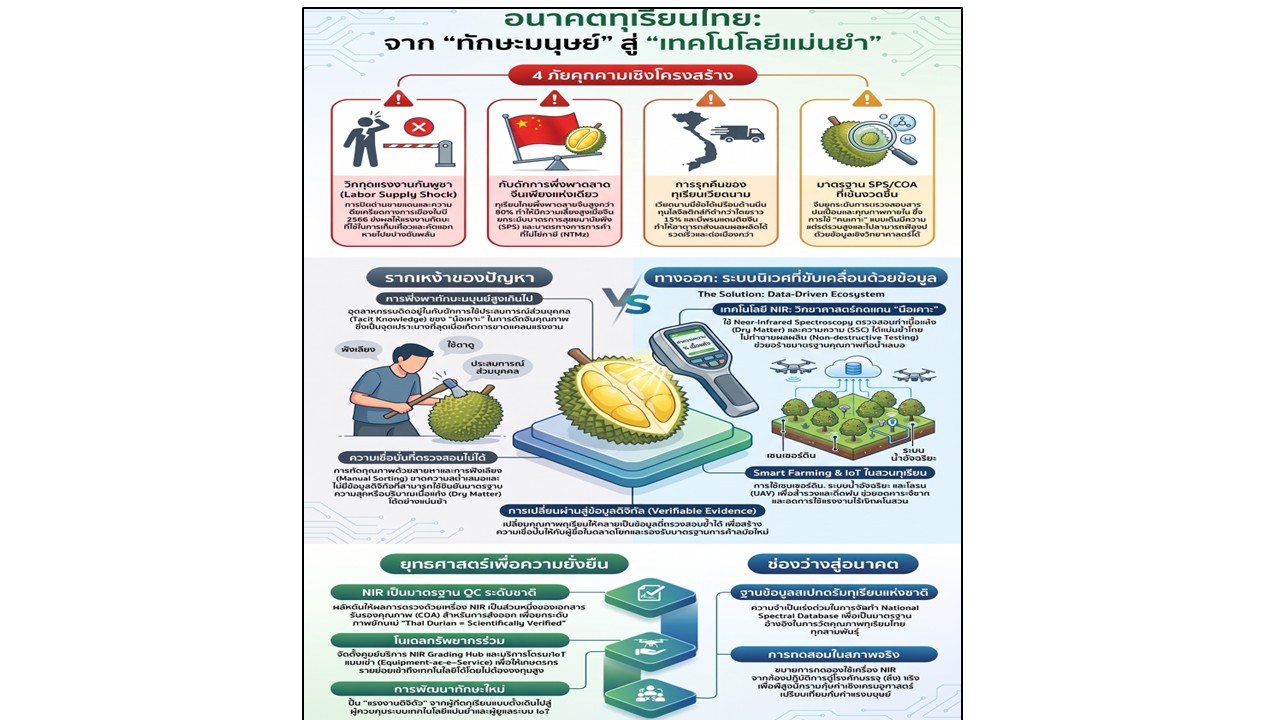
บทความวิชาการฉบับนี้มุ่งวิเคราะห์เจาะลึกถึงความท้าทายเชิงโครงสร้างที่สำคัญของอุตสาหกรรมทุเรียนไทยในเขตพื้นที่ภาคตะวันออก โดยเฉพาะอย่างยิ่งภายใต้สภาวะวิกฤตการขาดแคลนแรงงานข้ามชาติชาวกัมพูชา การพึ่งพิงตลาดส่งออกจีนเพียงรายใหญ่อย่างเข้มข้น แรงกดดันจากมาตรการด้านสุขอนามัยพืช (SPS) ที่เข้มงวดขึ้น และการแข่งขันที่ทวีความรุนแรงจากประเทศเพื่อนบ้าน การวิเคราะห์นี้อาศัยการสังเคราะห์วรรณกรรมวิชาการในช่วงทศวรรษที่ผ่านมา ซึ่งครอบคลุมประเด็นแรงงานเกษตรระหว่างประเทศ ความยืดหยุ่นของห่วงโซ่อุปทาน มาตรการทางการค้าที่ไม่ใช่ภาษี (NTMs) เทคโนโลยีการตรวจสอบแบบไม่ทำลาย (NDT) ผ่าน Near-Infrared Spectroscopy (NIR) ตลอดจนการประยุกต์ใช้เกษตรอัจฉริยะ (Smart Farming) และ IoT ผลการศึกษาพบว่า ปัญหาที่เป็นรากเหง้าของอุตสาหกรรมทุเรียนไทยไม่ได้เกิดจากปริมาณผลผลิตหรือการขาดตลาด แต่เกิดจาก "โครงสร้างการผลิตที่พึ่งพาทักษะแรงงานมนุษย์" ในสัดส่วนที่สูงเกินไป ทั้งในขั้นตอนการคัดกรองคุณภาพและการบริหารจัดการสวน การพึ่งพาเช่นนี้กลายเป็นจุดเปราะบางที่สำคัญเมื่อต้องเผชิญกับความผันผวนของแรงงานและข้อกำหนดทางการค้าสากลที่ต้องการการพิสูจน์คุณภาพด้วยหลักฐานทางวิทยาศาสตร์ งานวิจัยด้าน NIR และการวิเคราะห์ภาพสเปกตรัมแสดงให้เห็นถึงศักยภาพในการทำนายค่าเนื้อแห้งและคุณภาพภายในได้อย่างแม่นยำโดยไม่สร้างความเสียหายต่อผลผลิต ซึ่งสามารถทดแทนการประเมินด้วยประสบการณ์ส่วนบุคคลได้อย่างมีนัยสำคัญ ขณะที่นวัตกรรมโดรนและระบบเซนเซอร์จะช่วยลดภาระงานซ้ำซากและเพิ่มประสิทธิภาพการใช้ทรัพยากรในระดับสวน บทความจึงได้นำเสนอกรอบยุทธศาสตร์เชิงรุกที่ผสานการใช้เทคโนโลยีตรวจสอบคุณภาพเข้ากับการจัดการสวนอัจฉริยะ พร้อมทั้งเสนอให้มีการลงทุนในรูปแบบทรัพยากรร่วม (Shared Resources) และการพัฒนาทักษะทุนมนุษย์เพื่อสร้างภูมิคุ้มกันต่อความเสี่ยงด้านแรงงานและการค้า นอกจากนี้ยังระบุถึงทิศทางการวิจัยที่จำเป็นต่อระดับนโยบาย ได้แก่ การจัดทำฐานข้อมูลสเปกตรัมทุเรียนแห่งชาติ การทดลองใช้ระบบในสภาพแวดล้อมโรงคัดบรรจุ (ล้ง) จริง และการวิเคราะห์ความคุ้มค่าทางการเงินเปรียบเทียบกับต้นทุนแรงงาน การเปลี่ยนผ่านจากรูปแบบดั้งเดิมไปสู่ระบบที่ขับเคลื่อนด้วยข้อมูลและวิทยาศาสตร์ จะเป็นกุญแจสำคัญในการยกระดับทุเรียนไทยสู่การเป็นต้นแบบอุตสาหกรรมผลไม้เขตร้อนที่มีมาตรฐานและความน่าเชื่อถือในระดับสากลอย่างยั่งยืน
คำสำคัญ: NIR, เกษตรอัจฉริยะ, ห่วงโซ่อุปทานทุเรียน, แรงงานข้ามชาติ
Article Details

อนุญาตภายใต้เงื่อนไข Creative Commons Attribution-NonCommercial-NoDerivatives 4.0 International License.
เอกสารอ้างอิง
เครือข่ายองค์กรด้านประชากรข้ามชาติ. (2569). ข้อกังวลและข้อเสนอผลกระทบภาคเกษตรจากด่านชายแดนไทย–กัมพูชา. https://mwgthailand.org/th/press/1751250512
Aline, U., Bhattacharya, T., Faqeerzada, M. A., Kim, M. S., Baek, I., & Cho, B.-K. (2023). Advancement of non-destructive spectral measurements for the quality of major tropical fruits and vegetables: A review. Frontiers in Plant Science, 14, Article 1240361. https://doi.org/10.3389/fpls.2023.1240361
Bangkok Bank Economic Research. (2024). Thailand durian export report 2024: Economic impact and trade flows. Bangkok Bank. https://www.bangkokbank.com/th-TH/-/media/a4be6005ca354249aed043ca228bba58.ashx?r=1
Cambodian–Thai border crisis. (2026, January). In Wikipedia. https://en.wikipedia.org/wiki/2025_Cambodian%E2%80%93Thai_border_crisis
Doan, H. T. T., Kim, K., & Ghodsi, M. (2023). Divergence in non-tariff measures and the quality of traded products (ERIA Discussion Paper No. DP-2023-02). Economic Research Institute for ASEAN and East Asia. https://ideas.repec.org/p/era/wpaper/dp-2023-02.html
Fodor, M., Kovács, Z., & Sipos, L. (2024). The role of near-infrared spectroscopy in food quality assurance: A review of the past two decades. Foods, 13(21), Article 3501. https://doi.org/10.3390/foods13213501
Guebsi, R., Mami, S., & Chokmani, K. (2024). Drones in precision agriculture: A comprehensive review of applications, technologies, and challenges. Drones, 8(11), Article 686. https://doi.org/10.3390/drones8110686
Imai, M., Sangsoy, K., Blasco, J., Kittiwachana, S., Rittiron, R., Chaiwong, S., Munera, S., Arwatchananukul, S., Saengrayap, R., Lerslerwong, L., Mahajan, P., Di, W., & Luengwilai, K. (2025). Enhancing dry matter prediction in durian using peduncle-based NIR spectroscopy across maturation rates. Postharvest Biology and Technology, 230, Article 113773. https://doi.org/10.1016/j.postharvbio.2025.113773
Jespersen, S., Sok, S., & Chan, S. (2022). Labour migration in Cambodia, Laos, Thailand and Vietnam: Thematic brief. ODI. https://odi.org/documents/8422/Thematic_brief_4_FINAL_MR.pdf
Li, M., Pullanagari, R. R., Yule, I. J., & East, A. (2022). Segregation of 'Hayward' kiwifruit for storage potential using Vis-NIR spectroscopy. Postharvest Biology and Technology, 189, Article 111893. https://doi.org/10.1016/j.postharvbio.2022.111893
Likhitpichitchai, P., Khermkhan, J., & Kuhaswonvetch, S. (2023). The competitiveness of Thai durian export to China's market. GMSARN International Journal, 17(4), 371–378. https://gmsarnjournal.com/home/wp-content/uploads/2023/03/vol17no4-3.pdf
Mortensen, S. (2024). Rightless rurality: The illegalization of Myanmar migrant labour in Thailand. The Journal of Peasant Studies. https://doi.org/10.1080/03066150.2024.2340648
Office of Agricultural Economics. (2026). Thailand durian export quality and safety compliance report. https://www.nationthailand.com/business/trade/40060853
Park, H., Eo, H. J., Kim, C.-W., Stewart, J. E., Lee, U., & Lee, J. (2025). Soluble solids content-based fruit maturity affects postharvest fruit quality by mediating metabolic alterations in cold-stored 'Autumn Sense' hardy kiwifruit. Food Chemistry: X, 32, Article 103373. https://doi.org/10.1016/j.fochx.2025.103373
Reuters. (2025, August 19). Thailand turning to Sri Lankan workers to cope with Cambodian worker exodus, official says. https://www.reuters.com/world/asia-pacific/thailand-turning-sri-lankan-workers-cope-with-cambodian-exodus-official-says-2025-08-19/
Richardson, L., & Pettigrew, R. N. (2022). Migrant agricultural workers: A comparative analysis of policies and COVID-19 responses in Thailand, Italy, and Canada. SN Social Sciences, 2, Article 236. https://doi.org/10.1007/s43545-022-00548-9
Roque Júnior, L. C., Frederico, G. F., & Costa, M. L. N. (2023). Maturity and resilience in supply chains: A systematic review of the literature. International Journal of Industrial Engineering and Operations Management, 5(1), 1–25. https://doi.org/10.1108/IJIEOM-08-2022-0035
Shepotylo, O. (2016). Effect of non-tariff measures on extensive and intensive margins of exports in seafood trade. Marine Policy, 68, 47–54. https://doi.org/10.1016/j.marpol.2016.02.014
Swift, P., Htoo, S. E., Klay, S. M., & Rueff, H. (2024). COVID-19 migrant returnees, access to land, and subsistence under uncertain times in Karen State, Myanmar. Land Use Policy, 146, Article 107293. https://doi.org/10.1016/j.landusepol.2024.107293
Thairath. (2025). Labour shortages and durian production risk. https://en.thairath.co.th/news/governmentpolicy/2910851
Thongnim, P., & Srinil, P. (2025). Smart farming solutions for durian cultivation using IoT and chatbot integration for precision agriculture. Discover Internet of Things, 5, Article 227. https://doi.org/10.1007/s43926-025-00227-0
Walsh, K. B., McGlone, V. A., & Han, D. H. (2020). The uses of near infra-red spectroscopy in postharvest decision support: A review. Postharvest Biology and Technology, 163, Article 111139. https://doi.org/10.1016/j.postharvbio.2020.111139
Winrock International. (2023). Cambodian seasonal migrant workers in Thailand: Policy and practices. https://winrock.org/wp-content/uploads/2023/07/Asia-CTIP-Cam-Tha-Seasonsal-Migration-Research.pdf
Xinhua News Agency. (2024, August 27). 友谊关见闻 [Scenes at Friendship Pass]. Xinhuanet. https://www.news.cn/20240827/ddd9b0b10f144d0b8cbdc351c0833452/c.html
Yuan, M., Hu, H., Xue, M., & Li, J. (2024). Framework for resilience strategies in agricultural supply chain: Assessment in the era of climate change. Frontiers in Sustainable Food Systems, 8, Article 1444910. https://doi.org/10.3389/fsufs.2024.1444910
Zhang, R., & Zhang, X. (2025). Substitution effects between agricultural tariffs and SPS measures: Evidence from the structural characteristics of measures. Sustainability, 17(17), 7933. https://doi.org/10.3390/su17177933
