
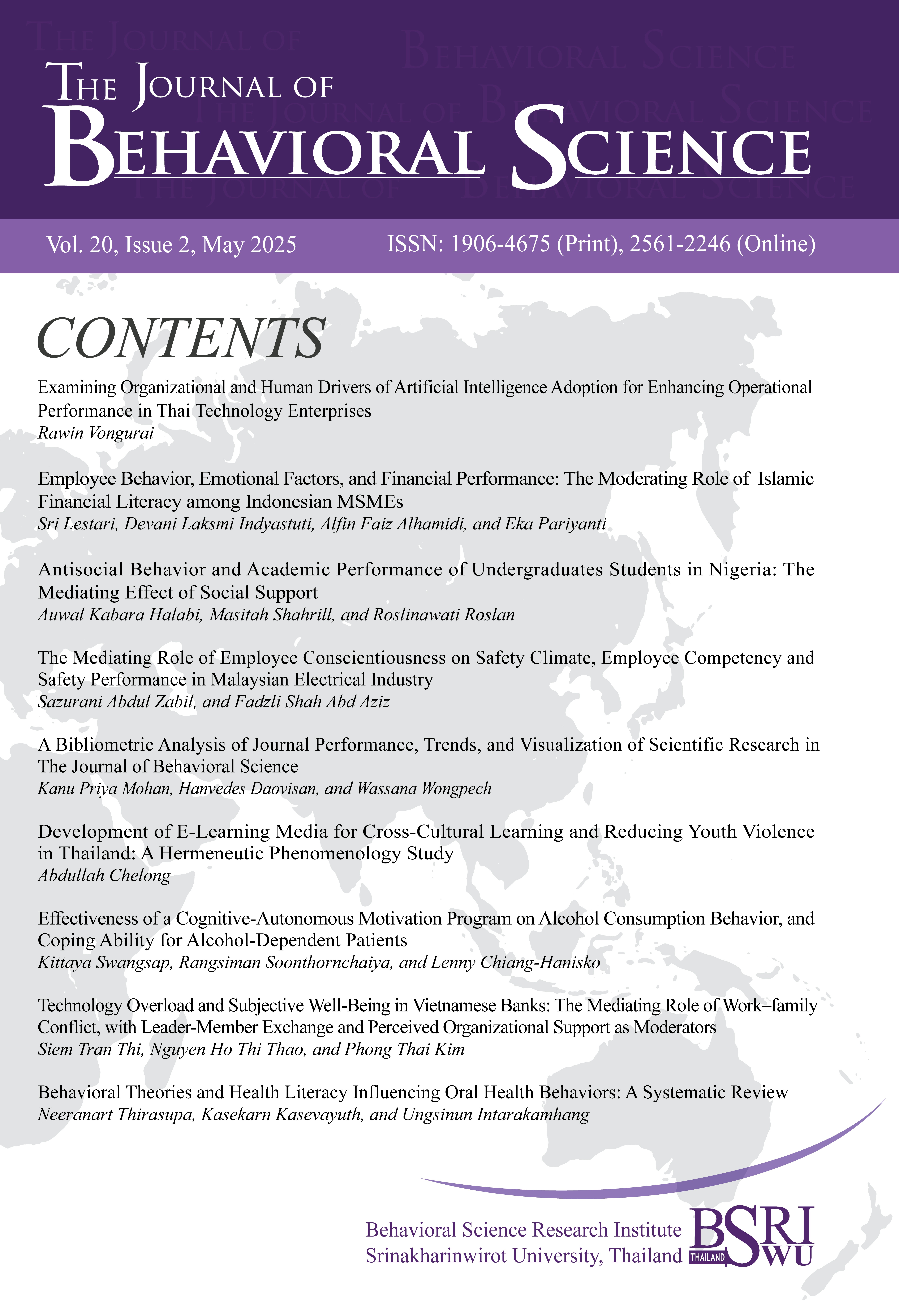
A Bibliometric Analysis of Journal Performance, Trends, and Visualization of Scientific Research in The Journal of Behavioral Science
Article Sidebar
Main Article Content
Abstract
Background/ problem: The Journal of Behavioral Science (TJBS) has made significant contributions to the discipline by publishing research that integrates interdisciplinary knowledge and uses advanced research methodologies to explore contemporary issues. Though the journal has been published since 2006, it was indexed in the prestigious SCOPUS database in 2018, which brought many changes in the published content.
Objective/ purpose: This research was designed to examine the changes in the journal content and performance. Specifically, there were three aims, 1) to study the changes in the journal metrics; 2) to examine the trends in the research articles published in TJBS after 2018; and 3) to examine and compare the publications between the two periods of content analysis of TJBS, period 1 (2006-14) and the current, period 2 (2018-24).
Design and Methodology: This research adopted a case study approach to conduct bibliometric analysis of the journal. Data from Scopus database was utilized, along with software for visualization of the information. Out of the total articles (n=154) published from 2018-2024, only 144 articles were selected for further analysis, excluding the review articles (n=10).
Results: The findings re-affirm the interest in behavioral science topics and advance research methodologies. Journal performance shows steady progress with an increase in the total publications, author networks, institutional collaborations, and citations over time. A comparison with the previous analysis shows enhanced diversity of authors, content, and rigors in methodologies.
Conclusion and Implications: Implications of these findings are discussed for quality management of similar journals, for orientation of scholars and authors, and for future researchers in behavioral science.
Downloads
Article Details

This work is licensed under a Creative Commons Attribution-NonCommercial-NoDerivatives 4.0 International License.
References
Albarracin, D., & Jung, H. (2021). A research agenda for the post-COVID-19 world: Theory and research in social psychology. Asian Journal of Social Psychology, 24(1), 10–17. https://doi.org/10.1111/ajsp.12469 DOI: https://doi.org/10.1111/ajsp.12469
Ayanoğlu, Ç. (2022). A content analysis on the journal of research in educational administration & leadership. International Journal of Management and Administration, 6(12), 111–147. https://doi.org/10.29064/ijma.1018310 DOI: https://doi.org/10.29064/ijma.1018310
Berrone, P., Rousseau, H. E., Ricart, J. E., Ruiz, E. B., & Giuliodori, A. (2023). How can research contribute to the implementation of sustainable development goals? An interpretive review of SDG literature in management. International Journal of Management Reviews, 25(2), 318–339. https://doi.org/10.1111/ijmr.12331 DOI: https://doi.org/10.1111/ijmr.12331
Bryan, C. J., Tipton, E., & Yeager, D. S. (2021). Behavioural science is unlikely to change the world without a heterogeneity revolution. Nature Human Behaviour, 5(8), 980–989. https://doi.org/10.1038/s41562-021-01143-3 DOI: https://doi.org/10.1038/s41562-021-01143-3
Crowe, S., Cresswell, K., Robertson, A., Huby, G., Avery, A., & Sheikh, A. (2011). The case study approach. BMC Medical Research Methodology, 11, 100. https://doi.org/10.1186/1471-2288-11-100 DOI: https://doi.org/10.1186/1471-2288-11-100
Daks, J. S., Peltz, J. S., & Rogge, R. D. (2020). Psychological flexibility and inflexibility as sources of resiliency and risk during a pandemic: Modeling the cascade of COVID-19 stress on family systems with a contextual behavioral science lens. Journal of Contextual Behavioral Science, 18, 16–27. https://doi.org/10.1016/j.jcbs.2020.08.003 DOI: https://doi.org/10.1016/j.jcbs.2020.08.003
Davis, R., Campbell, R., Hildon, Z., Hobbs, L., & Michie, S. (2015). Theories of behaviour and behaviour change across the social and behavioural sciences: a scoping review. Health Psychology Review, 9(3), 323–344. https://doi.org/10.1080/17437199.2014.941722 DOI: https://doi.org/10.1080/17437199.2014.941722
Donthu, N., Kumar, S., Mukherjee, D., Pandey, N., & Lim, W. M. (2021). How to conduct a bibliometric analysis: An overview and guidelines. Journal of Business Research, 133(c), 285–296. https://doi.org/10.1016/j.jbusres.2021.04.070 DOI: https://doi.org/10.1016/j.jbusres.2021.04.070
Givi, E, M., Saberi, M.K., Talafidaryani, M., Abdolhamid, M., Nikandish, R., & Fattahi, A. (2022). Assessment of the history and trends of The Journal of Intellectual Capital: A bibliometrics, altmetrics and text mining analysis. Journal of Intellectual Capital, 23(4), 864–912. https://doi.org/10.1108/JIC-02-2020-0057 DOI: https://doi.org/10.1108/JIC-02-2020-0057
Hagger, M. S., Cheung, M. W. L., Ajzen, I., & Hamilton, K. (2022). Perceived behavioral control moderating effects in the theory of planned behavior: A meta-analysis. Health Psychology, 41(2), 155–167. https://doi.org/10.1037/hea0001153 DOI: https://doi.org/10.1037/hea0001153
Hallsworth, M. (2023). A manifesto for applying behavioural science. Nature Human Behaviour, 7(3), 310–322. https://doi.org/10.1038/s41562-023-01555-3 DOI: https://doi.org/10.1038/s41562-023-01555-3
Järvelin, K., & Vakkari, P. (2021). LIS research across 50 years: Content analysis of journal articles. Journal of Documentation, 78(7), 65–88. https://doi.org/10.1108/JD-03-2021-0062 DOI: https://doi.org/10.1108/JD-03-2021-0062
Järvelin, K., Chang, Y. W., & Vakkari, P. (2023). Characteristics of LIS research articles affecting their citation impact. Journal of Librarianship and Information Science. https://doi.org/10.1177/09610006231196344 DOI: https://doi.org/10.1177/09610006231196344
Jia, C., & Mustafa, H. (2023). A bibliometric analysis and review of nudge research using VOSviewer. Behavioral Sciences, 13(1), 19. https://doi.org/10.3390/bs13010019 DOI: https://doi.org/10.3390/bs13010019
Klinmalee, P., Satchanan, C., & Ueawong, K. (2023). Analysis of Thai-language academic journals on educational administration between 2002-2017. Journal of Information and Learning, 34(1), 131–142. https://doi.org/10.14456/jil.2023.12 [In Thai]
Lehmann, P., Beck, S., de Brito, M. M., Gawel, E., Groß, M., Haase, A., Lepenies, R., Otto, D., Schiller, J., Strunz, S., & Thrän, D. (2021). Environmental Sustainability Post-COVID-19: Scrutinizing Popular Hypotheses from a Social Science Perspective. Sustainability, 13(16), 8679. https://doi.org/10.3390/su13168679 DOI: https://doi.org/10.3390/su13168679
Mladenović, D., Todua, N., & Pavlović-Höck, N. (2023). Understanding individual psychological and behavioral responses during COVID-19: Application of stimulus-organism-response model. Telematics and Informatics, 79, 101966. https://doi.org/10.1016/j.tele.2023.101966 DOI: https://doi.org/10.1016/j.tele.2023.101966
Mohan, K. P. (2015). Behavioral science research: An evaluation of the historical roots, evolution and future development in Thailand (Research report). Behavioral Science Research Institute, Srinakharinwirot University. http://bsris.swu.ac.th/upload/262296.pdf
Mohan, K. P. (2016). The Development of Behavioral Sciences, and its Research and Contributions: Glimpses from the BSRI, Thailand. In Behavioral science in different perspectives. Behavioral Science Research Institute, Srinakharinwirot University.
Mohan, K. P., Peungposop, N., & Junprasert, T. (2016). State of the art behavioral science research: A review of the publications in the International Journal of Behavioral Science. International Journal of Behavioral Science, 11 (1), 1–18. https://www.tci-thaijo.org/index.php/IJBS/article/view/47713/pdf_11
Munda, N., Srivastava, N., & Kaman, K. (2025). Mental health and employee well-being: A bibliometric and thematic content analysis. Journal of Information Systems Engineering and Management, 10(8s), 580–597. https://doi.org/10.52783/jisem.v10i8s.1114 DOI: https://doi.org/10.52783/jisem.v10i8s.1114
Nguyen, L. T., & Tuamsuk, K. (2024). Unveiling scientific integrity in scholarly publications: A bibliometric approach. International Journal for Educational Integrity, 20(1), 16. https://doi.org/10.1007/s40979-024-00164-5 DOI: https://doi.org/10.1007/s40979-024-00164-5
Ovretveit, J., Mittman, B. S., Rubenstein, L. V., & Ganz, D. A. (2021). Combining improvement and implementation sciences and practices for the post COVID-19 era. Journal of General Internal Medicine, 36(11), 3503–3510. https://doi.org/10.1007/s11606-020-06373-1 DOI: https://doi.org/10.1007/s11606-020-06373-1
Panitz, C., & Dell'Acqua, C. (2025). Mapping 60 years of psychophysiology: A bibliometric analysis of journal performance, authorship trends, and thematic evolution. Psychophysiology, 62(2), e70002. https://doi.org/10.1111/psyp.70002 DOI: https://doi.org/10.1111/psyp.70002
Passas, I. (2024). Bibliometric analysis: The main steps. Encyclopedia, 4(2), 1014–1025. https://doi.org/10.3390/encyclopedia4020065 DOI: https://doi.org/10.3390/encyclopedia4020065
Ryan, R. M., Deci, E. L., Vansteenkiste, M., & Soenens, B. (2021). Building a science of motivated persons: Self-determination theory’s empirical approach to human experience and the regulation of behavior. Motivation Science, 7(2), 97–110. https://doi.org/10.1037/mot0000194 DOI: https://doi.org/10.1037/mot0000194
Sahoo, J., Mohanty, B., Biswal, O., Dash, N. K., & Sahu, J. K. (2020). Authorship trend and content analysis: A case study on highly cited articles in library and information science journals. Performance Measurement and Metrics, 21(1), 33–51. https://doi.org/10.1108/PMM-06-2019-0021 DOI: https://doi.org/10.1108/PMM-06-2019-0021
van Aaken, A. (2024). Behavioural sciences used by the United Nations to achieve the sustainable development goals: A roadmap and some stop signs. Journal of Environmental Law and Policy, 4(1), 1–21. https://doi.org/10.33002/jelp040101 DOI: https://doi.org/10.33002/jelp040101
Wallgren, A., Veach, P. M., MacFarlane, I. M., & LeRoy, B. S. (2021). Content analysis of Journal of Genetic Counseling research articles: A multi-year perspective. Journal of Genetic Counseling, 30(3), 774–784. https://doi.org/10.1002/jgc4.1373 DOI: https://doi.org/10.1002/jgc4.1373
Yamaguchi, N. U., Bernardino, E. G., Ferreira, M. E. C., de Lima, B. P., Pascotini, M. R., & Yamaguchi, M. U. (2023). Sustainable development goals: A bibliometric analysis of literature reviews. Environmental Science and Pollution Research, 30(3), 5502–5515. https://doi.org/10.1007/s11356-022-24379-6 DOI: https://doi.org/10.1007/s11356-022-24379-6
Zhang, Y., & Wildemuth, B. M. (2009). Qualitative analysis of content. In B. Wildemuth (Ed.), Applications of Social Research Methods to Questions in Information and Library Science (pp.308–319). Libraries Unlimited.
Zyoud, S. H., & Zyoud, A. H. (2021). Visualization and mapping of knowledge and science landscapes in expert systems with Applications Journal: A 30 years’ bibliometric analysis. SAGE Open, 11(2). https://doi.org/10.1177/21582440211027574 DOI: https://doi.org/10.1177/21582440211027574
