
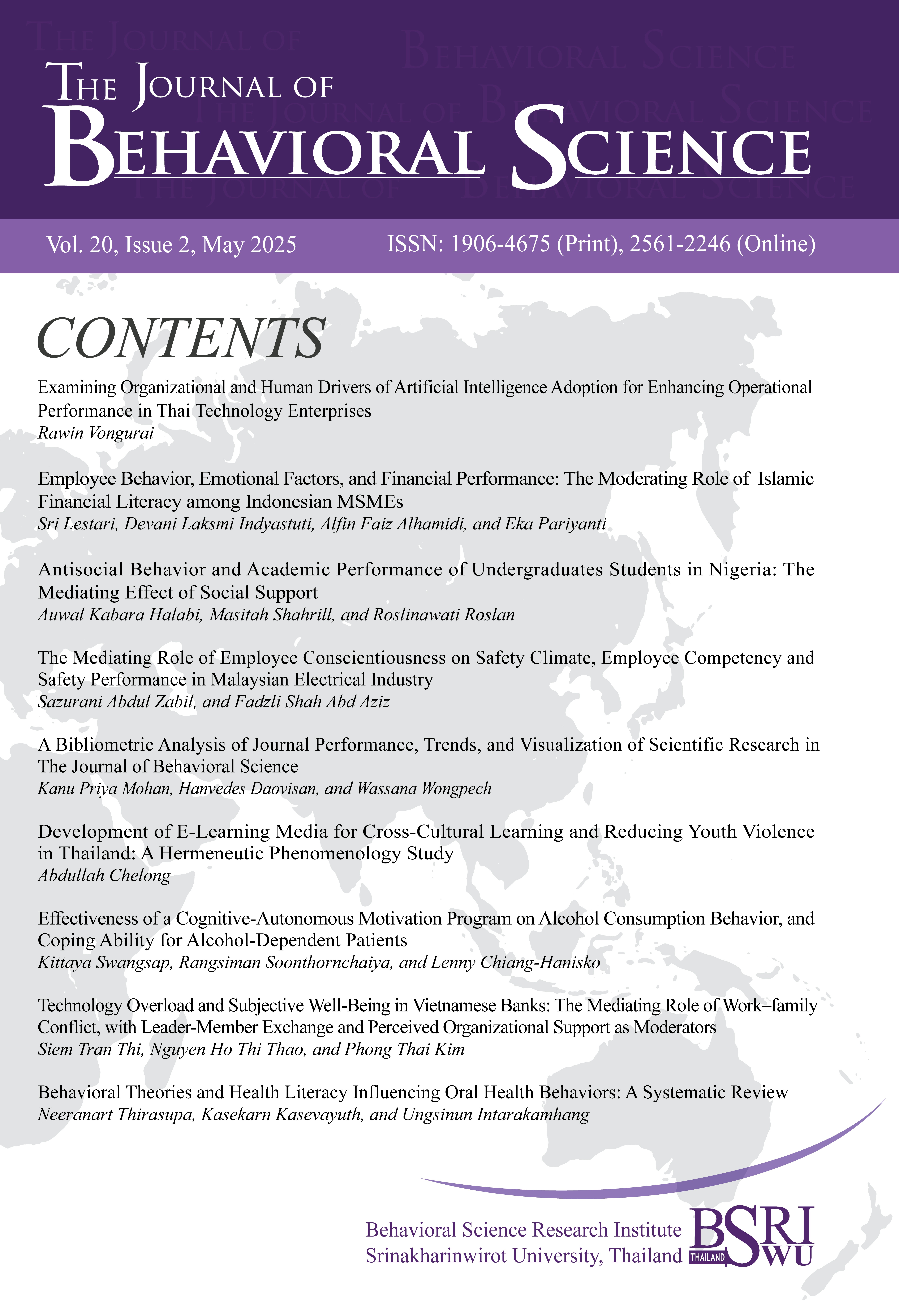
Technology Overload and Subjective Well-Being in Vietnamese Banks: The Mediating Role of Work–family Conflict, with Leader–Member Exchange and Perceived Organizational Support as Moderators
Article Sidebar
Main Article Content
Abstract
Background/ problem: Amid digital transformation in Vietnam’s banking sector, technology overload has triggered role stress and work-family conflict, raising concerns about employee well-being. This study investigates the psychological and organizational mechanisms behind these effects.
Objective/ purpose: This study examines how different forms of technology overload: information, communication, and system feature overload, affect the subjective well-being of Vietnamese bank employees, with work–family conflict (WFC) as a mediator and leader–member exchange (LMX) and perceived organizational support (POS) as moderators.
Design and Methodology: Data was collected from 409 bank employees in Ho Chi Minh City, Vietnam, via both online and offline surveys. Hypotheses were tested using partial least squares structural equation modeling (PLS-SEM) with SmartPLS 4 software.
Results: The study found that WFC was significantly influenced by information overload (β = .23, p = .00), communication overload (β = .20, p = .00), and system feature overload (β = .29, p = .00), while WFC negatively impacted SWB (β = –.40, p = .00). Mediator effect of WFC on TO components with SWB was confirmed. Moderator effect of POS on WFC with SWB was significant (β = .11, p = .04), while LMX showed no significant moderator effect on TO components with WFC (p > .05).
Conclusion and Implications: The findings highlight that employee behavior in the digital context is significantly influenced by role stress caused by technology overload, with POS playing a moderating role while LMX does not. Managers should optimize digital workload strategies, while employees need to proactively strengthen their digital adaptability.
Downloads
Article Details

This work is licensed under a Creative Commons Attribution-NonCommercial-NoDerivatives 4.0 International License.
References
Anderson, J. C., & Gerbing, D. W. (1988). Structural equation modeling in practice: A review and recommended two-step approach. Psychological Bulletin, 103(3), 411–423. https://doi.org/10.1037/0033-2909.103.3.411 DOI: https://doi.org/10.1037//0033-2909.103.3.411
Arnold, M., Goldschmitt, M., & Rigotti, T. (2023). Dealing with information overload: A comprehensive review. Frontiers in Psychology, 14, 1122200. https://doi.org/10.3389/fpsyg.2023.1122200 DOI: https://doi.org/10.3389/fpsyg.2023.1122200
Azpíroz-Dorronsoro, C., Fernández-Muñiz, B., Montes-Peón, J. M., & Vázquez-Ordás, C. J. (2024). Technostress and work-family conflict in ICT-user employees during the COVID-19 pandemic: The role of social support and mindfulness. Behaviour & Information Technology, 43(8), 1531–1553. https://doi.org/10.1080/0144929X.2023.2220051 DOI: https://doi.org/10.1080/0144929X.2023.2220051
Bai, N., Yan, Z., & Othman, R. (2023). The moderating effect of perceived organizational support: The impact of psychological capital and bidirectional work-family nexuses on psychological wellbeing in tourism. Frontiers in Psychology, 14, 1064632. https://doi.org/10.3389/fpsyg.2023.1064632 DOI: https://doi.org/10.3389/fpsyg.2023.1064632
Bankins, S., Ocampo, A. C., Marrone, M., Restubog, S. L. D., & Woo, S. E. (2024). A multilevel review of artificial intelligence in organizations: Implications for organizational behavior research and practice. Journal of Organizational Behavior, 45(2), 159–182. https://doi.org/10.1002/job.2735 DOI: https://doi.org/10.1002/job.2735
Brislin, R. W. (1970). Back-translation for cross-cultural research. Journal of Cross-Cultural Psychology, 1(3), 185–216. https://doi.org/10.1177/135910457000100301 DOI: https://doi.org/10.1177/135910457000100301
Brunetto, Y., Farr-Wharton, B., Wankhade, P., Saccon, C., & Xerri, M. (2023). Managing emotional labour: The importance of organisational support for managing police officers in England and Italy. The International Journal of Human Resource Management, 34(4), 832–854. https://doi.org/10.1080/09585192.2022.2047755 DOI: https://doi.org/10.1080/09585192.2022.2047755
Carlson, D. S., Kacmar, K. M., & Williams, L. J. (2000). Construction and initial validation of a multidimensional measure of work–family conflict. Journal of Vocational Behavior, 56(2), 249–276. https://doi.org/10.1006/jvbe.1999.1713 DOI: https://doi.org/10.1006/jvbe.1999.1713
Chin, W. W. (1998). The partial least squares approach to structural equation modeling. Modern Methods for Business Research, 295(2), 295–336
Choi, Y. (2024). The moderating effect of leader-member exchange on the relationship between technostress and organizational commitment. Management Research Review, 47(6), 928–942. https://doi.org/10.1108/MRR-02-2023-0138 DOI: https://doi.org/10.1108/MRR-02-2023-0138
Diener, E., Emmons, R. A., Larsen, R. J., & Griffin, S. (1985). The satisfaction with life scale. Journal of Personality Assessment, 49(1), 71–75. https://doi.org/10.1207/s15327752jpa4901_13 DOI: https://doi.org/10.1207/s15327752jpa4901_13
Eisenberger, R., Stinglhamber, F., Vandenberghe, C., Sucharski, I. L., & Rhoades, L. (2002). Perceived supervisor support: Contributions to perceived organizational support and employee retention. Journal of Applied Psychology, 87(3), 565–573. https://doi.org/10.1037/0021-9010.87.3.565 DOI: https://doi.org/10.1037//0021-9010.87.3.565
Graen, G. B., & Uhl-Bien, M. (1995). Relationship-based approach to leadership: Development of leader-member exchange (LMX) theory of leadership over 25 years: Applying a multi-level multi-domain perspective. The Leadership Quarterly, 6(2), 219–247. https://doi.org/10.1016/1048-9843(95)90036-5 DOI: https://doi.org/10.1016/1048-9843(95)90036-5
Hair, J. F., Risher, J. J., Sarstedt, M., & Ringle, C. M. (2019). When to use and how to report the results of PLS-SEM. European Business Review, 31(1), 2–24. https://doi.org/10.1108/EBR-11-2018-0203 DOI: https://doi.org/10.1108/EBR-11-2018-0203
Hair, Jr, J. F., Hult, G. T. M., Ringle, C. M., Sarstedt, M., Danks, N. P., & Ray, S. (2021). Partial least squares structural equation modeling (PLS-SEM) using R: A workbook (p. 197). Springer. https://doi.org/10.1007/978-3-030-80519-7 DOI: https://doi.org/10.1007/978-3-030-80519-7
Hameed, Z., Garavan, T. N., Naeem, R. M., Burhan, M., Moin, M. F., & McCabe, T. (2024). Subjective well‐being, COVID‐19 and financial strain following job loss: Stretching the role of human resource management to focus on human sustainability beyond the workplace. Asia Pacific Journal of Human Resources, 62(1), e12384. https://doi.org/10.1111/1744-7941.12384 DOI: https://doi.org/10.1111/1744-7941.12384
Harris, K. J., Harris, R. B., Valle, M., Carlson, J., Carlson, D. S., Zivnuska, S., & Wiley, B. (2022). Technostress and the entitled employee: Impact on work and family. Information Technology & People, 35(3), 1073–1095. https://doi.org/10.1108/ITP-07-2019-0348 DOI: https://doi.org/10.1108/ITP-07-2019-0348
Harunavamwe, M., & Ward, C. (2022). The influence of technostress, work–family conflict, and perceived organisational support on workplace flourishing amidst COVID-19. Frontiers in Psychology, 13, 921211. https://doi.org/10.3389/fpsyg.2022.921211 DOI: https://doi.org/10.3389/fpsyg.2022.921211
Henseler, J., Ringle, C. M., & Sarstedt, M. (2015). A new criterion for assessing discriminant validity in variance-based structural equation modeling. Journal of the Academy of Marketing Science, 43(1), 115–135. https://doi.org/10.1007/s11747-014-0403-8 DOI: https://doi.org/10.1007/s11747-014-0403-8
Hetrick, A. L., Haynes, N. J., Clark, M. A., & Sanders, K. N. (2024). The theoretical and empirical utility of dimension-based work–family conflict: A meta-analysis. Journal of Applied Psychology, 109(7), 987–1003. https://doi.org/10.1037/apl0000552 DOI: https://doi.org/10.1037/apl0000552
Hobfoll, S. E., Halbesleben, J., Neveu, J. P., & Westman, M. (2018). Conservation of resources in the organizational context: The reality of resources and their consequences. Annual Review of Organizational Psychology and Organizational Behavior, 5(1), 103–128. https://doi.org/10.1146/annurev-orgpsych-032117-104640 DOI: https://doi.org/10.1146/annurev-orgpsych-032117-104640
Hooper, D. T., & Martin, R. (2008). Beyond personal leader–member exchange (LMX) quality: The effects of perceived LMX variability on employee reactions. The Leadership Quarterly, 19(1), 20–30. https://doi.org/10.1016/j.leaqua.2007.12.002 DOI: https://doi.org/10.1016/j.leaqua.2007.12.002
Hue, N. (2024). Mental health warning for workers in stressful working environments: Safe living - your guide. https://cuocsongantoan.laodongcongdoan.vn/bao-dong-suc-khoe-tam-ly-cua-nguoi-lao-dong-trong-moi-truong-lam-viec-cang-thang-108551.html [in Vietnamese]
Ioannou, A., Lycett, M., & Marshan, A. (2024). The role of mindfulness in mitigating the negative consequences of technostress. Information Systems Frontiers, 26(2), 523–549. https://doi.org/10.1007/s10796-021-10239-0 DOI: https://doi.org/10.1007/s10796-021-10239-0
Kahn, R. L. (1964). Organizational stress: Studies in role conflict and ambiguity. John Wiley.
Kamath, R. R., Arun Kumar, A., Mathew, S. (2025). Exploring the Effect of Work-Family Conflict on Burnout Among ICU Nurses in Indian Private Hospitals: The Influence of Perceived Organization Support. In Alareeni, B. (Ed.), Big data in finance: Transforming the financial landscape (vol. 164, pp. 511–524). Springer. https://doi.org/10.1007/978-3-031-75095-3_40 DOI: https://doi.org/10.1007/978-3-031-75095-3_40
Karr-Wisniewski, P., & Lu, Y. (2010). When more is too much: Operationalizing technology overload and exploring its impact on knowledge worker productivity. Computers in Human Behavior, 26(5), 1061–1072. https://doi.org/10.1016/j.chb.2010.03.008 DOI: https://doi.org/10.1016/j.chb.2010.03.008
Landale, A. (2007). Hunter‐seeker strategies: The antidote to overload. Industrial and Commercial Training, 39(4), 227–230. https://doi.org/10.1108/00197850710755177 DOI: https://doi.org/10.1108/00197850710755177
Le, H., Gopalan, N., Lee, J., Kirige, I., Haque, A., Yadav, V., & Lambropoulos, V. (2023). Impact of work and non-work support on employee well-being: The moderating role of perceived organizational support. Sustainability, 15(22), 15808. https://doi.org/10.3390/su152215808
Liang, Y., Liu, Y., Park, Y., & Wang, L. (2022). Treat me better, but is it really better? Applying a resource perspective to understanding leader–member exchange (LMX), LMX differentiation, and work stress. Journal of Occupational Health Psychology, 27(2), 223–239. https://doi.org/10.1037/ocp0000303 DOI: https://doi.org/10.1037/ocp0000303
Marsh, E., Vallejos, E. P., & Spence, A. (2022). The digital workplace and its dark side: An integrative review. Computers in Human Behavior, 128, 107118. https://doi.org/10.1016/j.chb.2021.107118 DOI: https://doi.org/10.1016/j.chb.2021.107118
Merino, M. D., Privado, J., & Arnaiz, R. (2019). Is There Any Relationship between Unemployment in Young Graduates and Psychological Resources? An Empirical Research from the Conservation of Resources Theory. Journal of Work and Organizational Psychology, 35, 1–8. https://doi.org/10.5093/jwop2019a1 DOI: https://doi.org/10.5093/jwop2019a1
Nastjuk, I., Trang, S., Grummeck-Braamt, J. V., Adam, M. T. P., & Tarafdar, M. (2024). Integrating and synthesising technostress research: A meta-analysis on technostress creators, outcomes, and IS usage contexts. European Journal of Information Systems, 33(3), 361–382. https://doi.org/10.1080/0960085X.2022.2154712 DOI: https://doi.org/10.1080/0960085X.2022.2154712
Niazi, A., Qureshi, M. I., Iftikhar, M., & Obaid, A. (2024). The impact of GHRM practices on employee workplace outcomes and organizational pride: A conservation of resource theory perspective. Employee Relations: The International Journal, 46(2), 383–407. https://doi.org/10.1108/ER-05-2023-0249 DOI: https://doi.org/10.1108/ER-05-2023-0249
Ozduran, A., Saydam, M. B., Eluwole, K. K., & Mertens, E. U. (2023). Work-family conflict, subjective well-being, burnout, and their effects on presenteeism. The Service Industries Journal, 45(3–4), 303–329. https://doi.org/10.1080/02642069.2023.2209507 DOI: https://doi.org/10.1080/02642069.2023.2209507
Pranandari, A., & Sitalaksmi, S. (2024). Technology Overload’s Effects on Role-Conflict and Job Stress. In E. Lau, W. Paramita, K.-H. Tee, & L. M. Tan (Eds.), Economics and Finance Readings (pp. 253–263). Springer Nature Singapore. https://doi.org/10.1007/978-981-97-3512-9_14 DOI: https://doi.org/10.1007/978-981-97-3512-9_14
Quyen, M. T. M., Tạ Thị, T., & Lê Nguyễn, H. (2022). The effect of employees’ personal values on work-life balance and well-being – An empirical study in Vietnam. Journal of Asian Business and Economic Studies, 33(6), 58–71. https://doi.org/10.24311/jabes/2022.33.06.04 DOI: https://doi.org/10.24311/jabes/2022.33.06.04
Rasool, T., Warraich, N. F., & Sajid, M. (2022). Examining the impact of technology overload at the workplace: A systematic review. Sage Open, 12(3). https://doi.org/10.1177/21582440221114320 DOI: https://doi.org/10.1177/21582440221114320
Riglea, S., Rus, C. L., & Ratiu, L. (2021). The mediating role of the work-family conflict in the relationship between technostress and psychological well-being in the COVID-19 pandemic context. Psihologia Resurselor Umane, 19(2). https://doi.org/10.24837/pru.v19i2.497 DOI: https://doi.org/10.24837/pru.v19i2.497
Roy, I., Arefin, Md. S., & Rahman, Md. S. (2023). How do work–life support practices impact bank employees’ subjective well-being? Personnel Review, 52(3), 573–591. https://doi.org/10.1108/PR-01-2021-0050 DOI: https://doi.org/10.1108/PR-01-2021-0050
Shi, S., Chen, Y., & Cheung, C. M. K. (2023). How technostressors influence job and family satisfaction: Exploring the role of work–family conflict. Information Systems Journal, 33(4), 953–985. https://doi.org/10.1111/isj.12431 DOI: https://doi.org/10.1111/isj.12431
Statista. (2025). Banking industry in Vietnam. Statista. https://www.statista.com/topics/10042/banking-industry-in-vietnam/
Tien, N. D., & Hung, T. V. (2024). Preserving and promoting the traditional beauty of Vietnamese families in the context of international integration. https://www.quanlynhanuoc.vn/2024/05/07/bao-ton-va-phat-huy-net-dep-truyen-thong-cua-gia-dinh-viet-nam-trong-boi-canh-hoi-nhap-quoc-te/ [in Vietnamese]
Wang, Y., Wang, Y., & Liu, Y. (2023). Impact of work and non-work support on employee well-being: The moderating role of perceived organizational support. Sustainability, 15(22), 15808. https://doi.org/10.3390/su152215808 DOI: https://doi.org/10.3390/su152215808
Winston, B. E. (2022). Relationship of servant leadership, perceived organizational support, and work-family conflict with employee well-being. Servant Leadership: Theory & Practice, 9(1), 13–40. https://csuepress.columbusstate.edu/sltp/vol9/iss1/2/
Zhang, Q., Wang, X. H., & Bian, R. (2023). How family-role commitment moderates LMX’s effects on work-family conflict and enrichment. Current Psychology, 42(30), 26587–26601. https://doi.org/10.1007/s12144-022-03723-6 DOI: https://doi.org/10.1007/s12144-022-03723-6
