
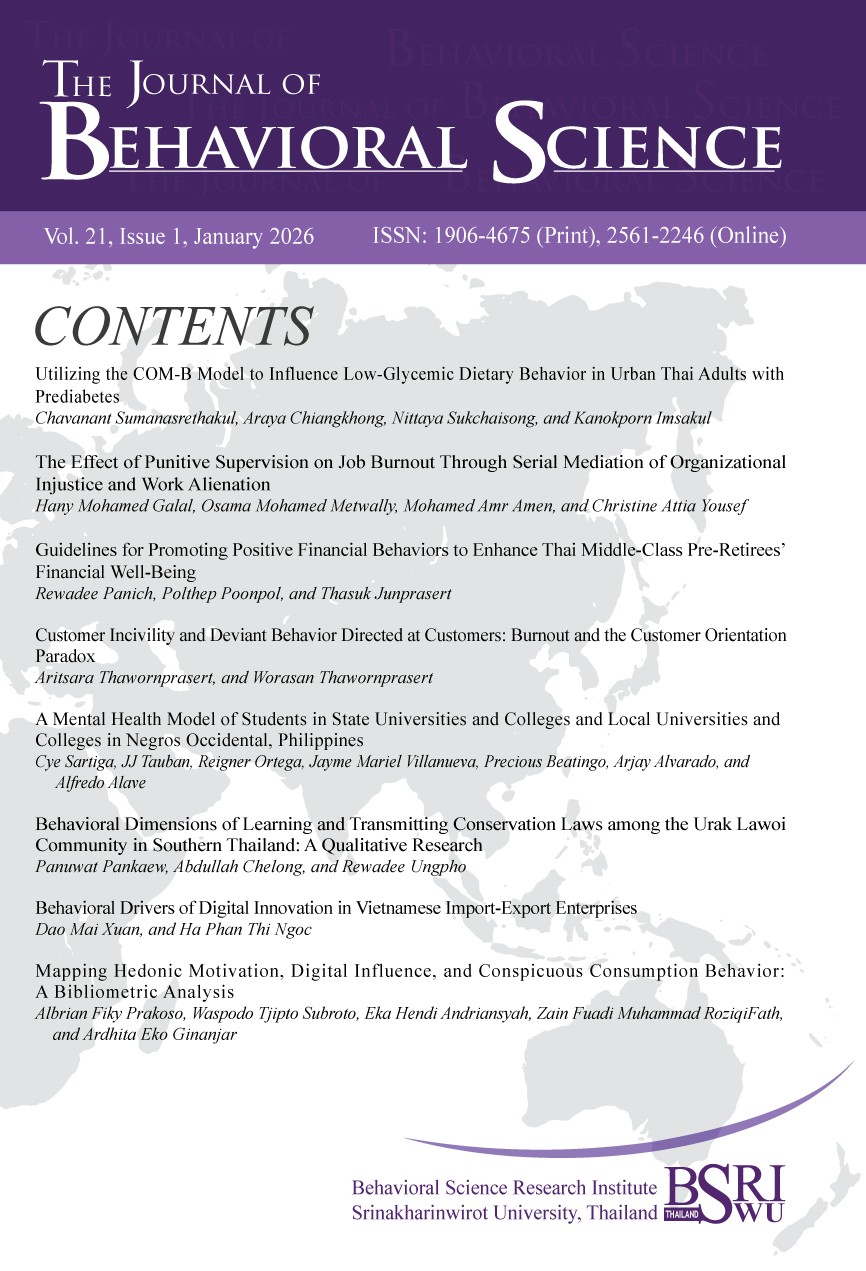
A Mental Health Model of Students in State Universities and Colleges and Local Universities and Colleges in Negros Occidental, Philippines
Article Sidebar
Main Article Content
Abstract
Background: The Philippine mental health act of 2018 reshaped the nation’s mental health care. Despite its global relevance, few studies examine factors affecting college mental health outcomes.
Objective: Based on Bronfenbrenner’s ecological systems theory, this study aims to develop a structural model illustrating the direct and indirect relationships between variables and mental health.
Design and Methodology: The study surveyed 510 randomly selected students from state and local universities in Philippines, employing a path model to examine relationships among the variables.
Results: The study found that mental health was significantly influenced by social support (β = .22, p < .001), academic stress (β = .21, p < .001), service accessibility (β = .18, p < .001), and campus policies (β = .16, p < .001). Mental health literacy directly influences help-seeking (β = .42, p < .001). Campus policies were influenced by mental health literacy (β = .16, p < .001) and service accessibility (β = .66, p < .001). Campus culture (β = .23, p < .001), service accessibility (β = .14, p < .001), academic stress (β = .15, p < .001), and mental health literacy (β = .13, p < .001) also influenced social support. Mental health literacy was negatively correlated with stigma (β = -.34, p < .001), while campus culture was positively linked to service accessibility (β = .39, p < .001). Mediator effect of campus policies and social support was confirmed.
Conclusion and Implications: These findings underscore the need for a systemic approach to mental health promotion in state universities, offering a framework to guide the development of supportive, well-being–oriented academic environments. Educational institutions are encouraged to promote mental health literacy programs aimed at reducing mental health stigma and actively promoting students’ willingness to seek help.
Downloads
Article Details

This work is licensed under a Creative Commons Attribution-NonCommercial-NoDerivatives 4.0 International License.
References
Acoba, E. F. (2024). Social support and mental health: The mediating role of perceived stress. Frontiers in Psychology, 15, 1330720. https://doi.org/10.3389/fpsyg.2024.1330720 DOI: https://doi.org/10.3389/fpsyg.2024.1330720
Awan, M., Boyce, M. A., & Lindsay, B. L. (2025). Mental health literacy and help-seeking: the mediating role of self-stigma and emotional intelligence. Frontier in Psychology, 16, 1589093. https://doi.org/10.3389/fpsyg.2025.1589093 DOI: https://doi.org/10.3389/fpsyg.2025.1589093
Aziz, N. A. A., Baharudin, N. S., & Alias, N. A. (2023). Association between stress and social support perceived among undergraduate health sciences student. Malaysian Journal of Medical Sciences, 30(3), 176–183. https://doi.org/10.21315/mjms2023.30.3.16 DOI: https://doi.org/10.21315/mjms2023.30.3.16
Barbayannis, G., Bandari, M., Zheng, X., Baquerizo, H., Pecor, K. W., & Ming, X. (2022). Academic stress and mental well-being in college students: Correlations, affected groups, and COVID-19. Frontiers in Psychology, 13, 886344. https://doi.org/10.3389/fpsyg.2022.886344 DOI: https://doi.org/10.3389/fpsyg.2022.886344
Bartolome, K. F., Lim, A. G., & Marinay, K. K. (2016). The help effect: Testing the moderating effects of compassion fatigue and help-seeking behavior among Filipino mental health responders [Bachelor’s thesis, De La Salle University]. Amino Repository. https://animorepository.dlsu.edu.ph/etd_bachelors/7905/
Bedewy, D., & Gabriel, A. (2015). Examining perceptions of academic stress and its sources among university students: The Perception of Academic Stress Scale. Health Psychology Open, 2(2), 2055102915596714. https://doi.org/10.1177/2055102915596714 DOI: https://doi.org/10.1177/2055102915596714
Bommersbach, T. J., Rosenheck, R. A., & Rhee, T. G. (2022). National trends of mental health care among US adults who attempted suicide in the past 12 months. JAMA Psychiatry, 79(3), 219–231. https://doi.org/10.1001/jamapsychiatry.2021.3958 DOI: https://doi.org/10.1001/jamapsychiatry.2021.3958
Broglia, E., Millings, A., & Barkham, M. (2017). Challenges to addressing student mental health in embedded counselling services: A survey of UK higher and further education institutions. British Journal of Guidance and Counselling, 46(4), 441–455. https://doi.org/10.1080/03069885.2017.1370695 DOI: https://doi.org/10.1080/03069885.2017.1370695
Bronfenbrenner, U. (1979). The ecology of human development: Experiments by nature and design. Harvard University Press. DOI: https://doi.org/10.4159/9780674028845
Byrd, D. R., & McKinney, K. J. (2012). Individual, interpersonal, and institutional level factors associated with the mental health of college students. Journal of American College Health, 60(3), 185–193. https://doi.org/10.1080/07448481.2011.584334 DOI: https://doi.org/10.1080/07448481.2011.584334
Campbell, F., Blank, L., Cantrell, A. J., Baxter, S., Blackmore, C., Dixon, J., & Goyder, E. (2022). Factors that influence mental health of university and college students in the UK: A systematic review. BMC Public Health, 22, 1778. https://doi.org/10.1186/s12889-022-13943-x DOI: https://doi.org/10.1186/s12889-022-13943-x
Carter, L. F. (1959). Proceedings of the sixty-seventh annual business meeting of the American Psychological Association, Inc.: Report of the recording secretary. American Psychologist, 14(12), 741–763. https://doi.org/10.1037/h0043919 DOI: https://doi.org/10.1037/h0043919
Çebi, E., & Demir, A. (2019). Help-seeking attitudes of university students in Turkey. International Journal for the Advancement of Counselling, 42(1), 37–47. https://doi.org/10.1007/s10447-019-09385-7 DOI: https://doi.org/10.1007/s10447-019-09385-7
Chan, K. K. S., & Tsui, J. K. C. (2023). Perceived stigma from mental health service providers and its adverse impact on service engagement and recovery among people with mental illness. American Journal of Orthopsychiatry, 93(5), 365–374. https://doi.org/10.1037/ort0000680 DOI: https://doi.org/10.1037/ort0000680
Eisenberg, D., Gollust, S. E., Golberstein, E., & Hefner, J. L. (2007). Prevalence and correlates of depression, anxiety, and suicidality among university students. American Journal of Orthopsychiatry, 77(4), 534–542. https://doi.org/10.1037/0002-9432.77.4.534 DOI: https://doi.org/10.1037/0002-9432.77.4.534
Engel, G. L. (1977). The need for a new medical model: A challenge for biomedicine. Science, 196(4286), 129–136. https://doi.org/10.1126/science.847460 DOI: https://doi.org/10.1126/science.847460
Espetvedt, M., Lyshol, H., & Johansen, R. (2017). Social support and the accessibility to and regular participation in various types of activities. European Journal of Public Health, 27(suppl_3). https://doi.org/10.1093/eurpub/ckx189.190 DOI: https://doi.org/10.1093/eurpub/ckx189.190
Gloria, A. M., & Kurpius, S. E. R. (1996). The validation of the cultural congruity scale and the university environment scale with Chicano/a students. Hispanic Journal of Behavioral Sciences, 18(4), 533–549. https://doi.org/10.1177/07399863960184007 DOI: https://doi.org/10.1177/07399863960184007
Hosek, S. G., Harper, G. W., Lemos, D., Martinez, J., & Adolescent Medicine Trials Network for HIV/AIDS Interventions. (2008). An ecological model of stressors experienced by youth newly diagnosed with HIV. Journal of HIV/AIDS Prevention in Children & Youth, 9(2), 192–218. https://doi.org/10.1080/15538340902824118 DOI: https://doi.org/10.1080/15538340902824118
Hunt, J., & Eisenberg, D. (2009). Mental Health Problems and Help-Seeking Behavior among college students. Journal of Adolescent Health, 46(1), 3–10. https://doi.org/10.1016/j.jadohealth.2009.08.008 DOI: https://doi.org/10.1016/j.jadohealth.2009.08.008
Jorm, A. F. (2012). Mental health literacy: Empowering the community to take action for better mental health. American Psychologist, 67(3), 231–243. https://doi.org/10.1037/a0025957 DOI: https://doi.org/10.1037/a0025957
Keyes, C. L. M. (2002). The mental health continuum: From languishing to flourishing in life. Journal of Health and Social Behavior, 43(2), 207. https://doi.org/10.2307/3090197 DOI: https://doi.org/10.2307/3090197
Keyes, C. L. M. (2005). Mental illness and/or mental health? Investigating axioms of the complete state model of health. Journal of Consulting and Clinical Psychology, 73(3), 539–548. https://doi.org/10.1037/0022-006x.73.3.539 DOI: https://doi.org/10.1037/0022-006X.73.3.539
Khan, A., Sriyanto, S., Baranovich, D. L., Tahir, L. M., Panatik, S. A., Sasmoko, S., Indrianti, Y., Hamid, M. A., Lukman, F., Van, N. T., & Jabor, M. K. (2023). The relationship between positive mental health, academic stress and suicide ideation among Malaysian adolescents residing in Johor Bahru. Current Psychology, 42, 15718–15726. https://doi.org/10.1007/s12144-022-02885-7 DOI: https://doi.org/10.1007/s12144-022-02885-7
Kline, R. B. (1998). Principles and practice of structural equation modeling. Guilford Press.
Kohoulat, N., Dehghani, M. R., & Kohoulat, N. (2015). Perceived school climate and students’ mental health. International Journal of School Health, 2(4), e27939. https://doi.org/10.17795/intjsh27939 DOI: https://doi.org/10.17795/intjsh27939
Komiya, N., Good, G. E., & Sherrod, N. B. (2000). Emotional openness as a predictor of college students’ attitudes toward seeking psychological help. Journal of Counseling Psychology, 47(1), 138–143. https://doi.org/10.1037/0022-0167.47.1.138 DOI: https://doi.org/10.1037//0022-0167.47.1.138
Lebowitz, B. D., & Niederehe, G. (1992). Concepts and issues in mental health and aging. In Handbook of mental health and aging (2nd ed., pp. 3–26). https://doi.org/10.1016/b978-0-12-101277-9.50005-x DOI: https://doi.org/10.1016/B978-0-12-101277-9.50005-X
Li, D., Ko, N., Chen, Y., Wang, P., Chang, Y., Yen, C., & Lu, W. (2020). COVID-19-Related Factors Associated with Sleep Disturbance and Suicidal Thoughts among the Taiwanese Public: A Facebook Survey. International Journal of Environmental Research and Public Health, 17(12), 4479. https://doi.org/10.3390/ijerph17124479 DOI: https://doi.org/10.3390/ijerph17124479
Lukat, J., Margraf, J., Lutz, R., van der Veld, W. M., & Becker, E. S. (2016). Positive mental health scale [Database record]. APA PsycTests. https://doi.org/10.1037/t74178-000 DOI: https://doi.org/10.1037/t74178-000
Luo, Y., Ma, T., & Deng, Y. (2023). School climate and adolescents’ prosocial behavior: the mediating role of perceived social support and resilience. Frontiers in Psychology, 14, 1095566. https://doi.org/10.3389/fpsyg.2023.1095566 DOI: https://doi.org/10.3389/fpsyg.2023.1095566
Manwell, L. A., Barbic, S. P., Roberts, K., Durisko, Z., Lee, C., Ware, E., & McKenzie, K. (2015). What is mental health? Evidence towards a new definition from a mixed methods multidisciplinary international survey. BMJ Open, 5(6), e007079. https://doi.org/10.1136/bmjopen-2014-007079 DOI: https://doi.org/10.1136/bmjopen-2014-007079
Monaghan, C., Linden, B., & Stuart, H. (2020). Postsecondary mental health policy in Canada: A scoping review of the grey literature. The Canadian Journal of Psychiatry, 66(7), 603–615. https://doi.org/10.1177/0706743720961733 DOI: https://doi.org/10.1177/0706743720961733
Mortier, P., Cuijpers, P., Kiekens, G., Auerbach, R. P., Demyttenaere, K., Green, J. G., Kessler, R. C., Nock, M. K., & Bruffaerts, R. (2017). The prevalence of suicidal thoughts and behaviours among college students: A meta-analysis. Psychological Medicine, 48(4), 554–565. https://doi.org/10.1017/s0033291717002215 DOI: https://doi.org/10.1017/S0033291717002215
O’Connor, M., & Casey, L. (2015). The Mental Health Literacy Scale (MHLS): A new scale-based measure of mental health literacy. Psychiatry Research, 229(1–2), 511–516. https://doi.org/10.1016/j.psychres.2015.05.064 DOI: https://doi.org/10.1016/j.psychres.2015.05.064
Özparlak, A., Karakaya, D., & Özer, Z. (2023). The association of mental health literacy with mental well-being and help-seeking in young people: A systematic review and meta-analysis. Journal of Pediatric Nursing, 73, e243–e250. https://doi.org/10.1016/j.pedn.2023.09.017 DOI: https://doi.org/10.1016/j.pedn.2023.09.017
Reis, A. C., Saheb, R., Moyo, T., Smith, C., & Sperandei, S. (2021). The impact of mental health literacy training programs on the mental health literacy of university students: A systematic review. Prevention Science, 23(4), 648–662. https://doi.org/10.1007/s11121-021-01283-y DOI: https://doi.org/10.1007/s11121-021-01283-y
Rodgers, L. S., & Tennison, L. R. (2009). A preliminary assessment of adjustment disorder among First-Year College students. Archives of Psychiatric Nursing, 23(3), 220–230. https://doi.org/10.1016/j.apnu.2008.05.007 DOI: https://doi.org/10.1016/j.apnu.2008.05.007
Roeser, R. W., Midgley, C., & Urdan, T. C. (1996). Perceptions of the school psychological environment and early adolescents’ psychological and behavioral functioning in school: The mediating role of goals and belonging. Journal of Educational Psychology, 88(3), 408–422. https://doi.org/10.1037/0022-0663.88.3.408 DOI: https://doi.org/10.1037/0022-0663.88.3.408
Saleem, S., Mahmood, Z., & Naz, M. (2013). Mental Health Problems in University Students: A Prevalence Study. FWU Journal of Social Sciences. https://researchmgt.monash.edu/ws/portalfiles/portal/660632963/3.Mental_Health_Problems_in_University.pdf
Samaniego, R. M. (2022). Mental health legislation in the Philippines. Taiwanese Journal of Psychiatry, 36(2), 51–58. https://doi.org/10.4103/tpsy.tpsy_13_22 DOI: https://doi.org/10.4103/TPSY.TPSY_13_22
Sheldon, E., Simmonds-Buckley, M., Bone, C., Mascarenhas, T., Chan, N., Wincott, M., Gleeson, H., Sow, K., Hind, D., & Barkham, M. (2021). Prevalence and risk factors for mental health problems in university undergraduate students: A systematic review with meta-analysis. Journal of Affective Disorders, 287, 282–292. https://doi.org/10.1016/j.jad.2021.03.054 DOI: https://doi.org/10.1016/j.jad.2021.03.054
Supreme Court E-Library. (2024). Republic act no. 12080, December 06, 2024. https://elibrary.judiciary.gov.ph/thebookshelf/showdocs/2/98130
Suwajo, T., Mungkornpanich, P., Patanapipat, P., Luksiri, P., Boontanaakrapat, P., Nititham, T., & Wainipitapong, S. (2024). Correlation of learning engagement and social support affecting the academic stress of Thai high school students. International Journal of Public Health Science (IJPHS), 13(3), 1095. https://doi.org/10.11591/ijphs.v13i3.23680 DOI: https://doi.org/10.11591/ijphs.v13i3.23680
Taylor, M. E., Liu, M., Abelson, S., Eisenberg, D., Lipson, S. K., & Schueller, S. M. (2024). The Reach, Effectiveness, adoption, implementation, and maintenance of digital mental health interventions for college Students: A Systematic review. Current Psychiatry Reports. https://doi.org/10.1007/s11920-024-01545-w DOI: https://doi.org/10.1007/s11920-024-01545-w
Torneo, A., & Roque, I. M. (2020). Exploring the impact of the Philippine Mental Health Law. The Lasallian. https://thelasallian.com/2020/01/24/exploring-the-impact-of-the-philippine-mental-health-law/
Torres, S. A. (2023). Number of students suffering from mental health issues growing. ABS-CBN News. https://www.abs-cbn.com/spotlight/01/31/23/number-of-students-suffering-from-mental-health-issues-growing
Wang, H., & Liu, Y. (2023). Influencing factors of Six Sigma management in the construction of students mental health service system in the post-COVID-19 era. International Journal of Lean Six Sigma, 15(3), 691–718. https://doi.org/10.1108/ijlss-02-2023-0034 DOI: https://doi.org/10.1108/IJLSS-02-2023-0034
Yani, D. I., Chua, J. Y. X., Wong, J. C. M., Pikkarainen, M., & Shorey, S. (2024). The Effects of Universal Educational Interventions in Improving Mental health Literacy, depression, and Anxiety among Adolescents: A Systematic Review and Meta‐Analysis. International Journal of Mental Health Nursing, 34(1). https://doi.org/10.1111/inm.13494 DOI: https://doi.org/10.1111/inm.13494
Yuhuan, Z., Pengyue, Z., Dong, C., Qichao, N., Dong, P., Anqi, S., Hongbo, J., & Zhixin, D. (2022). The association between academic stress, social support, and self-regulatory fatigue among nursing students: a cross-sectional study based on a structural equation modelling approach. BMC Medical Education, 22, 789. https://doi.org/10.1186/s12909-022-03829-2 DOI: https://doi.org/10.1186/s12909-022-03829-2
Zimet, G. D., Dahlem, N. W., Zimet, S. G., & Farley, G. K. (1988). The multidimensional scale of perceived social support. Journal of Personality Assessment, 52(1), 30–41. https://doi.org/10.1207/s15327752jpa5201_2 DOI: https://doi.org/10.1207/s15327752jpa5201_2
