
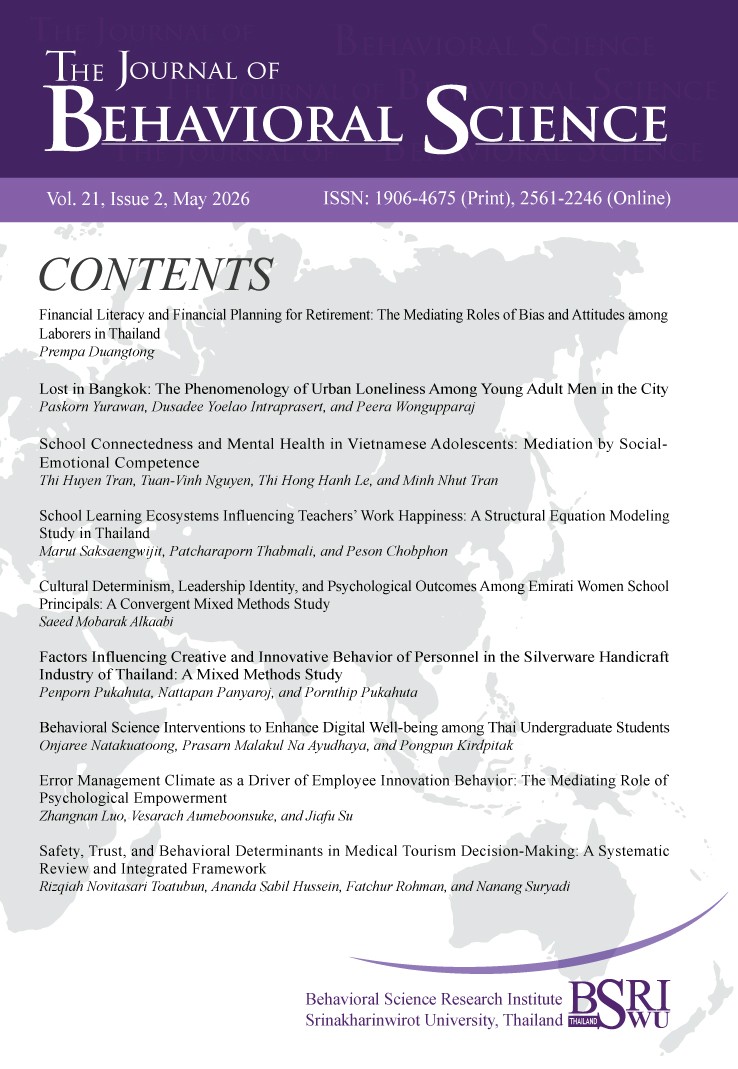
Factors Influencing Creative and Innovative Behavior of Personnel in the Silverware Handicraft Industry of Thailand: A Mixed Methods Study
Article Sidebar
Main Article Content
Abstract
Background/ problem: With the silverware handicraft sector is an important part of Thailand's cultural economy, employees’ inventiveness and creativity have become increasingly important for maintaining competitiveness. Previous studies have mostly concentrated on product design, paying little attention to how organizational and human factors interact to influence such behavior.
Objective/ purpose: This study aimed to 1) explore how organizational contexts and individual experiences shape creative and innovative behavior among personnel in the silverware handicraft industry; and
2) to examine the relationships among these factors.
Design and Methodology: This study employed an exploratory sequential mixed methods approach. In the qualitative phase, in-depth interviews were conducted with five experienced silverware entrepreneurs, which also informed instrument development for the quantitative phase. Data were collected from 214 employees and analyzed using multiple regression analysis.
Results: Qualitative findings revealed that creative and innovative behavior was shaped by leadership roles, organizational systems and policies, organizational climate and culture, employee competencies, and the work environment. Quantitative results showed strong interrelationships among organizational variables, prompting their integration into a higher-order construct—organizational context. Both organizational context (β = .21, p < .05) and individual attributes (β = .62, p < .05) had significant positive effects, with individual attributes the stronger predictor.
Conclusion and Implications: The findings support the interactionist perspective, showing that creative and innovative behavior arises from the interplay between individual capabilities and organizational conditions. For traditional craft industries, fostering innovation requires aligning supportive organizational contexts with personnel development through continuous learning and participatory practices.
Downloads
Article Details

This work is licensed under a Creative Commons Attribution-NonCommercial-NoDerivatives 4.0 International License.
References
Amabile, T. M., Conti, R., Coon, H., Lazenby, J., & Herron, M. (1996). Assessing the work environment for creativity. Academy of Management Journal, 39(5), 1154–1184. https://doi.org/10.2307/256995
Anderson, N., Potocnik, K., & Zhou, J. (2014). Innovation and creativity in organizations: A state-of-the-science review, prospective commentary, and guiding framework. Journal of Management, 40(5), 1297–1333. https://doi.org/10.1177/0149206314527128
Baer, M., & Frese, M. (2003). Innovation is not enough: Climates for initiative and psychological safety, process innovations, and firm performance. Journal of Organizational Behavior, 24(1), 45–68. https://doi.org/10.1002/job.179
Bandura, A. (1997). Self-efficacy: The exercise of control. Henry Holt and Company.
Bos-Nehles, A. C., & Veenendaal, A. A. R. (2019). Perceptions of HR practices and innovative work behavior: The moderating effect of an innovative climate. The International Journal of Human Resource Management, 30(18), 2661–2683. https://doi.org/10.1080/09585192.2017.1380680
Buranasaksathit, K., & Akkawanitcha, C. (2019). Innovative behavior of academic support staff at Rajabhat University Rattanakosin Group. Veridian E-Journal, Silpakorn University (Humanities, Social Sciences and Arts), 12(6), 138–152. https://he02.tci-thaijo.org/index.php/Veridian-E-Journal/article/view/201451 [in Thai]
Caesar Azeem, R. A., & Hanoum, S. (2024). Analyzing the impact of creative self-efficacy, leadership style, locus of control, and organizational culture on innovative work behavior and employee performance. Journal La Sociale, 5(2), 518–530. https://doi.org/10.37899/journal-la-sociale.v5i2.1096
Cochran, W. G. (1977). Sampling techniques (3rd ed.). John Wiley & Sons.
Creswell, J. W., & Plano Clark, V. L. (2011). Designing and conducting mixed methods research (2nd ed.). SAGE Publications.
De Jong, J. P. J., & Den Hartog, D. (2010). Measuring innovative work behaviour. Creativity and Innovation Management, 19(1), 23–36. https://doi.org/10.1111/j.1467-8691.2010.00547.x
De Jong, J. P. J., & Kemp, R. (2003). Determinants of co-workers’ innovative behaviour: An investigation into knowledge-intensive services. International Journal of Innovation Management, 7(2), 189–212. https://doi.org/10.1142/S1363919603000787
Elo, S., & Kyngäs, H. (2008). The qualitative content analysis process. Journal of Advanced Nursing, 62(1), 107–115. https://doi.org/10.1111/j.1365-2648.2007.04569.x
Gilar-Corbi, R., Perez-Soto, N., Izquierdo, A., Castejón, J. L., & Pozo-Rico, T. (2024). Emotional factors and self-efficacy in the psychological well-being of trainee teachers. Frontiers in Psychology, 15, 1434250. https://doi.org/10.3389/fpsyg.2024.1434250
Greene, J. C. (2007). Mixed methods in social inquiry. Jossey-Bass.
Guest, G., Bunce, A., & Johnson, L. (2006). How many interviews are enough? An experiment with data saturation and variability. Field Methods, 18(1), 59–82. https://doi.org/10.1177/1525822X05279903
Hair, J. F., Black, W. C., Babin, B. J., & Anderson, R. E. (2014). Multivariate data analysis (7th ed.). Pearson.
Isaksen, S. G. (2023). Assessing the work environment for creativity and innovation: Building on mathisen and einarsen’s review (2004). Creativity Research Journal, 35(2), 227–253. https://doi.org/10.1080/10400419.2022.2112837
Jameel, A., Guo, W., Hussain, A., & Kanwel, S. (2025). Enhancing innovative work behavior through transformational leadership in tourism and hospitality employees: The mediating role of intrinsic motivation and employee creativity. BMC Psychology, 13, 1018. https://doi.org/10.1186/s40359-025-03305-8
Kleysen, R. F., & Street, C. T. (2001). Toward a multi-dimensional measure of individual innovative behavior. Journal of Intellectual Capital, 2(3), 284–296. https://doi.org/10.1108/EUM0000000005660
Kunharming, Y., Boonanont, R., Sangngam, C., & Thongthammachart, Y. (2023). Upgrading and adding value to the silver handicraft businesses from local wisdom to a high-value creative economy of ban khlong toei, khlong lan district, kamphaeng phet province. Journal of Management Science Pibulsongkram Rajabhat University, 6(3), 1–15. https://so03.tci-thaijo.org/index.php/jmspsru/article/view/272289 [in Thai]
Lertpiromsuk, S., & Laohavichien, T. (2022). The influence of innovative organizational climate on innovative work behavior through workplace happiness: The moderating role of employee generation. Journal of Humanities and Social Sciences Thonburi University, 16(2), 135–146. https://so03.tci-thaijo.org/index.php/trujournal/article/view/255758 [in Thai]
Mahardika, G. Y., Yohana, C., & Fauzi, A. (2024). The role of creative self-efficacy on the proactive personality and self-leadership to innovative work behavior relationship. International Journal of Human Capital Management, 8(2), 49–60. https://doi.org/10.21009/IJHCM.08.02.4
Martinaityte, I., Sacramento, C., & Aryee, S. (2019). Delighting the customer: Creativity-oriented high-performance work systems, frontline employee creative performance, and customer satisfaction. Journal of Management, 45(2), 728–751. https://doi.org/10.1177/0149206316672532
Mutonyi, B. R., Slåtten, T., & Lien, G. (2020). Organizational climate and creative performance in the public sector. European Business Review, 32(4), 615–631. https://doi.org/10.1108/EBR-02-2019-0021
Panyaroj, N., Rattanawiboonsom, V., & Chayathatto, M. (2023). Important factors and characteristics of distinctive competencies of the silverware business in Thailand. Journal of Roi Kaensarn Academi, 8(8), 299–312. https://so02.tci-thaijo.org/index.php/JRKSA/article/view/262524 [in Thai]
Pitiniyomrot, N., Pooncharoen, N., & Sripha, A. (2018). Knowledge creation factors affecting the production of creative handicrafts in upper northern Thailand. Journal of Social Innovation and Lifelong Learning, 12(3), 59–76. https://so01.tci-thaijo.org/index.php/FEU/article/view/107646 [in Thai]
Podsakoff, P. M., MacKenzie, S. B., Lee, J. Y., & Podsakoff, N. P. (2003). Common method biases in behavioral research: A critical review of the literature and recommended remedies. Journal of Applied Psychology, 88(5), 879–903. https://doi.org/10.1037/0021-9010.88.5.879
Scott, S. G., & Bruce, R. A. (1994). Determinants of innovative behavior: A path model of individual innovation in the workplace. Academy of Management Journal, 37(3), 580–607. https://doi.org/10.2307/256701
Shalley, C. E., Zhou, J., & Oldham, G. R. (2004). The effects of personal and contextual characteristics on creativity: Where should we go from here? Journal of Management, 30(6), 933–958. https://doi.org/10.1016/j.jm.2004.06.007
Thailand Textile Institute. (2025, April). Export situation of Thai gems and jewelry: January–February 2025. Thailand Textile Institute. https://www.thaitextile.org/th/insign/detail.4556.1.0.html [in Thai]
The Gem and Jewelry Institute of Thailand. (2019). Annual report 2019. The Gem and Jewelry Institute of Thailand. https://git.or.th/en/about/13 [in Thai]
Tierney, P., & Farmer, S. M. (2002). Creative self-efficacy: Its potential antecedents and relationship to creative performance. Academy of Management Journal, 45(6), 1137–1148. https://doi.org/10.2307/3069429
Wang, Z. (2025). Linking innovative knowledge sharing and employees’ innovative behaviour: The mediating role of thriving at work. Knowledge Management Research & Practice, 23(1), 52–62. https://doi.org/10.1080/14778238.2023.2261411
Woodman, R. W., Sawyer, J. E., & Griffin, R. W. (1993). Toward a theory of organizational creativity. Academy of Management Review, 18(2), 293–321. https://doi.org/10.5465/amr.1993.3997517
Yu, P., He, A., Wang, Q., Li, Y., Hu, S., & Gao, Y. (2025). Psychological richness can enhance innovative behavior of Chinese college students: The chain mediating role of cognitive flexibility and creative self-efficacy. Frontiers in Psychology, 16, 1630873. https://doi.org/10.3389/fpsyg.2025.1630873
Yuliawati, A. K., Kamener, D., & Anggraini, F. (2025). The effect of inclusive leadership and intrinsic motivation on innovative work behavior: The mediating role of creative self-efficacy. Journal of Social Research, 4(8), 2097–2106. https://doi.org/10.55324/josr.v4i8.2736
