
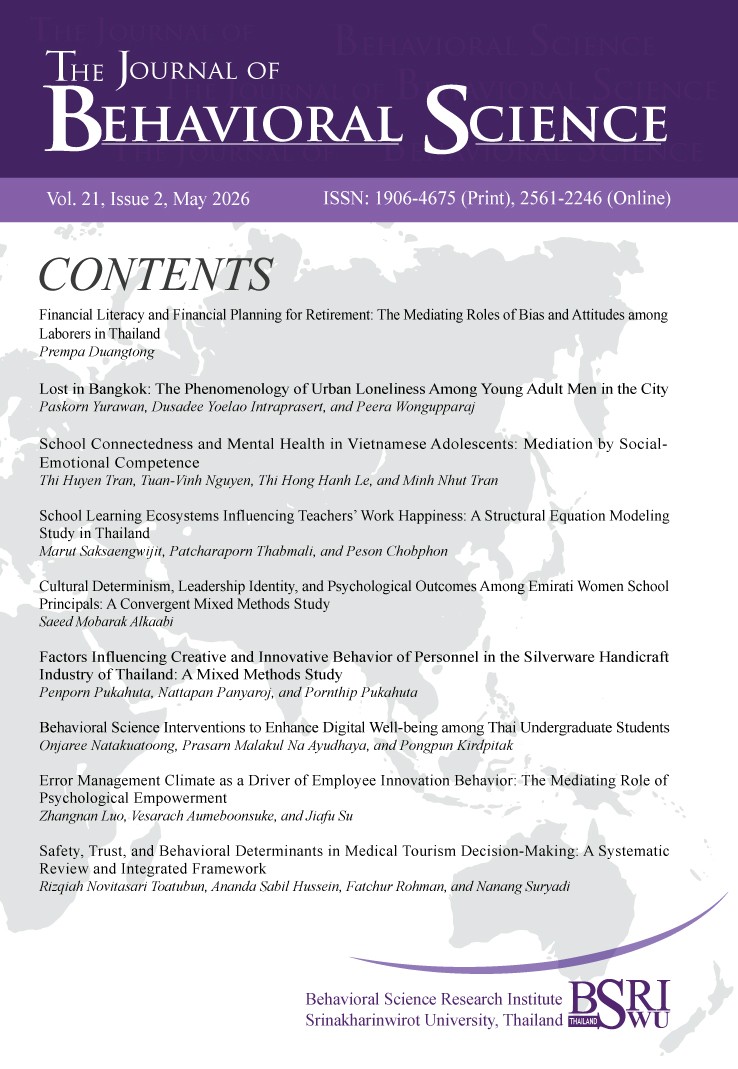
Financial Literacy and Financial Planning for Retirement: The Mediating Roles of Bias and Attitudes among Laborers in Thailand
Article Sidebar
Main Article Content
Abstract
Background/ problem: Many countries are becoming aging societies, making retirement planning a critical priority. However, limited financial literacy and financial bias hinder laborers' retirement planning, particularly in Thailand's Songkhla Province, which is characterized as a semi-urban, multicultural community and a major commercial center in southern Thailand.
Objective/ purpose: This study examines the relationship between financial literacy and retirement financial planning, with financial biases and attitudes as mediating variables.
Design and Methodology: Data were collected using a questionnaire administered through fieldwork from 400 formal and informal laborers from Songkhla Province in Thailand. The study used proportionate stratified sampling to collect data, which were then analyzed using structural equation modeling.
Results: Financial literacy did not significantly influence retirement financial planning (β = .17, p = .08), financial biases (β = −.66, p = .00), and financial attitudes (β = .45, p = .00). Financial biases negatively predicted retirement planning (β = −.42, p = .00) and mediated the effect of financial literacy (β = .28, p = .00), while financial attitudes positively affected retirement planning (β = .31, p = .00) and also served as a mediator (β = .14, p = .02).
Conclusion and Implications: This study integrates behavioral science and behavioral finance to show how financial literacy shapes attitudes and biases in retirement decisions. The findings highlight its role in improving retirement planning and reducing biases. However, financial literacy alone may be insufficient; thus, policies should promote positive financial attitudes and reduce behavioural biases to enhance effective retirement planning.
Downloads
Article Details

This work is licensed under a Creative Commons Attribution-NonCommercial-NoDerivatives 4.0 International License.
References
Ahamed, A. J., & Limbu, Y. B. (2024). Retirement planning: A moderated mediation model of cognitive beliefs, retirement planning attitude, and money availability. Financial Services Review, 32(2), 77–93. https://doi.org/10.61190/fsr.v32i2.3555
Ajzen, I. (1991). The theory of planned behavior. Organizational Behavior and Human Decision Processes, 50(2), 179–211. https://doi.org/10.1016/0749-5978(91)90020-T
Almansour, B. Y., Elkrghli, S., & Almansour, A. Y. (2023). Behavioral finance factors and investment decisions: A mediating role of risk perception. Cogent Economics & Finance, 11(2), 2239032. https://doi.org/10.1080/23322039.2023.2239032
Antoni, X. L., Saayman, M., & Vosloo, N. (2020). The relationship between financial literacy and retirement planning, Nelson Mandela Bay. International Journal of Business and Management Studies, 12(2), 579–593. https://sobiad.org/eJOURNALS/journal_IJBM/arhieves/IJBM_2020-2ek/xl-antoni.pdf
Baker, H. K., Kumar, S., Goyal, N., & Gaur, V. (2019). How financial literacy and demographic variables relate to behavioral biases. Managerial Finance, 45(1), 124–146. https://doi.org/10.1108/MF-01-2018-0003
Banthia, D., & Dey, S. K. (2022). Impact of financial knowledge, financial attitude and financial behaviour on financial literacy: Structural equitation modeling approach. Universal Journal of Accounting and Finance, 10(1), 327–337. https://doi.org/10.13189/ujaf.2022.100133
Baptista, S. M. J., & Dewi, A. S. (2021). The influence of financial attitude, financial literacy, and locus of control on financial management behavior. International Journal of Social Science and Business, 5(1), 93–98. https://doi.org/10.23887/ijssb.v5i1.31407
Boisclair, D., Lusardi, A., & Michaud, P. C. (2017). Financial literacy and retirement planning in Canada. Journal of pension economics & finance, 16(3), 277–296. https://doi.org/10.1017/S1474747215000311
Brislin, R. W. (1970). Back-translation for cross-cultural research. Journal of Cross-Cultural Psychology, 1(3), 185–216. https://doi.org/10.1177/135910457000100301
Dai, R. M., Kostini, N., & Tresna, P. W. (2021). The influence of financial attitude and financial literacy on behavioral finance: A study on leading small and medium enterprises in Cimahi City, Indonesia. Review of Integrative Business and Economics Research, 10(s1), 322–329. https://buscompress.com/uploads/3/4/9/8/34980536/riber_10-s1_27_u20-066_322-329.pdf
Elhussein, N. H. A., & Abdelgadir, J. N. A. (2020). Behavioral bias in individual investment decisions: Is it a common phenomenon in stock markets. International Journal of Financial Research, 11(6), 25–36. https://doi.org/10.5430/ijfr.v11n6p25.
Esomar, M. J. F., Sumiati, S., Wijayanti, R., & Aisjah, S. (2025). The mediating role of financial behavior on financial literacy/inclusion, and financial well-being among SMEs owners in Indonesian marine and fisheries industry. The Journal of Behavioral Science, 20(3), 106–119. https://doi.org/10.69523/tjbs.2025.287119
Goda, G. S., Levy, M. R., Manchester, C. F., Sojourner, A., Tasoff, J., & Xiao, J. (2023). Are retirement planning tools substitutes or complements to financial capability?. Journal of Economic Behavior & Organization, 214, 561–573. https://doi.org/10.1016/j.jebo.2023.08.001
Hair, J. F., Black, W. C., Babin, B. J., & Anderson, R. E. (2019). Multivariate data analysis (8th ed.). Cengage.
Ingale, K. K., & Paluri, R. A. (2025). Retirement planning–a systematic review of literature and future research directions. Management Review Quarterly, 75(1), 1–43. https://doi.org/10.1007/s11301-023-00377-x
Jalil, M. A., Razak, D. A., & Azam, S. F. (2013). Exploring factors influencing financial planning after retirement: Structural equation modeling approach. American Journal of Applied Sciences, 10(3), 270–279. https://doi.org/10.3844/ajassp.2013.270.279
Janposri, P. (2021). The role of financial literacy in retirement planning and wealth accumulation among self-employed Thai workers. Journal of Population & Social Studies, 29(1), 177–194. https://doi.org/10.25133/JPSSv292021.011
Jiang, Y., & Shimizu, S. (2025). Financial literacy may not directly drive investment participation or retirement planning in Japan. Frontiers in Behavioral Economics, 4, 1725333. https://doi.org/10.3389/frbhe.2025.1725333
Johnjun, A., & Supanut, A. (2022). Behavioral financial and loan repayment plan on student loan fund: Case study in borrower’s Pibulsongkram Rajabhat University. Rajapark Journal, 16(48), 234–248. https://so05.tci-thaijo.org/index.php/RJPJ/article/view/257975 [in Thai]
Kalmi, P., & Ruuskanen, O. P. (2018). Financial literacy and retirement planning in Finland. Journal of Pension Economics & Finance, 17(3), 335–362. https://doi.org/10.1017/S1474747217000270
Kartini, K., & Nahda, K. (2021). Behavioral biases on investment decision: A case study in Indonesia. The Journal of Asian Finance, Economics and Business, 8(3), 1231–1240. https://doi.org/10.13106/jafeb.2021
Ketkaew, C., Van Wouwe, M., Jorissen, A., Cassimon, D., Vichitthamaros, P., & Wongsaichia, S. (2022). Towards sustainable retirement planning of wageworkers in Thailand: A qualitative approach in behavioral segmentation and financial pain point identification. Risks, 10(1), 8. https://doi.org/10.3390/risks10010008
Lestari, S., Indyastuti, D. L., Alhamidi, A. F., & Pariyanti, E. (2025). Employee behavior, emotional factors, and financial performance: The moderating role of Islamic financial literacy among Indonesian MSMEs. The Journal of Behavioral Science, 20(2), 15–29. https://doi.org/10.69523/tjbs.2025.279354
Lusardi, A., & Mitchell, O. S. (2014). The economic importance of financial literacy: Theory and evidence. Journal of Economic Literature, 52(1), 5–44. https://doi.org/10.1257/jel.52.1.5
Mittal, S. K. (2022). Behavior biases and investment decision: Theoretical and research framework. Qualitative Research in Financial Markets, 14(2), 213–228. https://doi.org/10.1108/QRFM-09-2017-0085
Modigliani, F. (1966). The life cycle hypothesis of saving, the demand for wealth and the supply of capital. Social research, 33(2), 160–217. https://www.jstor.org/stable/40969831
Moko, W., Sudiro, A., & Kurniasari, I. (2022). The effect of financial knowledge, financial attitude, and personality on financial management behavior. International Journal of Research in Business & Social Science, 11(9), 184–192. https://doi.org/10.20525/ijrbs.v11i9.2210
Mudzingiri, C., Muteba Mwamba, J. W., & Keyser, J. N. (2018). Financial behavior, confidence, risk preferences and financial literacy of university students. Cogent Economics & Finance, 6(1), 1512366. https://doi.org/10.1080/23322039.2018.1512366
Mustafa, W. M. W., Islam, M. A., Asyraf, M., Hassan, M. S., Royhan, P., & Rahman, S. (2023). The effects of financial attitudes, financial literacy and health literacy on sustainable financial retirement planning: The moderating role of the financial advisor. Sustainability, 15(3), 2677. https://doi.org/10.3390/su15032677
Mustafa, W. M. W., Islam, M. A., Hassan, M. S., & Kassim, M. A. M. (2025). The dynamics of financial retirement planning: financial attitude, health literacy, and the role of financial advisors with financial literacy as a moderator. Journal of Financial Services Marketing, 30(1), 1–16. https://doi.org/10.1057/s41264-024-00296-2
National Statistical Office. (2025). The 2024 survey of the older persons in Thailand. Bangkok: Statistical forecasting division national statistical office, The government complex. https://www.nso.go.th/nsoweb/nso/survey_detail/iM?set_lang=en#gsc.tab=0 [in Thai]
Nguyen, L. T. M., Nguyen, P. T., Tran, Q. N. N., & Trinh, T. T. G. (2022). Why does subjective financial literacy hinder retirement saving? The mediating roles of risk tolerance and risk perception. Review of Behavioral Finance, 14(5), 627–645. https://doi.org/10.1108/RBF-03-2021-0036
Nunnally, J. C. (1978). Psychometric theory (2nd ed.). McGraw-Hill.
Ozen, E., & Ersoy, G. (2019). The impact of financial literacy on cognitive biases of individual investors. In Contemporary Issues in Behavioral Finance, 101, 77–95. https://doi.org/10.1108/S1569-375920190000101007
Provincial Labour Office Songkhla. (2024, May). Labour situation report and labour situation indicators of Songkhla Province: May 2024. Ministry of Labour, Thailand. https://songkhla.mol.go.th/news/รายงานสถานการณ์แรงงานและดัชนีชี้วัดภาวะแรงงานจังหวัดสงขลา-ประจำเดือนพฤษภาคม-2567 [in Thai]
Rahayu, F. S., Risman, A., Firdaus, I., & Haningsih, L. (2023). The behavioral finance of MSME in Indonesia: financial literacy, financial technology (fintech), and financial attitudes. International Journal of Digital Entrepreneurship and Business, 4(2), 95–107. https://doi.org/10.52238/ideb.v4i2.127
Ritika., Kishor, N. (2022). Development and validation of behavioral biases scale: A SEM approach. Review of Behavioral Finance, 14(2), 237–259. https://doi.org/10.1108/RBF-05-2020-0087
Sudirman, W. F. R., Syaipudin, M., Hasda, M., Priyatno, A. M., Mardiyah, S., & Zahara, A. (2025). Does investment literacy reduce the impact of investors' cognitive biases while investing? (role of gender difference). International Journal on Social Science, Economics and Art, 14(4), 457–466. https://ijosea.isha.or.id/index.php/ijosea/article/view/711
Tanuatmodjo, H., Nugraha, N., Disman, D., & Heryana, T. (2024). Behavioral bias in retirement planning: A literature review. In 8th Global Conference on Business, Management, and Entrepreneurship (GCBME 2023) (pp. 61–67). Atlantis Press. https://doi.org/10.2991/978-94-6463-443-3_10
Thaler, R. H. (2015). Misbehaving: The making of behavioral economics. W. W. Norton & Company.
Thaler, R. H. (2018). Nudge, not sludge. Science, 361(6401), 431–431. https://doi.org/10.1126/science.aau9241
Tomar, S., Baker, H. K., Kumar, S., & Hoffmann, A. O. (2021). Psychological determinants of retirement financial planning behavior. Journal of Business Research, 133, 432–449. https://doi.org/10.1016/j.jbusres.2021.05.007
World Bank. (2021). Aging and the labor market in Thailand. https://www.worldbank.org/en/country/thailand/publication/aging-and-the-labor-market-in-thailand
Xue, R., Gepp, A., O’Neill, T. J., Stern, S., & Vanstone, B. J. (2021). Financial literacy and financial strategies: The mediating role of financial concerns. Australian Journal of Management, 46(3), 437–465. https://doi.org/10.1177/0312896220940762
Yamane, T. (1967). Statistics: An introductory analysis (2nd ed). Harper & Row.
