
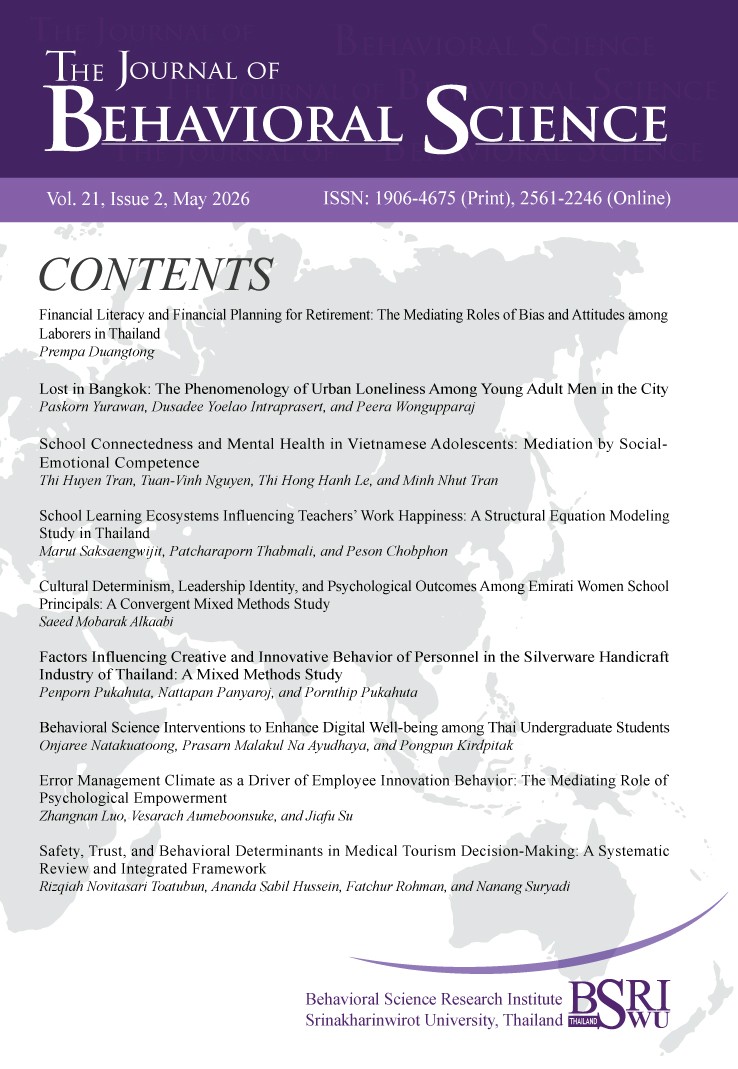
Behavioral Science Interventions to Enhance Digital Well-being among Thai Undergraduate Students
Article Sidebar
Main Article Content
Abstract
Background/problem: Digital technology has reshaped learning and daily life, while introducing risks for higher education such as addictive behaviors and mental health concerns. While global research has advanced digital well-being, integrated behavioral science interventions for undergraduates remain limited in Thailand.
Objective/purpose: This study aimed to (1) explore perceptions and institutional contexts of digital well‑being to design and validate a behavioral science intervention framework; (2) evaluate its effectiveness in improving students’ digital well‑being; and (3) compare experimental and control group outcomes across pretest, posttest, and follow‑up.
Design and Methodology: A mixed methods design was used. Focus groups (n = 30; 15 faculty, 15 undergraduates) guided the development of a seven-step behavioral science intervention. The program was delivered to 30 undergraduates over seven weeks via in-class sessions, online modules, and structured tasks. Quantitative evaluation used repeated measures ANOVA to assess changes in five digital well-being dimensions at a four-week follow-up, supported by classroom observations and student feedback.
Results: The experimental group showed significant improvements across all five dimensions versus the control group (F(1, 58) = 9.84, p < .001), with medium to large effect sizes (η² = .18–.32). Gains in self-regulation, reflective awareness, and collaborative engagement were sustained, with mean scores rising 15–22% from baseline; the control group showed minimal or declining outcomes.
Conclusion and Implications: A theory-driven, seven-step behavioral science framework enhanced undergraduate digital well-being, offering a scalable model to foster healthier digital habits and purposeful technology use in higher education.
Downloads
Article Details

This work is licensed under a Creative Commons Attribution-NonCommercial-NoDerivatives 4.0 International License.
References
Bach, A., & Thiel, F. (2024). Collaborative online learning in higher education—quality of digital interaction and associations with individual and group-related factors. Frontiers in Education, 9, 1356271. https://doi.org/10.3389/feduc.2024.1356271
Bandura, A. (1986). Social foundations of thought and action: A social cognitive theory. Prentice Hall.
Bandura, A. (1997). Self-efficacy: The exercise of control. W. H. Freeman.
Beck, A. T. (1976). Cognitive therapy and the emotional disorders. International Universities Press.
Büchi, M. (2024). Digital well-being theory and research. New Media & Society, 26(1), 172–189. https://doi.org/10.1177/14614448211056851
Burr, C., Taddeo, M., & Floridi, L. (2020). The ethics of digital well-being: A thematic review. Science and Engineering Ethics, 26(4), 2313–2343. https://doi.org/10.1007/s11948-020-00175-8
Chareonwanit, S., & Charoenwanit, E. (2020). Differentiation of stress and depressive symptoms between university students with either addictive or non-addictive smartphone behavior. Songklanakarin Journal of Science and Technology, 42(3), 714–720. https://doi.org/10.14456/SJST-PSU.2020.90
Chevacharoen, P. (2023). Exploring the impact of ICT integration on student learning outcomes in Thailand: A scoping review [Doctoral thesis, Thammasat University]. https://doi.org/10.14457/TU.the.2023.1168
Creswell, J. W., & Plano Clark, V. L. (2017). Designing and conducting mixed methods research (3rd ed.). Sage.
Creswell, J. W., & Creswell, J. D. (2023). Research design: Qualitative, quantitative, and mixed methods approaches (6th ed.). Sage.
Diener, E., Suh, E. M., Lucas, R. E., & Smith, H. L. (1999). Subjective well-being: Three decades of progress. Psychological Bulletin, 125(2), 276–302. https://doi.org/10.1037/0033-2909.125.2.276
Haleem, A., Javaid, M., Qadri, M. A., & Suman, R. (2022). Understanding the role of digital technologies in education: A review. Sustainable Operations and Computers, 3, 275–285. https://doi.org/10.1016/j.susoc.2022.05.004
Hattie, J., & Timperley, H. (2007). The power of feedback. Review of Educational Research, 77(1), 81–112. https://doi.org/10.3102/003465430298487
Janschitz, G., & Penker, M. (2022). How digital are digital natives actually? Developing an instrument to measure the degree of digitalisation of university students – the DDS-Index. Bulletin de Méthodologie Sociologique, 153, 127–159. https://doi.org/10.1177/07591063211061760
Johnson, D. W., & Johnson, R. T. (2009). An educational psychology success story: Social interdependence theory and cooperative learning. Educational Researcher, 38(5), 365–379. https://doi.org/10.3102/0013189X09339057
Kaewpradit, K., Ngamchaliew, P., & Buathong, N. (2025). Digital screen time usage, prevalence of excessive digital screen time, and its association with mental health, sleep quality, and academic performance among Southern University students. Frontiers in Psychiatry, 16, 1535631. https://doi.org/10.3389/fpsyt.2025.1535631
Klussman, K., Curtin, N., Langer, J., & Nichols, A. L. (2022). The importance of awareness, acceptance, and alignment with the self: A framework for understanding self-connection. Europe's Journal of Psychology, 18(1), 120–131. https://doi.org/10.5964/ejop.3707
Li, X., Li, Y., Wang, R., & Li, J. (2024). Exploring fluctuations in collaborative engagement: How do cognitive and socio emotional interaction intertwine in online collaborative learning? Educational Technology Research and Development, 72(6), 3021–3045. https://doi.org/10.1007/s11423-024-10386-6
Lissitsa, S., & Chachashvili-Bolotin, S. (2016). Life satisfaction in the internet age – Changes in the past decade. Computers in Human Behavior, 54, 197–206. https://doi.org/10.1016/j.chb.2015.08.001
Livingstone, S., & Stoilova, M. (2021). The 4Cs: Classifying online risk to children (CO:RE Short Report Series on Key Topics). Leibniz-Institut für Medienforschung | Hans-Bredow-Institut (HBI). https://doi.org/10.21241/ssoar.71817
McCarney, R., Warner, J., Iliffe, S., van Haselen, R., Griffin, M., & Fisher, P. (2007). The Hawthorne Effect: A randomised, controlled trial. BMC Medical Research Methodology, 7, 30. https://doi.org/10.1186/1471-2288-7-30
Ministry of Higher Education, Science, Research and Innovation [MHESI]. (2021). Higher education, science, research and innovation policy and strategy framework 2023–2027. https://www.mhesi.go.th/index.php/all-media/book-ministry/8485-2564-2570-2566-2570.html [in Thai]
OECD. (2021). Measuring well-being and progress. Organisation for Economic Co-operation and Development. https://www.oecd.org/en/topics/measuring-well-being-and-progress.html
Orak, C., & Saritepeci, M. (2024). Predictors of problematic social media use among university students: virtual world risk perception, social influence, and internet and social media use patterns. Current Psychology, 43, 5626–5639. https://doi.org/10.1007/s12144-023-04741-8
Pokao, S., Sangrung, K., & Thepsumroeng, A. (2025). A comparative study of adaptation, well-being, and learning management in the era of digital disruption after COVID-19 in Thai educational institutions. Journal of Public and Private Management, 32(1), 15–32. https://doi.org/10.14456/ppm.2025.2
Prochaska, J. O., & DiClemente, C. C. (1983). Stages and processes of self change of smoking: Toward an integrative model of change. Journal of Consulting and Clinical Psychology, 51(3), 390–395. https://doi.org/10.1037/0022-006X.51.3.390
Renjith, R., & Arundev, P. R. (2024). Exploring the interplay of digital addiction and academic performance: A regression analysis approach. Educational Administration: Theory and Practice, 30(5), 2946–2949. https://doi.org/10.53555/kuey.v30i5.3370
Ryan, R. M., & Deci, E. L. (2000). Self determination theory and the facilitation of intrinsic motivation, social development, and well-being. American Psychologist, 55(1), 68–78. https://doi.org/10.1037/0003-066X.55.1.68
Ryan, R. M., & Deci, E. L. (2017). Self determination theory: Basic psychological needs in motivation, development, and wellness. Guilford Press.
Srivastava, S. (2025). Collaborative learning in digital environment. International Journal of Research and Analytical Reviews, 12(1), 392–404. https://ijrar.org/viewfull.php?&p_id=IJRAR25A1174
Sun, H., Yuan, C., Qian, Q., He, S., & Luo, Q. (2022). Digital resilience among individuals in school education settings: A concept analysis based on a scoping review. Frontiers in Psychiatry, 13, 858515. https://doi.org/10.3389/fpsyt.2022.858515
Tang, H., Huang, J., & Yan, Y. (2025). Digital transformation in higher education: Logical framework, practical dilemmas, and implementation approaches. Frontiers in Psychology, 16, 1565591. https://doi.org/10.3389/fpsyg.2025.1565591
Thianthai, C., & Tamdee, P. (2024). Understanding digital well-being and insights from technological impacts on university students' everyday lives in Bangkok. Journal of Health Research, 38(2), 137–145. https://doi.org/10.56808/2586-940X.1069
Zimmerman, B. J. (2002). Becoming a self regulated learner: An overview. Theory Into Practice, 41(2), 64–70. https://doi.org/10.1207/s15430421tip4102_2
