
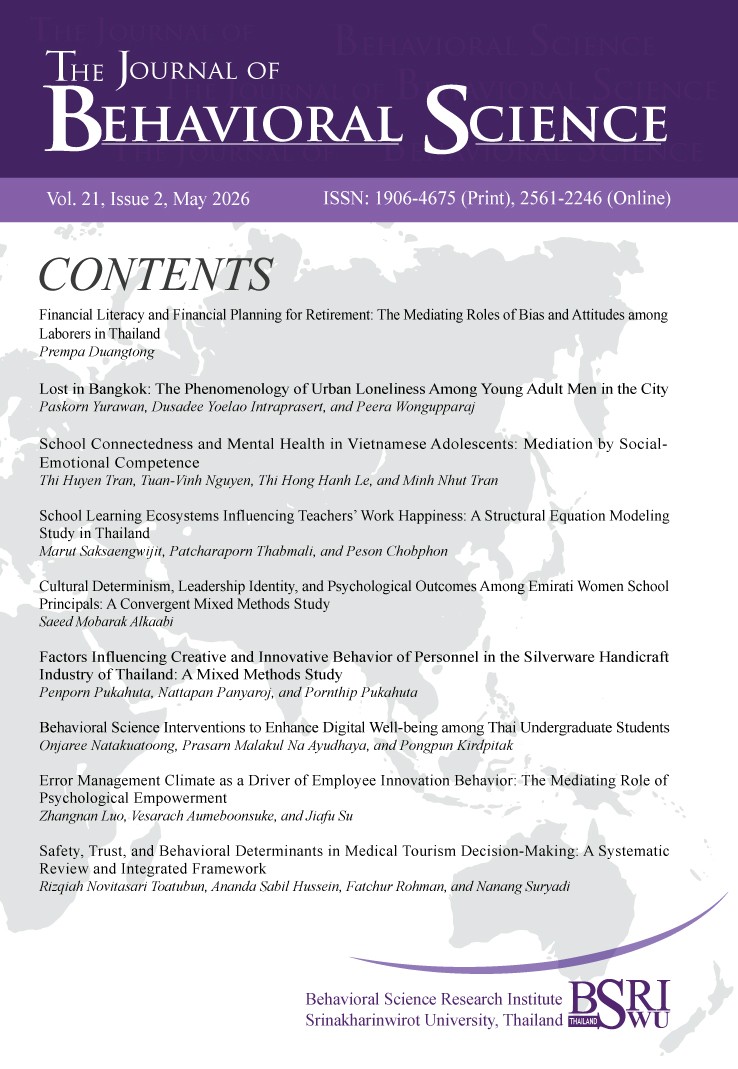
School Learning Ecosystems Influencing Teachers’ Work Happiness: A Structural Equation Modeling Study in Thailand
Article Sidebar
Main Article Content
Abstract
Background: Teachers’ work happiness is important for effective teaching and student learning. In Thailand, teachers have faced increasing professional demands due to ongoing educational reform and the integration of digital technologies in schools. However, research remains fragmented, and few studies in Thailand have examined whether these influences vary by school size.
Objective: This study aimed to (1) develop and test a causal model of the school learning ecosystem influencing teachers’ work happiness; and (2) examine differences by school size using multi-group SEM.
Design and Methodology: Data were collected from 913 teachers and school administrators in Thailand using a five-point Likert-scale questionnaire through multistage stratified random sampling. Analyses in Mplus included CFA, SEM, and multi-group SEM.
Results: The measurement model showed excellent fit [(χ² (199) = 517.39, CFI = .97, TLI = .96, RMSEA = .04, SRMR = .04)]. The SEM results indicated that learning and collaborative culture and stability and professional development significantly influenced teachers’ work happiness. The multi-group model also showed acceptable fit (χ² (898) = 1495.87, CFI = .95, TLI = .94, RMSEA = .05, SRMR = .08). Stability and professional development had a significant effect across all school sizes, while the effect of learning and collaborative culture varied by school size.
Conclusion and Implications: The school learning ecosystem provides an integrated explanation of teachers’ work happiness. Strengthening teachers’ stability, professional growth, and collaborative learning culture may help sustain teachers’ work happiness, enhance teacher well-being, and inform school development and teacher support policies in Thailand.
Downloads
Article Details

This work is licensed under a Creative Commons Attribution-NonCommercial-NoDerivatives 4.0 International License.
References
Abu-Tineh, A. M., Romanowski, M. H., Chaaban, Y., Alkhatib, H., Ghamrawi, N., & Alshaboul, Y. M. (2023). Career advancement, job satisfaction, career retention, and other related dimensions for sustainability: A perception study of Qatari public school teachers. Sustainability, 15(5), 4370. https://doi.org/10.3390/su15054370
Bronfenbrenner, U. (1979). The ecology of human development: Experiments by nature and design. Harvard University Press.
Buonomo, I., Fiorilli, C., & Benevene, P. (2020). Unravelling teacher job satisfaction: The contribution of collective efficacy and emotions towards professional role. International Journal of Environmental Research and Public Health, 17(3), 736. https://doi.org/10.3390/ijerph17030736
Butket, W., & Onsamphan, S. (2020). Organization culture and happy workplace of teachers in school under the Secondary Educational Service Area Office 9. Journal of Arts Management, 4(3), 747–760. https://so02.tci-thaijo.org/index.php/jam/article/view/243407 [In Thai]
Canrinus, E. T., Helms-Lorenz, M., Beijaard, D., Buitink, J., & Hofman, A. (2012). Self-efficacy, job satisfaction, motivation and commitment: Exploring the relationships between indicators of teachers’ professional identity. European Journal of Psychology of Education, 27, 115–132. https://doi.org/10.1007/s10212-011-0069-2
Cascio, W. F. (2019). Managing human resources: Productivity, quality of work life, profits. McGraw-Hill Education.
Civís Zaragoza, M., & Díaz-Gibson, J. (2024). Exploring educational ecosystems: insights from the implementation of SchoolWeavers tool in Catalonia. International Journal of Leadership in Education, 1–19. https://doi.org/10.1080/13603124.2024.2418605
Damsawang, K., Masantiah, C., & Panidvadtana, P. (2022). A study of happiness at work of teachers under the Secondary Educational Service Area Office Bangkok 1 under the situation of Corona Virus Disease 2019 (COVID-19) pandemic. Journal of Legal Entity Management and Local Innovation, 8(10), 196–208. https://so04.tci-thaijo.org/index.php/jsa-journal/article/view/257928 [In Thai]
Day, C., & Gu, Q. (2010). The new lives of teachers. Routledge. https://doi.org/10.4324/9780203847909
Day, C., & Sammons, P. (2016). Successful school leadership. Education Development Trust. https://files.eric.ed.gov/fulltext/ED565740.pdf
De Jong, L. (2021). Teacher professional learning and collaboration in secondary schools (Doctoral dissertation, Leiden University). Leiden University Graduate School of Teaching (ICLON).
Donsri, P., & Mahasinpaisan, T. (2024). The communication patterns in school affecting the teacher work motivation in the secondary educational service area office Bangkok 1. Journal of MCU Ubon Review, 9(3), 1220–1234. https://so06.tci-thaijo.org/index.php/mcjou/article/view/275561/ [In Thai]
Dziuba, S. T., Ingaldi, M. & Zhuravskaya, M. (2020). Employees’ job satisfaction and their work performance as elements influencing work safety. System Safety: Human - Technical Facility - Environment, 2(1), 18-25. https://doi.org/10.2478/czoto-2020-0003
Economist Impact. (2022). The learning ecosystems framework. The economist group. https://cdn.vev.design/private/BCwBc9ZFZyVz8yQQKr9VeLxSnjf1/mMv3dnzecY_Economist%20Impact_Learning%20Ecosystems_Whitepaper.pdf.pdf
Goestjahjanti, F. S., Novitasari, D., Hutagalung, D., Asbari, M., & Supono, J. (2020). Impact of talent management, authentic leadership and employee engagement on job satisfaction: Evidence from south east Asian industries. Journal of Critical Reviews, 7(19), 67–88. https://jcreview.com/archives/volume-7/issue-19/726
Hannon, V., Patton, A., & Temperley, J. (2011). Developing an innovation ecosystem for education. Innovation Unit for Global Education; Cisco Systems. https://cdn.auckland.ac.nz/assets/education/about/learning-change-networks/GELP%20Ecosystems.pdf
Hargreaves, A., & Fullan, M. (2012). Professional capital: Transforming teaching in every school. Teachers College Press.
Li, J., Xue, E., & Liu, Y. (2024). The chain mediating role of teacher job stress in the influence of distributed school leadership on job satisfaction: Evidence from China, the United States, England, and Australia. Behavioral Sciences, 14(4), 279. https://doi.org/10.3390/bs14040279
Liu, Y., Bellibaş, M. Ş., & Gümüş, S. (2021). The effect of instructional leadership and distributed leadership on teacher self-efficacy and job satisfaction: Mediating roles of supportive school culture and teacher collaboration. Educational Management Administration & Leadership, 49(3), 430–453. https://doi.org/10.1177/1741143220910438
Ma, X., & Marion, R. (2025). Linking distributed leadership to teacher job satisfaction in China: Mediating roles of teacher well-being and work motivation. Educational Management Administration & Leadership. https://doi.org/10.1177/17411432241303299
Ministry of Education. (2024). Annual report 2024. https://bic.moe.go.th/images/stories/pdf/BIC_MOE_Annual_Report_2567_final.pdf [in Thai]
Ministry of Education. (2021, February 17). Announcement on the determination and amendment of Secondary Educational Service Areas. Royal Thai Government Gazette, 138(38 Ng), 4. https://www.ratchakitcha.soc.go.th/DATA/PDF/2564/E/038/T_0004.PDF [In Thai]
Nguyen, L. T., & Tuamsuk, K. (2022). Digital learning ecosystem at educational institutions: A content analysis of scholarly discourse. Cogent Education, 9(1), 2111033. https://doi.org/10.1080/2331186X.2022.2111033
OECD. (2025). Results from TALIS 2024: The state of teaching. OECD Publishing, https://doi.org/10.1787/90df6235-en
Ortan, F., Șimșuț, C., & Șimșuț, R. (2021). Self-efficacy, job satisfaction and teacher well-being in the K-12 educational system. International Journal of Environmental Research and Public Health, 18(23), 12763. https://doi.org/10.3390/ijerph182312763
Phaet-udom, P., Kaewmongkol, S., & Raksanakorn, K. (2024). Factors affecting teachers’ happiness at work in educational institutions under the Trat Primary Educational Service Area Office. Journal of MCU Social Development, 9(3), 293–305. https://so06.tci-thaijo.org/index.php/JMSD/article/view/279055 [In Thai]
Prikjumroon, S. (2024). Teacher happiness: The key to the success of education management. Journal of Educational Review Faculty of Education in MCU, 11(2), 691–702. https://so02.tci-thaijo.org/index.php/EDMCU/article/view/269650 [In Thai]
Sahito, Z., & Schotten, M. (2020). A literature review on teachers' job satisfaction in developing countries: Recommendations and solutions for the enhancement of the job. Review of Education, 8(1), 3–34. https://doi.org/10.1002/rev3.3159
Singh, N., & Loh, S. C. (2024). Role of professional learning communities in improving teachers’ job satisfaction: Why does trust in colleagues and emotional intelligence matter? International Journal of Leadership in Education, 1–24. https://doi.org/10.1080/13603124.2024.2342293
Sriyotha, I., & Sawangmek, T. (2024). Factors of organizational climate affecting happiness at work under the secondary educational service area office Kamphang Phet. Journal of MCU Ubon Review, 9(2), 1406–1416. https://so06.tci-thaijo.org/index.php/mcjou/article/view/274436/ [In Thai]
Stoll, L., Bolam, R., McMahon, A., Wallace, M., & Thomas, S. (2006). Professional learning communities: A review of the literature. Journal of Educational Change, 7(4), 221–258. https://doi.org/10.1007/s10833-006-0001-8
Tank, S., Tank, B. K., & Kuchhal, V. C. (2021). Investigating the impact of technology integration on teacher job satisfaction and retention in elementary schools: A human resource management perspective. Elementary Education Online, 20(6), 6694–6704. https://ilkogretim-online.org/index.php/pub/article/view/8210
Thongbaion, T., & Charoenkul, N. (2022). Guidelines for enhancing happiness at workplace for teachers under Samutsakorn Primary Educational Service Area Office. OJED, 17(1), Article OJED-17-01-030. https://doi.nrct.go.th/admin/doc/doc_622419.pdf [In Thai]
Tu, L., Rao, Z., Jiang, H., & Dai, L. (2025). Technostress, burnout, and job satisfaction: An empirical study of STEM teachers’ well-being and performance. Behavioral Sciences, 15(7), 992. https://doi.org/10.3390/bs15070992
Väljataga, T., Poom-Valickis, K., Rumma, K., & Aus, K. (2020). Transforming higher education learning ecosystem: Teachers’ perspective. Interaction Design and Architecture(s) Journal (IxD&A), 46, 47–69. https://doi.org/10.55612/s-5002-046-003
Vescio, V., Ross, D., & Adams, A. (2008). A review of research on the impact of professional learning communities on teaching practice and student learning. Teaching and Teacher Education, 24(1), 80–91. https://doi.org/10.1016/j.tate.2007.01.004
Walcutt, J. J., & Schatz, S. (2019). Modernizing learning: Building the future learning ecosystem. Advanced Distributed Learning Initiative.
Xu, Z., Weng, W., Hu, X., & Luo, W. (2025). Comparative analysis of collaborative impacts on teacher job satisfaction: A cross-cultural study between the United States and China. Research in Comparative and International Education, 20(1), 145–166. https://doi.org/10.1177/17454999251313599
Yang, D., Liu, J., Wang, H., Chen, P., Wang, C., & Metwally, A. H. S. (2025). Technostress among teachers: A systematic literature review and future research agenda. Computers in Human Behavior, 168, 108619. https://doi.org/10.1016/j.chb.2025.108619
Zhang, J., & Yuan, R. (2020). How can professional learning communities influence teachers’ job satisfaction? A mixed-method study in China. Teachers and Teaching, 26(3–4), 229–247. https://doi.org/10.1080/13540602.2020.1806049
