
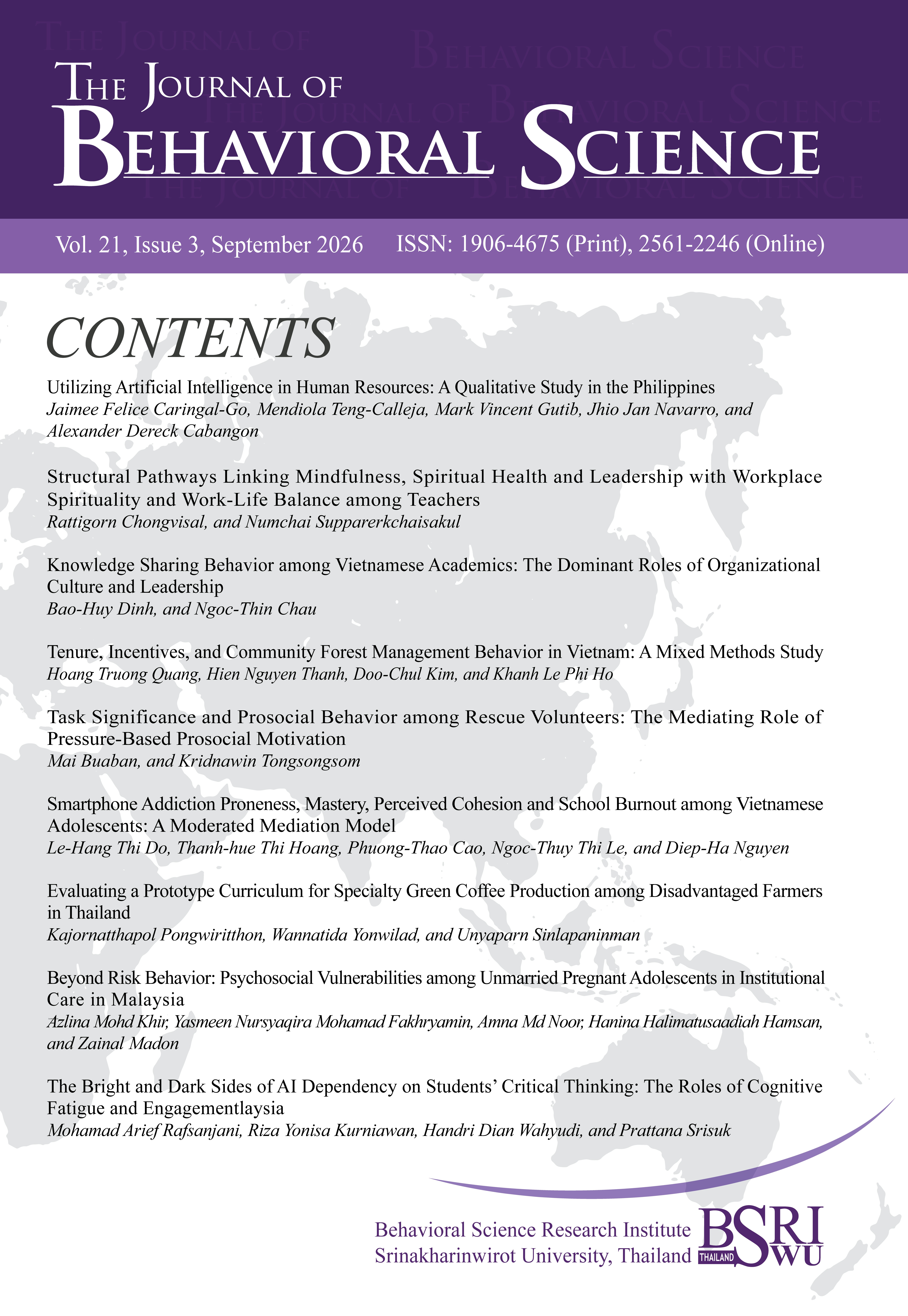
Tenure, Incentives, and Community Forest Management Behavior in Vietnam: A Mixed Methods Study
Article Sidebar
Main Article Content
Abstract
Background/problem: Community forest management depends on institutional arrangements that shape participation, incentives, and long-term stewardship. In Vietnam, community forest allocation and forest protection contracting create contrasting governance conditions.
Objective/purpose: The qualitative objective was to examine how tenure, decision authority, incentives, benefit sharing, and participation differed across the two arrangements. The quantitative objective was to assess household perceptions of protection and long-term forest-development activities under forest protection contracting.
Design and Methodology: An exploratory sequential mixed methods comparative case-study design was used. Phase 1 comprised field observations, six focus group discussions, and eight key informant interviews. Findings informed Phase 2, a survey of 89 respondents using nine Likert-type perception items. The strands were integrated through a joint display based on Ostrom’s common-pool resource principles and adaptive co-management.
Results: Community forest allocation cases showed more secure rights, greater local decision authority, and broader long-term management activities, whereas forest protection contracting concentrated participation on assigned protection duties. Quantitatively, 93% of respondents disagreed that patrols were insufficient, 91% disagreed that illegal exploitation had increased, and 89% agreed that no forest-enrichment activities had been undertaken. Household economic status differed between communes, p < .001. Integrated findings converged on a distinction between favorable perceptions of routine protection and limited long-term forest development under short-term contracting.
Conclusion and Implications: More secure rights, meaningful local decision-making, equitable benefits, and expectations of future gains were associated with stronger conditions for long-term stewardship. Policies should combine protection incentives with inclusive participation, longer-term rights, and local decision authority.
Downloads
Article Details

This work is licensed under a Creative Commons Attribution-NonCommercial-NoDerivatives 4.0 International License.
References
Agresti, A. (2019). An introduction to categorical data analysis (3rd ed.). Wiley.
Armitage, D., Berkes, F., & Doubleday, N. (Eds.). (2007). Adaptive co-management: Collaboration, learning, and multi-level governance. UBC Press.
Armitage, D. R., Plummer, R., Berkes, F., Arthur, R. I., Charles, A. T., Davidson-Hunt, I. J., Diduck, A. P., Doubleday, N. C., Johnson, D. S., Marschke, M., McConney, P., Pinkerton, E. W., & Wollenberg, E. K. (2009). Adaptive co-management for social–ecological complexity. Frontiers in Ecology and the Environment, 7(2), 95–102. https://doi.org/10.1890/070089
Bayrak, M. M. (2019). State of forest governance in Vietnam: Where are the local communities? In H. James (Ed.), Population, development, and the environment: Challenges to achieving the Sustainable Development Goals in the Asia Pacific (pp. 273–295). Palgrave Macmillan. https://doi.org/10.1007/978-981-13-2101-6_16
Blomley, T., Pfliegner, K., Isango, J., Zahabu, E., Ahrends, A., & Burgess, N. D. (2008). Seeing the wood for the trees: An assessment of the impact of participatory forest management on forest condition in Tanzania. Oryx, 42(3), 380–391. https://doi.org/10.1017/S0030605308071433
Bray, D. B., Merino-Pérez, L., & Barry, D. (Eds.). (2005). The community forests of Mexico: Managing for sustainable landscapes. University of Texas Press.
Braun, V., & Clarke, V. (2006). Using thematic analysis in psychology. Qualitative Research in Psychology, 3(2), 77–101. https://doi.org/10.1191/1478088706qp063oa
Braun, V., & Clarke, V. (2021). Thematic analysis: A practical guide. SAGE.
Childress, M., Kukkonen, M., Berning, C., Huntington, H., Lisher, J., Lindsay, J., & Setyowati, A. B. (2025). Good practices for strengthening land rights recognition in forestlands of the East Asia and Pacific Region. World Bank. https://hdl.handle.net/10986/43139
Creswell, J. W., & Plano Clark, V. L. (2018). Designing and conducting mixed methods research (3rd ed.). SAGE Publications.
Dinh, H. H., & Wesseler, J. (2024). Decentralization of Vietnam’s forestlands: The policy process and impact. Land Use Policy, 143, 107194. https://doi.org/10.1016/j.landusepol.2024.107194
Do, N. T., Casse, T., & Ton, T. V. (2025). Actor-centered power and forest governance: Can a conceptual framework help us understand the conflict in managing national parks in Vietnam? Forest Policy and Economics, 174, 103482. https://doi.org/10.1016/j.forpol.2025.103482
Fetters, M. D., Curry, L. A., & Creswell, J. W. (2013). Achieving integration in mixed methods designs—Principles and practices. Health Services Research, 48(6, Pt. 2), 2134–2156. https://doi.org/10.1111/1475-6773.12117
Fereday, J., & Muir-Cochrane, E. (2006). Demonstrating rigor using thematic analysis: A hybrid approach of inductive and deductive coding and theme development. International Journal of Qualitative Methods, 5(1), 80–92. https://doi.org/10.1177/160940690600500107
Gallemore, C., Pham, T. T., Hamilton, M., & Munroe, D. K. (2024). Vietnam’s Payments for Forest Ecosystem Services scheme’s puzzling role in protecting longstanding forests as deforestation rates rise. Ecological Economics, 217, 108078. https://doi.org/10.1016/j.ecolecon.2023.108078
Le, H. T. T., & Shinjo, H. (2025). Motivational indicators for local participation in forest protection under Vietnam’s payment for forest environmental services. Environmental and Sustainability Indicators, 28, 101038. https://doi.org/10.1016/j.indic.2025.101038
Ma, T., Zhong, L., Foggin, J. M., & Wang, P. (2025). Policy perceptions and local stakeholder engagement in forest co-management in the Yarlung Tsangpo River Basin, China. Forest Policy and Economics, 181, 103655. https://doi.org/10.1016/j.forpol.2025.103655
Moeliono, M., Pham, T. T., Bong, I. W., Wong, G. Y., & Brockhaus, M. (2017). Social forestry—Why and for whom? A comparison of policies in Vietnam and Indonesia. Forest and Society, 1(2), 78–97. https://doi.org/10.24259/fs.v1i2.2484
Nguyen, V. T. H., McElwee, P., Le, H. T. V., Nghiem, T., & Vu, H. T. D. (2022). The challenges of collective PES: Insights from three community-based models in Vietnam. Ecosystem Services, 56, 101438. https://doi.org/10.1016/j.ecoser.2022.101438
Ostrom, E. (1990). Governing the commons: The evolution of institutions for collective action. Cambridge University Press. https://doi.org/10.1017/CBO9780511807763
Paudel, G., Carr, J., & Munro, P. G. (2022). Community forestry in Nepal: A critical review. International Forestry Review, 24(1), 43–58. https://doi.org/10.1505/146554822835224810
Pham, H. T., Nguyen, Q. T., Nguyen, C. D., Tran, T. P. N., Tran, T. Q. T., & Le, C. H. C. (2023). Uncovering gender disparities in payment for forest environmental services (PFES): A feminist political ecology view from Vietnam. Environmental and Sustainability Indicators, 19, 100281. https://doi.org/10.1016/j.indic.2023.100281
Poudyal, B. H., Khatri, D. B., Paudel, D., Marquardt, K., & Khatri, S. (2023). Examining forest transition and collective action in Nepal’s community forestry. Land Use Policy, 134, 106872. https://doi.org/10.1016/j.landusepol.2023.106872
Putraditama, A., Kim, Y.-S., & Sánchez Meador, A. J. (2019). Community forest management and forest cover change in Lampung, Indonesia. Forest Policy and Economics, 106, 101976. https://doi.org/10.1016/j.forpol.2019.101976
Setia, M. S. (2016). Methodology series module 3: Cross-sectional studies. Indian Journal of Dermatology, 61(3), 261–264. https://doi.org/10.4103/0019-5154.182410
Situmorang, R. O., Sanudin, Widiyanto, A., & Fauziyah, E. (2026). Assessment of community sustainability on social forestry program implementation in Indonesia: Insights from agroforestry model in Java and Sumatra. Trees, Forests and People, 23, 101124. https://doi.org/10.1016/j.tfp.2025.101124
Tias, P. A., McDermott, C. L., & Mulyani, M. E. (2026). Navigating the nexus between customary norms and state laws in shaping rural forest governance: A case study in Aceh Province, Indonesia. Forest Policy and Economics, 182, 103672. https://doi.org/10.1016/j.forpol.2025.103672
USAID Sustainable Forest Management Project. (2024a). Community forest management (CFM) and community-based forest management (CBFM): Two governance models. https://tenuresecurity.org/document/community-forest-management-cfm-community-based-forest-management-cbfm-two-governance-models/
USAID Sustainable Forest Management Project. (2024b). Why forest and forest land allocation is critical to sustainable forestry in Vietnam. https://tenuresecurity.org/document/why-forest-and-forest-land-allocation-is-critical-to-sustainable-forestry-in-vietnam/
Yin, R. K. (2018). Case study research and applications: Design and methods (6th ed.). Sage Publications.
