
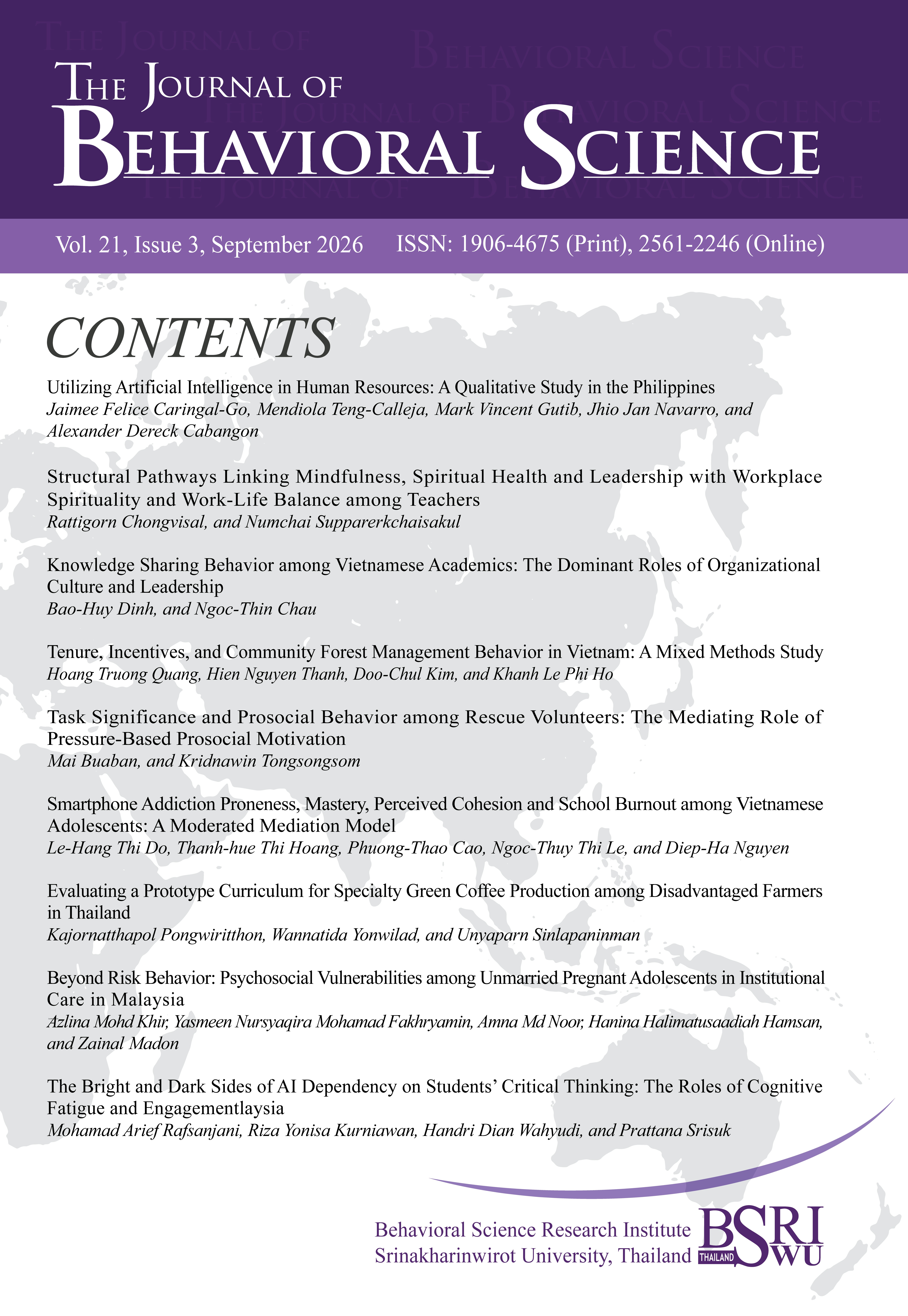
Smartphone Addiction Proneness, Mastery, Perceived Cohesion and School Burnout among Vietnamese Adolescents: A Moderated Mediation Model
Article Sidebar
Main Article Content
Abstract
Background/ problem: Smartphone addiction proneness is associated with academic and psychological difficulties among adolescents, yet mechanisms linking it to school burnout remain underexamined in Vietnam. Drawing on conservation of resources (COR) theory, smartphone addiction proneness may undermine mastery, thereby increasing vulnerability to school burnout.
Objective/ purpose: This study examined whether mastery mediated the association between smartphone addiction proneness and school burnout and whether perceived classroom cohesion moderated this association.
Design and Methodology: A cross-sectional of 375 secondary and high school students in Hanoi and Ho Chi Minh City, Vietnam employed convenience sampling. Participants completed measures of smartphone addiction proneness, school burnout, mastery, and perceived classroom cohesion. A moderated mediation path model was estimated using standardized scores and 5,000 bootstrap resamples.
Results: Smartphone addiction proneness negatively predicted mastery (β = -.20, p < .001), while mastery negatively predicted school burnout (β = -.19, p < .001). The indirect effect through mastery was significant (β = .04, p = .03, 95% CI [.01, .08]), and the direct effect remained significant (β = .33, p < .001). Perceived classroom cohesion negatively predicted school burnout (β = -.17, p < .001), whereas its interaction with smartphone addiction proneness was positive (β = .10, p = .04).
Conclusion and Implications: Smartphone addiction proneness was linked to higher school burnout directly and through lower mastery. Perceived classroom cohesion was associated with lower burnout overall but strengthened the positive association between smartphone addiction proneness and school burnout. School-based interventions should strengthen mastery and promote healthier peer connection norms.
Downloads
Article Details

This work is licensed under a Creative Commons Attribution-NonCommercial-NoDerivatives 4.0 International License.
References
Aiken, L. S., & West, S. G. (1991). Multiple regression: Testing and interpreting interactions. Sage.
Allred, R. J., & Atkin, D. (2020). Cell phone addiction, anxiety, and willingness to communicate in face-to-face encounters. Communication Reports, 33(3), 95–106. https://doi.org/10.1080/08934215.2020.1780456
Al Battashi, N., Al Omari, O., Sawalha, M., Al Maktoumi, S., Alsuleitini, A., & Al Qadire, M. (2021). The Relationship Between Smartphone Use, Insomnia, Stress, and Anxiety Among University Students: A Cross-Sectional Study. Clinical nursing research, 30(6), 734–740. https://doi.org/10.1177/1054773820983161
Amez, S. & Baert, S. (2020). Smartphone use and academic performance: A systematic review and meta-analysis. International Journal of Educational Research, 103, 101618. https://doi.org/10.1016/j.ijer.2020.101618
Anderman, E. M., & Freeman, T. M. (2004). Students' sense of belonging in school. In P. R. Pintrich & M. L. Maehr (Eds.), Advances in motivation and achievement: Vol. 13. Motivating students, improving schools: The legacy of Carol Midgley (pp. 27–63). Elsevier JAI.
Bilgiz, S., & Peker, A. (2021). The mediating role of mindfulness in the relationship between school burnout and problematic smartphone and social media use. International Journal of Progressive Education, 17(1), 68–85. https://doi.org/10.29329/ijpe.2021.329.5
Bollen, K. A., & Hoyle, R. H. (1990). Perceived cohesion: A conceptual and empirical examination. Social Forces, 69(2), 479–504. https://doi.org/10.2307/2579670
Bosselut, G., Castro, O., Chevalier, S., & Fouquereau, E. (2020). Does perceived cohesion mediate the student personality–engagement relationship in the university setting? Journal of Educational Psychology, 112(8), 1692–1706. https://doi.org/10.1037/edu0000442
Chen, C., Shen, Y., Xiao, F., Ni, J., & Zhu, Y. (2023). The effect of smartphone dependence on learning burnout among undergraduates: The mediating effect of academic adaptability and the moderating effect of self-efficacy. Frontiers in Psychiatry, 14, 1155544. https://doi.org/10.3389/fpsyt.2023.1155544
Chin, W. W., Salisbury, W. D., Pearson, A. W., & Stollak, M. J. (1999). Perceived cohesion in small groups: Adapting and testing the perceived cohesion scale in a small-group setting. Small Group Research, 30(6), 751–766. https://doi.org/10.1177/104649649903000605
Gisch, U. A., Robert, M., Berlin, N., Nebout, A., Etilé, F., Teyssier, S., Fezeu, L. K., Hercberg, S., Touvier, M., Kesse-Guyot, E., & Péneau, S. (2022). Mastery is associated with weight status, food intake, snacking, and eating disorder symptoms in the NutriNet-Santé cohort study. Frontiers in Nutrition, 9, 871669. https://doi.org/10.3389/fnut.2022.871669
Guo, N., Luk, T. T., Ho, S. Y., Lee, J. J., Shen, C., Oliffe, J., Chan, S. S.-C., Lam, T. H., & Wang, M. P. (2020). Problematic Smartphone Use and Mental Health in Chinese Adults: A Population-Based Study. International Journal of Environmental Research and Public Health, 17(3), 844. https://doi.org/10.3390/ijerph17030844
He, Q., Turel, O., & Bechara, A. (2022). Excessive social media use relates to impaired cognitive control and diminished prefrontal cortex activity in adolescents with problematic use. Frontiers in Psychology, 13, 896482. https://doi.org/10.3389/fpsyg.2022.896482
Ho, T. T. Q., Nguyen, B. T. N., & Nguyen, N. P. H. (2022). Academic stress and depression among Vietnamese adolescents: a moderated mediation model of life satisfaction and resilience. Current psychology, 1–11. https://doi.org/10.1007/s12144-022-03661-3
Ho, T. T. Q., Tran, T. K. L., & Huynh, S. V. (2023). Smartphone addiction and psychological distress among Vietnamese college students: Cyber-victimization as a mediator and academic stress as a moderator. Journal of Public Mental Health, 22(1), 25–35. https://doi.org/10.1108/jpmh-08-2022-0081
Hobfoll, S. E. (1989). Conservation of resources: A new attempt at conceptualizing stress. American Psychologist, 44(3), 513–524. https://doi.org/10.1037/0003-066X.44.3.513
Hu, Q., Yang, N., Huang, Q., Cheng, C., Xiao, L., Gao, X., & Zhang, F. (2024). Mobile phone addiction and psychological capital mediates the relationship between life satisfaction and learning burnout in Chinese medical postgraduate students: A structural equation model analysis. Psychology Research and Behavior Management, 17, 3169–3180. https://doi.org/10.2147/PRBM.S466422
Kim, D., Lee, Y., Lee, J., Nam, J. K., & Chung, Y. (2014). Development of Korean smartphone addiction proneness scale for youth. PLOS ONE, 9(5), e97920. https://doi.org/10.1371/journal.pone.0097920
Kwon, M., Kim, D. J., Cho, H., & Yang, S. (2013). The smartphone addiction scale: Development and validation of a short version for adolescents. PLOS ONE, 8(12), e83558. https://doi.org/10.1371/journal.pone.0083558
Li, W., & Zhou, Y. (2025). Smartphone addiction and malevolent creativity—the mediating role of psychological capital and the moderating role of self-concept clarity. Frontiers in Psychiatry, 16, 1574738. https://doi.org/10.3389/fpsyt.2025.1574738
MacKinnon, D. P., Fairchild, A. J., & Fritz, M. S. (2007). Mediation analysis. Annual Review of Psychology, 58, 593–614. https://doi.org/10.1146/annurev.psych.58.110405.085542
Ministry of Information and Communications. (2023). Report on smartphone subscription statistics in Vietnam. Ministry of Information and Communications of Vietnam.
O'Brien, K. A., & Bowles, T. V. (2013). The importance of belonging for adolescents in secondary school settings. European Journal of Social & Behavioural Sciences, 4(1), 689–699. https://doi.org/10.15405/ejsbs.72
Pearlin, L. I., & Schooler, C. (1978). The structure of coping. Journal of Health and Social Behavior, 19(1), 2–21. https://doi.org/10.2307/2136319
R Core Team. (2025). R: A language and environment for statistical computing (Version 4.5.2). R Foundation for Statistical Computing. https://www.R-project.org/
Rudolf, R. (2024). Predictors of adolescent well-being around the globe: Are students from Confucian East Asia different? Frontiers in Psychology, 15, 1446301. https://doi.org/10.3389/fpsyg.2024.1446301
Salmela-Aro, K., Kiuru, N., Leskinen, E., & Nurmi, J.-E. (2009). School Burnout Inventory (SBI): Reliability and validity. European Journal of Psychological Assessment, 25(1), 48–57. https://doi.org/10.1027/1015-5759.25.1.48
Skierkowski, D., & Wood, R. M. (2012). To text or not to text? The importance of text messaging among college-aged youth. Computers in Human Behavior, 28(2), 744–756. https://doi.org/10.1016/j.chb.2011.11.023
Tomaszek, K., & Muchacka-Cymerman, A. (2021). Be Aware of Burnout! The Role of Changes in Academic Burnout in Problematic Facebook Usage among University Students. International journal of environmental research and public health, 18(15), 8055. https://doi.org/10.3390/ijerph18158055
Truc, T. T., Loan, K. X., Nguyen, N. D., Dixon, J., Sun, J., & Dunne, M. P. (2015). Validation of the Educational Stress Scale for Adolescents (ESSA) in Vietnam. Asia-Pacific journal of public health, 27(2), NP2112–NP2121. https://doi.org/10.1177/1010539512440818
Tuerlinckx, F., Kuppens, P., Ariens, S., Cloos, L., Dejonckheere, E., Lafit, G., Niemeijer, K., Revol, J., Schat, E., Schreuder, M., Vanhasbroeck, N., & Ceulemans, E. (2026). New developments in experience sampling methodology. The British journal of mathematical and statistical psychology, 79(1), 46–65. https://doi.org/10.1111/bmsp.12398
Ulaş, S., & Seçer, İ. (2022). Developing a CBT-based intervention program for reducing school burnout and investigating its effectiveness with mixed methods research. Frontiers in Psychology, 13, 884912. https://doi.org/10.3389/fpsyg.2022.884912
Ulmanen, S., Soini, T., Pietarinen, J., & Pyhältö, K. (2016). Students' experiences of the development of emotional engagement. International Journal of Educational Research, 79, 86–96. https://doi.org/10.1016/j.ijer.2016.06.003
UNICEF. (2022). DISRUPTING HARM IN VIET NAM [SNAPSHOT]: Evidence on online child sexual exploitation and abuse. UNICEF. https://www.unicef.org/innocenti/media/4181/file/DH-Viet-Nam-Report-2022.pdf
van Buuren, S., & Groothuis-Oudshoorn, K. (2011). mice: Multivariate imputation by chained equations in R. Journal of Statistical Software, 45(3), 1–67. https://doi.org/10.18637/jss.v045.i03
Wang, M., Zhao, M., Ma, D., Ji, X., Li, D., & Xu, Z. (2025). The relationship between mobile phone dependency and academic burnout in middle and high school students. International Journal of Mental Health Promotion, 27(8), 1165–1180. https://doi.org/10.32604/ijmhp.2025.067133
West, S. G., Finch, J. F., & Curran, P. J. (1995). Structural equation models with nonnormal variables: Problems and remedies. In R. H. Hoyle (Ed.), Structural equation modeling: Concepts, issues, and applications (pp. 56–75). Sage.
Wu-Ouyang, B. (2023). More mobile connectedness, less well-being? Examining how multiplatform mobile connectedness affects negative well-being through FoMO and leisure boredom. Journal of Media Psychology: Theories, Methods, and Applications, 35(5), 291–302. https://doi.org/10.1027/1864-1105/a000388
Yang, G. H., Cao, X. X., Fu, Y. Y., Wang, N. D., & Lian, S. L. (2024). Mobile phone addiction and academic burnout: The mediating role of technology conflict and the protective role of mindfulness. Frontiers in Psychiatry, 15, 1365914. https://doi.org/10.3389/fpsyt.2024.1365914
Zhao, X., Wang, H., Ma, Z., Zhang, L., & Chang, T. (2025). Smartphone addiction and academic procrastination among college students: A serial mediation model of self-control and academic self-efficacy. Frontiers in Psychiatry, 16, 1572963. https://doi.org/10.3389/fpsyt.2025.1572963