
School Connectedness and Mental Health in Vietnamese Secondary School Adolescents: The Mediating Role of Social-Emotional Competence
Article Sidebar
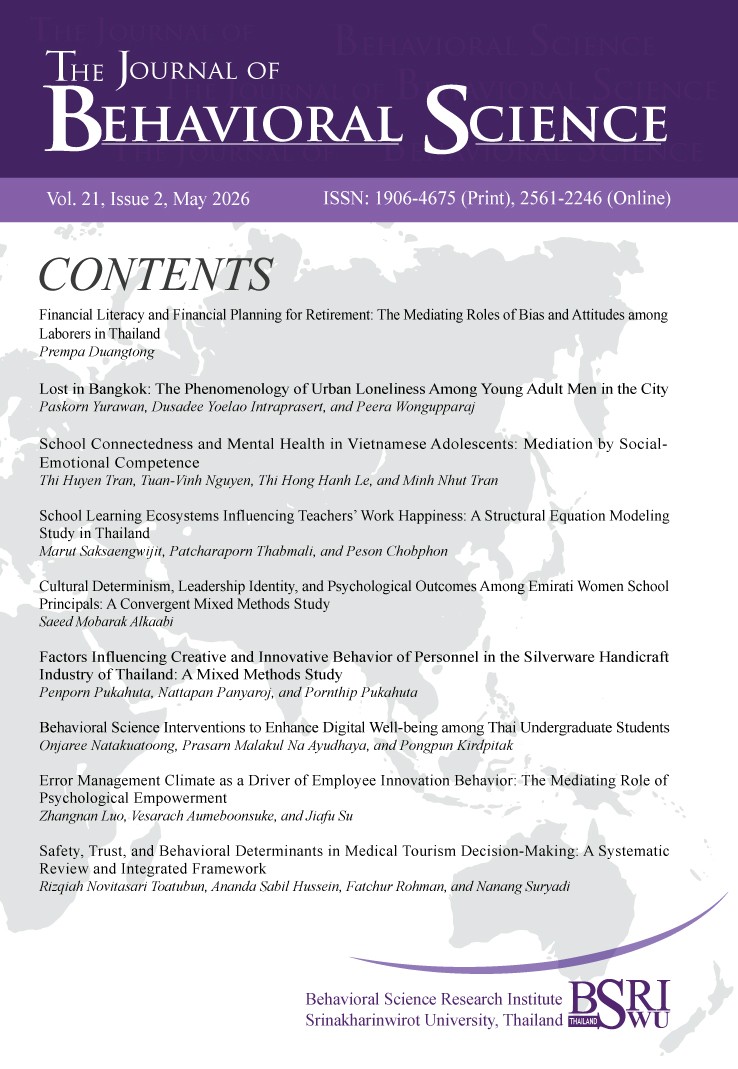
Main Article Content
Abstract
Background: School connectedness is a critical factor influencing adolescent mental health. However, the mechanisms through which its multidimensional components, such as teacher support, peer support, social participation, and perceived safety, influence well-being in Vietnam remain underexplored.
Objective: This study examined the mechanism through which multidimensional school connectedness influences the mental health of Vietnamese adolescents.
Method: Drawing on a cross-sectional sample of 395 lower secondary students (Mage = 12.3, SD = 1.05) from public secondary schools in Vietnam, the study first validated the component structure of the school connectedness scale using principal component analysis (PCA) with Promax rotation. Mediation analyses were then conducted using the PROCESS macro to examine the role of social-emotional competence.
Results: The analysis identified a clear four-component structure of the scale, accounting for a substantial proportion of the variance (55.46%) and indicating good construct validity (KMO = .90; Bartlett’s test, p < .001). Mediation analyses revealed that social-emotional competence significantly mediated the relationship between school connectedness and mental health. Specifically, the indirect effects were robust (ab = -.16 to -.21, 95% CI [-.33, -.07]), whereas several direct effects became non-significant after the mediator was included.
Conclusion and Implications: School connectedness may support adolescent mental health partly through the development of social-emotional competence. These findings highlight the importance of strengthening supportive school environments and implementing school-based social-emotional learning interventions to promote student mental health.
Downloads
Article Details

This work is licensed under a Creative Commons Attribution-NonCommercial-NoDerivatives 4.0 International License.
References
Allen, K. A., Greenwood, C. J., Berger, E., Letcher, P., Olsson, C. A., Toumbourou, J. W., & Hutchinson, D. M. (2024). Adolescent school belonging and mental health outcomes in young adulthood: Findings from a multi-wave prospective cohort study. School Mental Health, 16, 149–160. https://doi.org/10.1007/s12310-023-09626-6
Allen, K. A., Vella-Brodrick, D., & Waters, L. (2016). Fostering school belonging in secondary schools using a socio-ecological framework. Educational and Developmental Psychologist, 33(1), 97–121. https://doi.org/10.1017/edp.2016.5
Bonfanti, R. C., Melchiori, F., Teti, A., Albano, G., Raffard, S., Rodgers, R., & Coco, G. L. (2025). The association between social comparison in social media, body image concerns and eating disorder symptoms: A systematic review and meta-analysis. Body Image, 52, 101841. https://doi.org/10.1016/j.bodyim.2024.101841
Branje, S., de Moor, E. L., Spitzer, J., & Becht, A. I. (2021). Dynamics of identity development in adolescence: A decade in review. Journal of Research on Adolescence, 31(4), 908–927. https://doi.org/10.1111/jora.12678
Bronfenbrenner, U. (1979). The ecology of human development: Experiments by nature and design. Harvard University Press. https://www.hup.harvard.edu/books/9780674224575
Coleman, J. S. (1988). Social capital in the creation of human capital. American Journal of Sociology, 94, S95–S120. https://doi.org/10.1086/228943
Collaborative for Academic, Social, and Emotional Learning. (2020). CASEL’s SEL framework: What are the core competence areas and where are they promoted? CASEL. https://casel.org/casel-sel-framework-11-2020/
Dinh, H.-V. T., Nguyen Phuoc, C. T., Tran, T.-A. T., Dau, M. L., & Nguyen, T. V. (2021). The Vietnamese version of the social and emotional competence questionnaire (SECQ): Psychometric properties among adolescents. TPM: Testing, Psychometrics, Methodology in Applied Psychology, 28(2), 251–266. https://doi.org/10.4473/TPM28.2.7
Durlak, J. A., Domitrovich, C. E., Weissberg, R. P., & Gullotta, T. P. (Eds.). (2015). Handbook of social and emotional learning: Research and practice. The Guilford Press. https://www.guilford.com/books/Handbook-of-Social-and-Emotional-Learning/Durlak-Domitrovich-Weissberg-Gullotta/9781462520152
Eccles, J. S., & Roeser, R. W. (2011). School and community influences on human development (6th ed.). In M. H. Bornstein & M. E. Lamb (Eds.), Developmental science: An advanced textbook (pp. 571–643). Psychology Press. https://doi.org/10.4324/9780203846766
Field, A. (2018). Discovering statistics using IBM SPSS statistics (5th ed.). SAGE Publications.
Greenberg, M. T. (2023). Evidence for social and emotional learning in schools. Learning Policy Institute. https://doi.org/10.54300/928.269
Hair, J. F., Babin, B. J., Anderson, R. E., & Black, W. C. (2019). Multivariate data analysis (8th ed.). Cengage.
Hayes, A. F. (2022). Introduction to mediation, moderation, and conditional process analysis: A regression-based approach (3rd ed.). The Guilford Press.
Hirota, T., Guerrero, A. P., & Skokauskas, N. (2020). Child and adolescent mental health needs, services, and gap in East and Southeast Asia and the Pacific Islands. In N. Skokauskas, C. Fung, N. Flaherty, M. von Klitzing, & P. Puras (Eds.), Child and adolescent mental health: Global challenges and opportunities (pp. 295–315). Academic Press. https://doi.org/10.1016/B978-0-12-819749-3.00012-9
Institute of Sociology, University of Queensland, & Johns Hopkins Bloomberg School of Public Health. (2022). Viet Nam adolescent mental health survey (V-NAMHS): Report on main findings. Institute of Sociology. https://qcmhr.org/docman/reports/15-vnamhs-report-eng-15-feb-2023/file
Jennings, P. A., & Greenberg, M. T. (2009). The prosocial classroom: Teacher social and emotional competence in relation to student and classroom outcomes. Review of Educational Research, 79(1), 491–525. https://doi.org/10.3102/0034654308325693
Krejcie, R. V., & Morgan, D. W. (1970). Determining sample size for research activities. Educational and Psychological Measurement, 30(3), 607–610. https://doi.org/10.1177/001316447003000308
Kroenke, K., Spitzer, R. L., & Williams, J. B. (2001). The PHQ-9: Validity of a brief depression severity measure. Journal of General Internal Medicine, 16(9), 606–613. https://doi.org/10.1046/j.1525-1497.2001.016009606.x
Lee, J., & Wang, C. (2025). Social–emotional competence growth profiles in upper elementary school years and pathways to mental health outcomes in middle school. International Journal of Environmental Research and Public Health, 22(11), 1744. https://doi.org/10.3390/ijerph22111744
Li, G., Chen, T., Zhang, F., Wang, P., Yi, Y., Yin, X., & Luo, H. (2025). Psychological wellbeing and social emotional competence of Chinese children and adolescents in the post-pandemic era: Patterns, determinants, and interrelations. Frontiers in Public Health, 13, 1677632. https://doi.org/10.3389/fpubh.2025.1677632
Liu, C. K. (2026). School connectedness impact on adolescent weekly depression and anxiety: Based on the self-acceptance. SHS Web of Conferences, 229, 03002. https://doi.org/10.1051/shsconf/202622903002
Lloret, S., Ferreres, A., Hernández, A., & Tomás, I. (2017). The exploratory factor analysis of items: Guided analysis based on empirical data and software. Anales De Psicología/Annals of Psychology, 33(2), 417–432. https://doi.org/10.6018/analesps.33.2.270211
Loewenthal, K. M. (2004). An introduction to psychological tests and scales (2nd ed.). Psychology Press.
Mah, A., & D'Souza, B. (2026). Social-emotional Learning for Bullying Prevention and Adolescent Mental Well-Being: A Systematic Review. The Open Psychology Journal, 19, e18743501427835. http://dx.doi.org/10.2174/0118743501427835251205065937
Nguyen, T. H., Le, M. T., & Ngo, A. V. (2024). Standardize the PHQ-9 depression scale among high school students at two high schools in Hanoi city. Vietnam Medical Journal, 544(1), 316–320.
Pranowo, T. A., Astuti, B., & Setiawati, F. A. (2026). Social-emotional learning for bullying prevention and adolescent mental well-being: A systematic review. The Open Psychology Journal, 19, e18743501427835. https://doi.org/10.2174/0118743501427835251205065937
Putnam, R. D. (2000). Bowling alone: The collapse and revival of American community. Touchstone Books/Simon & Schuster.
Raniti, M., Rakesh, D., Patton, G. C., & Sawyer, S. M. (2022). The role of school connectedness in the prevention of youth depression and anxiety: A systematic review with youth consultation. BMC Public Health, 22, 2152. https://doi.org/10.1186/s12889-022-14364-6
Ryan, R. M., & Deci, E. L. (2017). Self-determination theory: Basic psychological needs in motivation, development, and wellness. The Guilford Press.
Spitzer, R. L., Kroenke, K., Williams, J. B. W., & Löwe, B. (2006). A brief measure for assessing generalized anxiety disorder: The GAD-7. Archives of Internal Medicine, 166(10), 1092–1097. https://doi.org/10.1001/archinte.166.10.1092
Taber, K. S. (2018). The use of Cronbach’s alpha when developing and reporting research instruments in science education. Research in Science Education, 48(6), 1273–1296. https://doi.org/10.1007/s11165-016-9602-2
Tran, L. C. T., Rattanapan, C., Laosee, O., Suksaroj, T. T., Du, R., Ramazanu, S., Truong, T. N., To, T. B. S., & Shorey, S. (2025). Prevalence of depressive symptoms and their determinants among adolescents in Can Tho City, Vietnam: A cross-sectional study. Cambridge Prisms: Global Mental Health, 12, e139. https://doi.org/10.1017/gmh.2025.10096
UNICEF. (2022). Comprehensive study on school-related factors impacting mental health and well-being of adolescent boys and girls in Viet Nam. UNICEF & Ministry of Education and Training (MOET). https://www.unicef.org/vietnam/reports/study-school-related-factors-impacting-mental-health-and-well-being-adolescents-viet-nam
UNICEF. (2021). The State of the world’s children 2021: On my mind – promoting, protecting and caring for children’s mental health. UNICEF. https://www.unicef.org/reports/state-worlds-children-2021
Valdés-Cuervo, Á. A., Velderrain-Valenzuela, M., Grijalva-Quiñonez, C. S., Morales-Álvarez, A., & Parra-Pérez, L. G. (2025). Teachers’ autonomy support and homework effort: Moderated mediation of psychological control and autonomous motivation. Universitas Psychologica, 24, 1–15. https://doi.org/10.11144/Javeriana.upsy24.tash
Vygotsky, L. S. (1978). Mind in society: The development of higher psychological processes. Harvard University Press.
Zhou, M., & Ee, J. (2012). Development and validation of the social emotional competence questionnaire (SECQ). The International Journal of Emotional Education, 4(2), 27–42. https://www.um.edu.mt/library/oar/handle/123456789/6140
