การประเมินบทบาททางเศรษฐกิจและขีดความสามารถในการแข่งขันของอุตสาหกรรมโทรคมนาคมของประเทศไทย
คำสำคัญ:
ขีดความสามารถในการแข่งขัน, บัญชีเมตริกซ์สังคม (SAM), อุตสาหกรรมโทรคมนาคมบทคัดย่อ
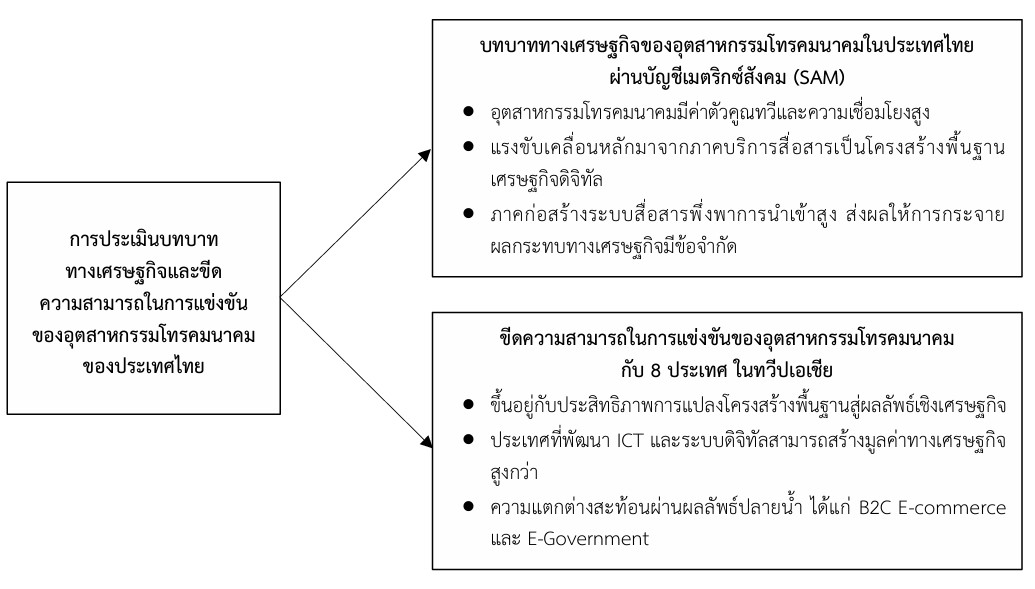
บทความวิจัยนี้มีวัตถุประสงค์เพื่อ 1) ประเมินบทบาททางเศรษฐกิจของอุตสาหกรรมโทรคมนาคมในประเทศไทยผ่านบัญชีเมตริกซ์สังคมของประเทศไทย พ.ศ. 2564 ที่ปรับปรุงให้เป็นปัจจุบัน เพื่อสะท้อนภาพรวมเศรษฐกิจ พ.ศ. 2567 และ 2) ประเมินและเปรียบเทียบขีดความสามารถในการแข่งขันของอุตสาหกรรมโทรคมนาคมของประเทศไทยกับ 8 ประเทศในทวีปเอเชีย ได้แก่ สิงคโปร์ มาเลเซีย อินโดนีเซีย ฟิลิปปินส์ เวียดนาม จีน ญี่ปุ่น และเกาหลีใต้ การวิจัยครั้งนี้เป็นการวิจัยแบบผสม โดยเครื่องมือที่ใช้วิเคราะห์เชิงปริมาณ คือ บัญชีเมตริกซ์สังคม และเชิงคุณภาพ คือ เทคนิคการจัดลำดับความสำคัญแบบการให้ค่าคะแนน เพื่อประเมินขีดความสามารถในการแข่งขันในองค์ประกอบต่าง ๆ ผลการศึกษา พบว่า 1) อุตสาหกรรมโทรคมนาคมของประเทศไทยในสาขาการก่อสร้างอาคารและระบบสื่อสาร มีค่าตัวคูณทวีด้านผลผลิต ด้านมูลค่าเพิ่ม และด้านรายได้ เท่ากับ 3.83 1.39 และ 1.27 ตามลำดับ และสาขาบริการไปรษณีย์โทรเลข โทรศัพท์ และการสื่อสาร เท่ากับ 3.84 1.52 และ 1.36 ตามลำดับ โดยในสาขาบริการไปรษณีย์โทรเลข โทรศัพท์ และการสื่อสารมีค่า ตัวคูณทวีในทุกประเภทที่สูงกว่าสาขาการก่อสร้างเล็กน้อย เนื่องจากโดยภาพรวมสาขาดังกล่าวมีระดับความเชื่อมโยงกับสาขาการผลิตอื่น ๆ ที่สูงกว่า โดยเฉพาะระดับความเชื่อมโยงไปข้างหน้า และสาขาการก่อสร้างค่อนข้างพึ่งพิงปัจจัยขั้นกลางที่นำเข้าจากต่างประเทศในระดับสูง และ 2) อุตสาหกรรมโทรคมนาคมของประเทศไทยโดยภาพรวมนับเป็นจุดแข็งของประเทศไทย เนื่องจากมีองค์ประกอบจำนวน 6 จากทั้งหมด 7 องค์ประกอบเป็นจุดแข็ง ได้แก่ ด้านการใช้งานด้าน ICTs ด้านการถูกแบ่งแยก โดยดิจิทัล ด้านความปลอดภัยทางไซเบอร์ ด้านอีคอมเมิร์ซแบบ B2C ด้านรัฐบาลอิเล็กทรอนิกส์ และด้านทักษะด้านดิจิทัล ขณะที่องค์ประกอบด้านการเข้าถึงบริการนับเป็นจุดอ่อนของประเทศไทย โดยเฉพาะในด้านการสมัครใช้งานโทรศัพท์พื้นฐาน และด้านแบนด์วิดท์ระหว่างประเทศ
เอกสารอ้างอิง
ฉลองภพ สุสังกร์กาญจน์ และ ปราณี ทินกร. (2542). บัญชีเมตริกซ์สังคม (Social Accounting Matrix) และการวิเคราะห์ผลกระทบของการใช้จ่ายงบประมาณ. กรุงเทพฯ: มูลนิธิสถาบันวิจัยเพื่อการพัฒนาประเทศไทย.
ณัฐกานต์ อ่อนรักษ์. (2567). การพัฒนาตารางบัญชีเมทริกซ์เชิงสังคมเพื่อการวิเคราะห์แรงงาน และการกระจายรายได้ของครัวเรือนในประเทศไทย. (เศรษฐศาสตรมหาบัณฑิต, จุฬาลงกรณ์มหาวิทยาลัย).
มานะ ลักษมีอรุโณทัย. (2561). ผลกระทบทางเศรษฐกิจของภาคการท่องเที่ยวในประเทศไทย: วิเคราะห์โดยใช้บัญชีเมตริกซ์สังคมด้านการท่องเที่ยว (งานวิจัยลำดับที่ 23/2561). กรุงเทพฯ: คณะเศรษฐศาสตร์ มหาวิทยาลัยเกษตรศาสตร์.
Achimugu, P., Selamat, A., Ibrahim, R., & Mahrin, M. N. R. (2014). A systematic literature review of software requirements prioritization research. Information and software technology, 56(6), 568-585.
Backinezos, C., Panagiotou, S., & Vourvachaki, E. (2020). Multiplier effects by sector: An input-output analysis of the Greek economy. Bank of Greece Economic Bulletin, 52, 7–28.
Breisinger, C., Thomas, M., & Thurlow, J. (2009). Social accounting matrices and multiplier analysis: An introduction with exercises. Washington, DC: International Food Policy Research Institute.
Dobrota, M., Jeremic, V., & Markovic, A. (2012). A new perspective on the ICT Development Index. Information Development, 28(4), 271–280.
Drejer, I. (2002). Input-output based measures of interindustry linkages revisited: A survey and discussion. Retrieved from https://iioa.org/conferences/14th/files/Drejer_.pdf.
Gerpott, T. J., & Ahmadi, N. (2015). Composite indices for the evaluation of a country's information technology development level: Extensions of the IDI of the ITU. Technological Forecasting and Social Change, 98, 174-185.
Golan, A., Judge, G., & Miller, D. (1996). Maximum entropy econometrics: Robust estimation with limited data. New Jersey: Wiley.
Hirschman, A. O. (1958). The strategy of economic development. London: Yale University Press.
International Telecommunication Union, UNESCO, & UNICEF. (2022). E-learning in Thailand: Mapping the digital divide. Retrieved from https://handle.itu.int/11.1002/pub/81dc9e5b-en.
International Telecommunication Union. (2023a). Measuring digital development: Facts and Figures 2023. Retrieved from https://www.itu.int/itu-d/reports/statistics/facts-figures-2023/.
International Telecommunication Union. (2023b). The ICT Development Index 2023. Retrieved from https://www.itu.int/itu-d/reports/statistics/idi2023/.
International Telecommunication Union. (2024). ICT statistics / ICT DataHub. Retrieved from https://data.itu.int/.
Kaleem, S., Asim, M., El-Affendi, M., & Babar, M. (2024). Optimizing requirements prioritization for IoT applications using extended analytical hierarchical process and an advanced grouping framework. Future Internet, 16(5), 160.
Katz, M. L., & Shapiro, C. (1985). Network externalities, competition, and compatibility. The American Economic Review, 75(3), 424–440.
Kay, D. L., Pratt, J. E., & Warner, M. E. (2007). Role of services in regional economy growth. Growth and Change, 38(3), 419–442.
McDougall, R. A. (1999). Entropy theory and RAS are friends. Retrieved from https://ageconsearch.umn.edu/record/283439/?v=pdf.
OECD, & Joint Research Centre. (2008). Handbook on constructing composite indicators: Methodology and user guide. Paris: OECD Publishing.
OECD. (2020). OECD Digital Economy Outlook 2020. Paris: OECD Publishing.
Pyatt, G., & Round, J. I. (Eds.). (1985). Social accounting matrices: A basis for planning. Washington, D.C.: World Bank.
Robinson, S., Cattaneo, A., & El-Said, M. (2001). Updating and estimating a social accounting matrix using cross entropy methods. Economic Systems Research, 13(1), 47–64.
Röller, L.-H., & Waverman, L. (2001). Telecommunications infrastructure and economic development: A simultaneous approach. American Economic Review, 91(4), 909–923.
Round, J. (2003). Social accounting matrices and SAM-based multiplier analysis. In F. Bourguignon & L. A. Pereira da Silva (Eds.), The impact of economic policies on poverty and income distribution: Evaluation techniques and tools (pp. 301–324). World Bank and Oxford University Press.
Srinuan, C., & Bohlin, E. (2013). Analysis of fixed broadband access and use in Thailand: Drivers and barriers. Telecommunications Policy, 37(8), 615–625.
Stone, R., & Brown, A. (1962). A computable model of economic growth. London: Chapman and Hall.
Tapscott, D. (1995). The digital economy: Promise and peril in the age of networked intelligence. New York: McGraw-Hill.
UNESCO Institute for Statistics. (2024). UIS Data Browser. Retrieved from https://databrowser.uis.unesco.org/
United Nations Conference on Trade and Development. (2023). E-commerce and digital economy programme: Year in review 2023. Geneva: UNCTAD.
United Nations Department of Economic and Social Affairs. (2024). UN E-Government Survey 2024: Accelerating digital transformation for sustainable development. New York: United Nations.
United Nations, European Commission, International Monetary Fund, Organisation for Economic Co-operation and Development, & World Bank. (2009). System of National Accounts 2008. New York: United Nations.
Universal Postal Union. (2024). Integrated Index for Postal Development (2IPD) / State of the Postal Sector 2024. Bern, Switzerland: Universal Postal Union.
World Bank. (2021). World Development Indicators. Washington, D.C.: World Bank.
World Bank. (2024). World Development Indicators. Washington, D.C.: World Bank.
ดาวน์โหลด
เผยแพร่แล้ว
รูปแบบการอ้างอิง
ฉบับ
ประเภทบทความ
สัญญาอนุญาต
ลิขสิทธิ์ (c) 2026 วารสารสังคมศาสตร์ปัญญาพัฒน์

อนุญาตภายใต้เงื่อนไข Creative Commons Attribution-NonCommercial-NoDerivatives 4.0 International License.


