Assessing the Economic Role and Competitiveness of Thailand’s Telecommunications Industry
Keywords:
Competitiveness, Social Accounting Matrix (SAM), Telecommunications IndustryAbstract
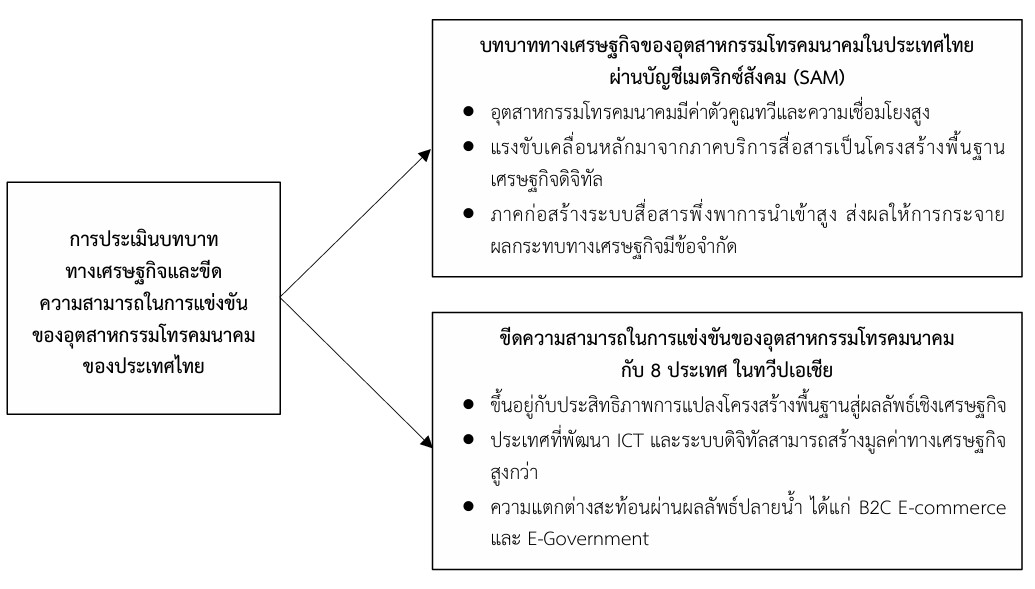
This article aims to (1) assess the economic role of Thailand’s telecommunications industry through the Thailand Social Accounting Matrix (SAM) for 2021, updated to reflect the overall economic structure in 2024, and (2) evaluate and compare the competitiveness of Thailand’s telecommunications industry with eight Asian economies, namely Singapore, Malaysia, Indonesia, the Philippines, Vietnam, China, Japan, and South Korea. This study adopts a mixed-methods approach. The quantitative analysis employs a Social Accounting Matrix (SAM), while the qualitative analysis utilizes a scoring-based prioritization technique to assess competitiveness across various dimensions. The results of the study indicate that: (1) In Thailand’s telecommunications industry, the construction of buildings and communication systems sector recorded output, value-added, and income multipliers of 3.83, 1.39, and 1.27, respectively. Meanwhile, the postal, telegraph, telephone, and communication services sector recorded corresponding multipliers of 3.84, 1.52, and 1.36, respectively. The postal, telegraph, telephone, and communication services sector demonstrates slightly higher multiplier effects in all categories due to its stronger intersectoral linkages, particularly forward linkages, while the construction sector relies heavily on imported intermediate inputs. (2) Overall, the telecommunications industry represents a competitive strength for Thailand, with 6 out of 7 competitiveness dimensions identified as strengths: ICT usage, digital divide reduction, cybersecurity, B2C e-commerce, e-government, and digital skills. The remaining dimension—access to services—emerges as a weakness, particularly concerning fixed-line subscriptions and international bandwidth capacity.
References
ฉลองภพ สุสังกร์กาญจน์ และ ปราณี ทินกร. (2542). บัญชีเมตริกซ์สังคม (Social Accounting Matrix) และการวิเคราะห์ผลกระทบของการใช้จ่ายงบประมาณ. กรุงเทพฯ: มูลนิธิสถาบันวิจัยเพื่อการพัฒนาประเทศไทย.
ณัฐกานต์ อ่อนรักษ์. (2567). การพัฒนาตารางบัญชีเมทริกซ์เชิงสังคมเพื่อการวิเคราะห์แรงงาน และการกระจายรายได้ของครัวเรือนในประเทศไทย. (เศรษฐศาสตรมหาบัณฑิต, จุฬาลงกรณ์มหาวิทยาลัย).
มานะ ลักษมีอรุโณทัย. (2561). ผลกระทบทางเศรษฐกิจของภาคการท่องเที่ยวในประเทศไทย: วิเคราะห์โดยใช้บัญชีเมตริกซ์สังคมด้านการท่องเที่ยว (งานวิจัยลำดับที่ 23/2561). กรุงเทพฯ: คณะเศรษฐศาสตร์ มหาวิทยาลัยเกษตรศาสตร์.
Achimugu, P., Selamat, A., Ibrahim, R., & Mahrin, M. N. R. (2014). A systematic literature review of software requirements prioritization research. Information and software technology, 56(6), 568-585.
Backinezos, C., Panagiotou, S., & Vourvachaki, E. (2020). Multiplier effects by sector: An input-output analysis of the Greek economy. Bank of Greece Economic Bulletin, 52, 7–28.
Breisinger, C., Thomas, M., & Thurlow, J. (2009). Social accounting matrices and multiplier analysis: An introduction with exercises. Washington, DC: International Food Policy Research Institute.
Dobrota, M., Jeremic, V., & Markovic, A. (2012). A new perspective on the ICT Development Index. Information Development, 28(4), 271–280.
Drejer, I. (2002). Input-output based measures of interindustry linkages revisited: A survey and discussion. Retrieved from https://iioa.org/conferences/14th/files/Drejer_.pdf.
Gerpott, T. J., & Ahmadi, N. (2015). Composite indices for the evaluation of a country's information technology development level: Extensions of the IDI of the ITU. Technological Forecasting and Social Change, 98, 174-185.
Golan, A., Judge, G., & Miller, D. (1996). Maximum entropy econometrics: Robust estimation with limited data. New Jersey: Wiley.
Hirschman, A. O. (1958). The strategy of economic development. London: Yale University Press.
International Telecommunication Union, UNESCO, & UNICEF. (2022). E-learning in Thailand: Mapping the digital divide. Retrieved from https://handle.itu.int/11.1002/pub/81dc9e5b-en.
International Telecommunication Union. (2023a). Measuring digital development: Facts and Figures 2023. Retrieved from https://www.itu.int/itu-d/reports/statistics/facts-figures-2023/.
International Telecommunication Union. (2023b). The ICT Development Index 2023. Retrieved from https://www.itu.int/itu-d/reports/statistics/idi2023/.
International Telecommunication Union. (2024). ICT statistics / ICT DataHub. Retrieved from https://data.itu.int/.
Kaleem, S., Asim, M., El-Affendi, M., & Babar, M. (2024). Optimizing requirements prioritization for IoT applications using extended analytical hierarchical process and an advanced grouping framework. Future Internet, 16(5), 160.
Katz, M. L., & Shapiro, C. (1985). Network externalities, competition, and compatibility. The American Economic Review, 75(3), 424–440.
Kay, D. L., Pratt, J. E., & Warner, M. E. (2007). Role of services in regional economy growth. Growth and Change, 38(3), 419–442.
McDougall, R. A. (1999). Entropy theory and RAS are friends. Retrieved from https://ageconsearch.umn.edu/record/283439/?v=pdf.
OECD, & Joint Research Centre. (2008). Handbook on constructing composite indicators: Methodology and user guide. Paris: OECD Publishing.
OECD. (2020). OECD Digital Economy Outlook 2020. Paris: OECD Publishing.
Pyatt, G., & Round, J. I. (Eds.). (1985). Social accounting matrices: A basis for planning. Washington, D.C.: World Bank.
Robinson, S., Cattaneo, A., & El-Said, M. (2001). Updating and estimating a social accounting matrix using cross entropy methods. Economic Systems Research, 13(1), 47–64.
Röller, L.-H., & Waverman, L. (2001). Telecommunications infrastructure and economic development: A simultaneous approach. American Economic Review, 91(4), 909–923.
Round, J. (2003). Social accounting matrices and SAM-based multiplier analysis. In F. Bourguignon & L. A. Pereira da Silva (Eds.), The impact of economic policies on poverty and income distribution: Evaluation techniques and tools (pp. 301–324). World Bank and Oxford University Press.
Srinuan, C., & Bohlin, E. (2013). Analysis of fixed broadband access and use in Thailand: Drivers and barriers. Telecommunications Policy, 37(8), 615–625.
Stone, R., & Brown, A. (1962). A computable model of economic growth. London: Chapman and Hall.
Tapscott, D. (1995). The digital economy: Promise and peril in the age of networked intelligence. New York: McGraw-Hill.
UNESCO Institute for Statistics. (2024). UIS Data Browser. Retrieved from https://databrowser.uis.unesco.org/
United Nations Conference on Trade and Development. (2023). E-commerce and digital economy programme: Year in review 2023. Geneva: UNCTAD.
United Nations Department of Economic and Social Affairs. (2024). UN E-Government Survey 2024: Accelerating digital transformation for sustainable development. New York: United Nations.
United Nations, European Commission, International Monetary Fund, Organisation for Economic Co-operation and Development, & World Bank. (2009). System of National Accounts 2008. New York: United Nations.
Universal Postal Union. (2024). Integrated Index for Postal Development (2IPD) / State of the Postal Sector 2024. Bern, Switzerland: Universal Postal Union.
World Bank. (2021). World Development Indicators. Washington, D.C.: World Bank.
World Bank. (2024). World Development Indicators. Washington, D.C.: World Bank.
Downloads
Published
How to Cite
Issue
Section
License
Copyright (c) 2026 Journal of Social Science Panyapat

This work is licensed under a Creative Commons Attribution-NonCommercial-NoDerivatives 4.0 International License.


