หนี้ เงินทุนสำรองระหว่างประเทศ และวิกฤตการเงิน
คำสำคัญ:
วิกฤตการเงิน, วิกฤตค่าเงิน, วิกฤตหนี้สิน, วิกฤตธนาคาร, หนี้, เงินทุนสำรองระหว่างประเทศบทคัดย่อ
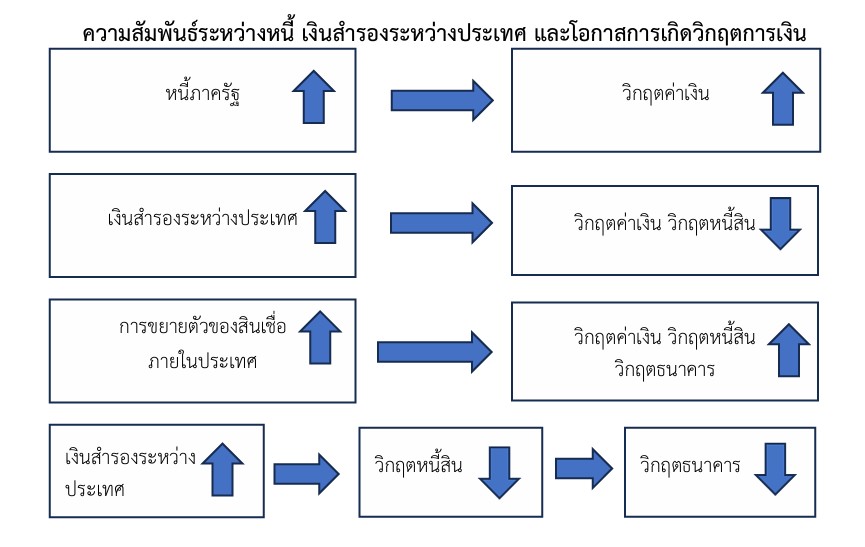
งานวิจัยนี้มีวัตถุประสงค์เพื่อศึกษาความสัมพันธ์ระหว่าง หนี้ เงินทุนสำรองระหว่างประเทศ และโอกาสการเกิดวิกฤตการเงินในกลุ่มประเทศเศรษฐกิจเกิดใหม่และกำลังพัฒนา วิกฤตการเงินสามารถแบ่งเป็น 3 รูปแบบ ได้แก่ วิกฤตค่าเงิน วิกฤตหนี้สิน และวิกฤตธนาคาร การวิจัยนี้เป็นการวิจัยเชิงปริมาณด้วยแบบจำลองโลจิต ข้อมูลที่ศึกษาเป็นลักษณะ Panel Data โดยศึกษากลุ่มประเทศเศรษฐกิจเกิดใหม่และกำลังพัฒนาจำนวน 36 ประเทศ ครอบคลุมตั้งแต่ปี ค.ศ. 1980-2018 ผลการศึกษาพบว่า กลุ่มประเทศเศรษฐกิจเกิดใหม่และกำลังพัฒนามีสัดส่วนหนี้ต่อผลิตภัณฑ์มวลรวมในประเทศที่สูงขึ้นอย่างก้าวกระโดดทั้งหนี้ภาครัฐและหนี้ภาคเอกชน นอกจากนี้ หลายประเทศที่เคยเผชิญกับวิกฤตการเงินในเอเชียช่วงปี ค.ศ. 1997 -1998 พยายามสะสมเงินสำรองระหว่างประเทศ เพื่อเป็นสินทรัพย์สภาพคล่องช่วยปกป้องค่าเงินและลดความรุนแรงอันเกิดจากการโจมตีค่าเงิน การศึกษายังพบว่า หนี้ภาครัฐที่เพิ่มมากขึ้นส่งผลให้โอกาสการเกิดวิกฤตค่าเงินที่สูงขึ้น ในขณะที่การสะสมเงินทุนสำรองระหว่างประเทศสามารถเป็นเกราะป้องกันการเกิดวิกฤตค่าเงินและวิกฤตหนี้สินได้อย่างมีนัยสำคัญทางสถิติ ดังนั้น ภาครัฐควรรักษาระดับหนี้สินและเงินสำรองระหว่างประเทศในระดับที่เหมาะสมเพื่อลดความเสี่ยงจากการเกิดวิกฤตการเงินในอนาคต
เอกสารอ้างอิง
ธนาคารแห่งประเทศไทย (2567). รู้จัก SDR ในทุนสำรองระหว่างประเทศ. สืบค้นจาก https://www.bot.or.th/th/research-and-publications/articles-and-publications/articles/article-2024sep19.html.
นิธิสาร พงศ์ปิยะไพบูลย์. (2565). ทุนสำรองกับเสถียรภาพด้านต่างประเทศ. สืบค้นจาก https://www.bot.or.th/th/research-and-publications/articles-and-publications/articles/Article_17Mar2022.html.
สำนักงานบริหารหนี้สาธารณะ. (2568). ข้อมูลหนี้สาธารณะ. สืบค้นจาก https://www.pdmo.go.th/th/faq-debt.
Aghion, P., Bacchetta, P., & Banerjee, A. (2000). A simple model of monetary policy and currency crises. European Economic Review, 44(4-6), 728–738.
Aizenman, J., & Lee, J. (2007). International reserves: Precautionary versus Mercantilist views, Theory and Evidence. Open Economies Review, 18, 191-214.
Aizenman, J., & Sun, Y. (2012). The financial crisis and sizable international reserves depletion: From ‘fear of floating’to the ‘fear of losing international reserves’?. International Review of Economics & Finance, 24, 250-269.
Angkinand, A. P., Sawangngoenyuang, W., & Wihlborg, C. (2010). Financial Liberalization and Banking Crises: A Cross-Country Analysis. International Review of Finance, 10(2), 263–292.
Carkovic, M. V., & Levine, R. (2005). Does Foreign Direct Investment Accelerate Economic Growth?. In Does foreign direct investment promote development (pp. 195-220). Minnesota: Department of Finance, University of Minnesota.
Cole, H. L., & Kehoe, T. J. (2000). Self-Fulfilling Debt Crises. The Review of Economic Studies, 67(1), 91–116.
Efremidze, L., Sula, O., & Willett, T. (2018). Capital Flow Reversals, Sudden Stops, and International Reserve Adequacy: Further Evidence from the Global Financial Crisis. International Journal of Financial Research, 10(1), 52.
Flood, R. P., & Garber, P. M. (1984). Collapsing exchange-rate regimes. Journal of International Economics, 17(1-2), 1–13.
Glick, R. & Hutchison, M. (2011). Currency Crises. Retrieved from https://www.frbsf.org/wp-content/uploads/wp11-22bk.pdf.
Hausmann, R., Panizza, U., & Stein, E. (2001). Why Do Countries Float the Way They Float?. Journal of Development Economics, 66(2), 387-414.
Jeanne, O. (1997). Are currency crises self-fulfilling?: A test. Journal of International Economics, 43(3-4), 263-286.
Koes, M.A., Nagle, P., Ohnsorge, F., & Sugawara, N. (2021). Global Waves of Debt: Causes and Consequences. Washington, DC: World bank.
Koh, W.C., Koes, M.A., Nagle, P., Ohnsorge, F., & Sugawara, N. (2020). Debt and Financial Crises. Retrieved from https://documents1.worldbank.org/curated/en/560291579701550183/pdf/Debt-and-Financial-Crises.pdf.
Krugman, P. (1979). A Model of Balance-of-Payments Crises. Journal of Money, Credit and Banking, 11(3), 311.
Laeven, L., & Valencia, F. (2018). Systemic Banking Crises Revisited. Retrieved from https://www.imf.org/en/publications/wp/issues/2018/09/14/systemic-banking-crises-revisited-46232.
Obstfeld, M. (1986). Rational and self-fulfilling balance-of–payments crises. American Economic Review, 76(1), 72-81.
Obstfeld, M. (1994). The logic of currency crises. Cahiers Economiques et Monetaires, 43, 189-213.
ดาวน์โหลด
เผยแพร่แล้ว
รูปแบบการอ้างอิง
ฉบับ
ประเภทบทความ
สัญญาอนุญาต
ลิขสิทธิ์ (c) 2026 วารสารสังคมศาสตร์ปัญญาพัฒน์

อนุญาตภายใต้เงื่อนไข Creative Commons Attribution-NonCommercial-NoDerivatives 4.0 International License.


