Debts, International Reserves, and Financial Crises
Keywords:
Financial Crises, Currency Crisis, Debt Crisis, Banking Crisis, Debts, International ReservesAbstract
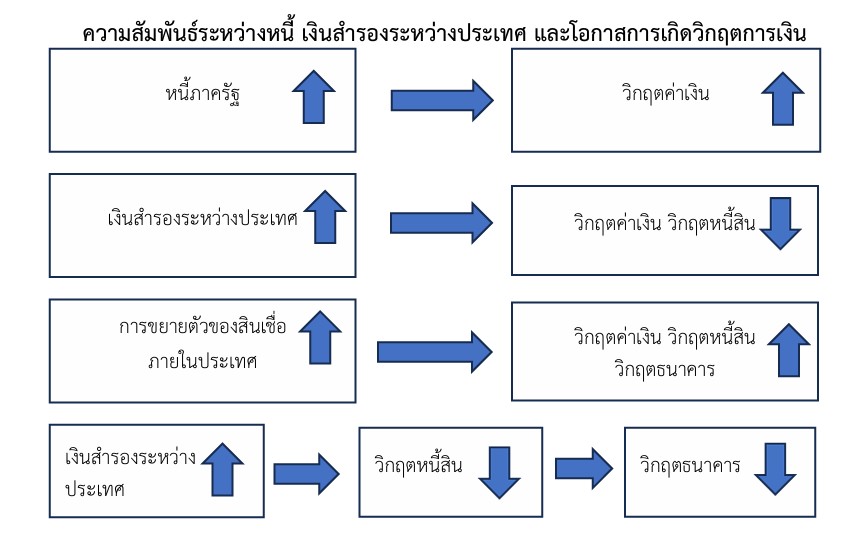
This research aims to investigate the relationships among debts, international reserves, and financial crises in emerging markets and developing economies. The financial crisis can be divided into three different categories: currency crisis, debt crisis, and banking crisis. This research is a quantitative study using the logit model to examine the effects of debts and international reserves on the probability of financial crisis. This study uses panel data on 36 countries in emerging markets and developing economies from 1980 to 2018. The results indicate that both public and private debts in emerging markets and developing economies have increased significantly. In addition, many countries that had experienced the Asian financial crisis during 1997-1998 tried to build up their international reserves as liquid assets to protect their currency and reduce the severity of currency attacks. The findings of this study also suggest that the accumulation of central government debt is associated with an increased likelihood of a currency crisis, while the accumulation of international reserves can act as a buffer against currency crises and debt crises. Therefore, governments should maintain their debts and international reserves at optimal levels to reduce the risk of future financial crises.
References
ธนาคารแห่งประเทศไทย (2567). รู้จัก SDR ในทุนสำรองระหว่างประเทศ. สืบค้นจาก https://www.bot.or.th/th/research-and-publications/articles-and-publications/articles/article-2024sep19.html.
นิธิสาร พงศ์ปิยะไพบูลย์. (2565). ทุนสำรองกับเสถียรภาพด้านต่างประเทศ. สืบค้นจาก https://www.bot.or.th/th/research-and-publications/articles-and-publications/articles/Article_17Mar2022.html.
สำนักงานบริหารหนี้สาธารณะ. (2568). ข้อมูลหนี้สาธารณะ. สืบค้นจาก https://www.pdmo.go.th/th/faq-debt.
Aghion, P., Bacchetta, P., & Banerjee, A. (2000). A simple model of monetary policy and currency crises. European Economic Review, 44(4-6), 728–738.
Aizenman, J., & Lee, J. (2007). International reserves: Precautionary versus Mercantilist views, Theory and Evidence. Open Economies Review, 18, 191-214.
Aizenman, J., & Sun, Y. (2012). The financial crisis and sizable international reserves depletion: From ‘fear of floating’to the ‘fear of losing international reserves’?. International Review of Economics & Finance, 24, 250-269.
Angkinand, A. P., Sawangngoenyuang, W., & Wihlborg, C. (2010). Financial Liberalization and Banking Crises: A Cross-Country Analysis. International Review of Finance, 10(2), 263–292.
Carkovic, M. V., & Levine, R. (2005). Does Foreign Direct Investment Accelerate Economic Growth?. In Does foreign direct investment promote development (pp. 195-220). Minnesota: Department of Finance, University of Minnesota.
Cole, H. L., & Kehoe, T. J. (2000). Self-Fulfilling Debt Crises. The Review of Economic Studies, 67(1), 91–116.
Efremidze, L., Sula, O., & Willett, T. (2018). Capital Flow Reversals, Sudden Stops, and International Reserve Adequacy: Further Evidence from the Global Financial Crisis. International Journal of Financial Research, 10(1), 52.
Flood, R. P., & Garber, P. M. (1984). Collapsing exchange-rate regimes. Journal of International Economics, 17(1-2), 1–13.
Glick, R. & Hutchison, M. (2011). Currency Crises. Retrieved from https://www.frbsf.org/wp-content/uploads/wp11-22bk.pdf.
Hausmann, R., Panizza, U., & Stein, E. (2001). Why Do Countries Float the Way They Float?. Journal of Development Economics, 66(2), 387-414.
Jeanne, O. (1997). Are currency crises self-fulfilling?: A test. Journal of International Economics, 43(3-4), 263-286.
Koes, M.A., Nagle, P., Ohnsorge, F., & Sugawara, N. (2021). Global Waves of Debt: Causes and Consequences. Washington, DC: World bank.
Koh, W.C., Koes, M.A., Nagle, P., Ohnsorge, F., & Sugawara, N. (2020). Debt and Financial Crises. Retrieved from https://documents1.worldbank.org/curated/en/560291579701550183/pdf/Debt-and-Financial-Crises.pdf.
Krugman, P. (1979). A Model of Balance-of-Payments Crises. Journal of Money, Credit and Banking, 11(3), 311.
Laeven, L., & Valencia, F. (2018). Systemic Banking Crises Revisited. Retrieved from https://www.imf.org/en/publications/wp/issues/2018/09/14/systemic-banking-crises-revisited-46232.
Obstfeld, M. (1986). Rational and self-fulfilling balance-of–payments crises. American Economic Review, 76(1), 72-81.
Obstfeld, M. (1994). The logic of currency crises. Cahiers Economiques et Monetaires, 43, 189-213.
Downloads
Published
How to Cite
Issue
Section
License
Copyright (c) 2026 Journal of Social Science Panyapat

This work is licensed under a Creative Commons Attribution-NonCommercial-NoDerivatives 4.0 International License.


