ผลกระทบของความไม่แน่นอนทางภูมิเศรษฐศาสตร์ต่อการค้าและการลงทุนโดยตรงระหว่างประเทศไทยกับสาธารณรัฐประชาชนจีน
คำสำคัญ:
ความไม่แน่นอนทางภูมิเศรษฐศาสตร์, ความไม่แน่นอนทางนโยบายการค้า, สงครามการค้า, การค้าไทย–จีน, การลงทุนโดยตรงจากจีน, แบบจำลอง Seemingly Unrelated Regressionบทคัดย่อ
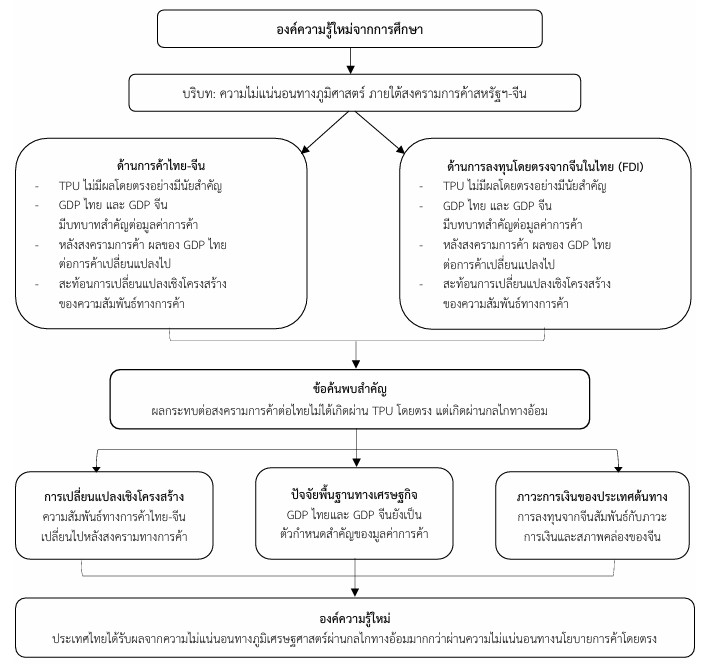
การศึกษานี้มีวัตถุประสงค์เพื่อศึกษา 1) ผลกระทบของความไม่แน่นอนทางภูมิเศรษฐศาสตร์ ภายใต้บริบทของสงครามการค้าระหว่างสหรัฐอเมริกาและสาธารณรัฐประชาชนจีน ที่มีต่อมูลค่าการค้าไทย–จีน และ 2) ผลกระทบต่อการลงทุนโดยตรงจากจีนในประเทศไทย โดยใช้ดัชนีความไม่แน่นอนทางนโยบายการค้า (Trade Policy Uncertainty: TPU) เป็นตัวแทนของความไม่แน่นอนทางภูมิเศรษฐศาสตร์ในมิติของนโยบายการค้า การศึกษาใช้ข้อมูลอนุกรมเวลารายไตรมาส ตั้งแต่ไตรมาสที่ 1 ปี พ.ศ. 2552 ถึงไตรมาสที่ 4 ปี พ.ศ. 2567 รวม 64 ไตรมาส และวิเคราะห์ด้วยแบบจำลอง Seemingly Unrelated Regression (SUR) ผลการศึกษาพบว่า TPU ไม่มีความสัมพันธ์อย่างมีนัยสำคัญทางสถิติกับมูลค่าการค้าไทย–จีนและการลงทุนโดยตรงจากจีนในประเทศไทย อีกทั้งตัวแปรปฏิสัมพันธ์ระหว่าง TPU กับตัวแปรจำลองสงครามการค้าไม่มีนัยสำคัญทางสถิติทั้งในสมการการค้าและสมการการลงทุน ดังนั้น การศึกษานี้จึงไม่พบหลักฐานเชิงประจักษ์ว่า TPU มีความสัมพันธ์โดยตรงกับการค้าและการลงทุนระหว่างไทยกับจีนภายใต้แบบจำลองที่ใช้ อย่างไรก็ตาม แบบจำลองสุดท้ายพบว่า GDP ของไทยและ GDP ของจีนมีความสัมพันธ์เชิงบวกกับมูลค่าการค้าไทย–จีนอย่างมีนัยสำคัญทางสถิติ ขณะที่ตัวแปรปฏิสัมพันธ์ระหว่าง GDP ของไทยกับตัวแปรจำลองสงครามการค้ามีความสัมพันธ์เชิงลบกับมูลค่าการค้าอย่างมีนัยสำคัญทางสถิติ สะท้อนว่าความสัมพันธ์ระหว่าง GDP ไทยกับการค้าไทย–จีนเปลี่ยนแปลงไปภายหลังสงครามการค้า สำหรับสมการการลงทุน พบว่า SHIBOR มีความสัมพันธ์เชิงบวกกับการลงทุนโดยตรงจากจีนในประเทศไทยอย่างมีนัยสำคัญทางสถิติ ผลการศึกษาชี้ว่า ประเทศไทยควรเสริมสร้างปัจจัยพื้นฐานทางเศรษฐกิจ เพิ่มขีดความสามารถในการส่งออก ปรับโครงสร้างการค้า และติดตามภาวะการเงินของจีน เพื่อใช้ประกอบการกำหนดนโยบายดึงดูดการลงทุนจากจีน
เอกสารอ้างอิง
กระทรวงพาณิชย์. (2567). ข้อมูลการค้าระหว่างประเทศไทยกับสาธารณรัฐประชาชนจีน. กรุงเทพฯ: กระทรวงพาณิชย์.
สำนักงานคณะกรรมการส่งเสริมการลงทุน. (2567). รายงานภาวะการส่งเสริมการลงทุนจากต่างประเทศ. กรุงเทพฯ: สำนักงานคณะกรรมการส่งเสริมการลงทุน.
Anderson, J. E., & Van Wincoop, E. (2003). Gravity with gravitas: A solution to the border puzzle. American economic review, 93(1), 170-192.
Blackwill, R. D., & Harris, J. M. (2016). War by other means: Geoeconomics and statecraft. Cambridge, MA: Harvard University Press.
Bown, C. P. (2021). The US–China trade war and phase one agreement (Peterson Institute for International Economics Working Paper No. 21-2). Washington, DC: Peterson Institute for International Economics.
Caldara, D., Iacoviello, M., Molligo, P., Prestipino, A., & Raffo, A. (2020). The economic effects of trade policy uncertainty. Journal of monetary economics, 109, 38-59.
Chen, K., Xiao, Y., & Zha, T. (2022). China’s monetary transmission and systemic risk: A role of interbank bond markets. Georgia: Emory University and Federal Reserve Bank of Atlanta.
Dang, A. H., Krishna, K., & Zhao, Y. (2023). Winners and losers from the U.S.–China trade war (NBER Working Paper No. 31922). Cambridge, MA: National Bureau of Economic Research.
Das, S., & Song, W. (2023). Monetary policy transmission and policy coordination in China. China Economic Review, 82, 102032.
Dixit, A. K., & Pindyck, R. S. (1994). Investment under uncertainty. Princeton, NJ: Princeton University Press.
Fajgelbaum, P. D., Goldberg, P. K., Kennedy, P. J., & Khandelwal, A. K. (2020). The return to protectionism. The Quarterly Journal of Economics, 135(1), 1–55.
Farrell, H., & Newman, A. L. (2019). Weaponized interdependence: How global economic networks shape state coercion. International Security, 44(1), 42–79.
Freund, C., Mattoo, A., Mulabdic, A., & Ruta, M. (2023). Is US trade policy reshaping global supply chains? (Policy Research Working Paper No. 10593). Washington, DC: World Bank.
Handley, K., & Limão, N. (2017). Policy uncertainty, trade, and welfare: Theory and evidence for China and the United States. American Economic Review, 107(9), 2731–2783.
Keorite, M., & Pan, H. (2016). The impacts of Chinese direct investment in Thailand on the Sino-Thai bilateral trade. Journal of Chinese Economic and Foreign Trade Studies, 9(1), 24–39.
Office of the United States Trade Representative. (2018). Section 301 investigation: China’s acts, policies, and practices related to technology transfer, intellectual property, and innovation. Washington, DC: Office of the United States Trade Representative.
Sinha, A., & Ghosh, T. (2021). Impact of economic policy uncertainty on FDI inflows: Evidence from India. In W. A. Barnett & B. S. Sergi (Eds.), Recent developments in Asian economics: International symposia in economic theory and econometrics (Vol. 28, pp. 157–167). Bingley, UK: Emerald Publishing Limited.
Tinbergen, J. (1962). Shaping the world economy: Suggestions for an international economic policy. New York: The Twentieth Century Fund.
UNCTAD. (2020). World Investment Report 2020: International production beyond the pandemic. Geneva: United Nations.
ดาวน์โหลด
เผยแพร่แล้ว
รูปแบบการอ้างอิง
ฉบับ
ประเภทบทความ
สัญญาอนุญาต
ลิขสิทธิ์ (c) 2026 วารสารสังคมศาสตร์ปัญญาพัฒน์

อนุญาตภายใต้เงื่อนไข Creative Commons Attribution-NonCommercial-NoDerivatives 4.0 International License.


