The Impact of Geo-economic Uncertainty on Trade and Foreign Direct Investment between Thailand and China
Keywords:
Geo-economic Uncertainty, Trade Policy Uncertainty, Trade War, Thailand–China Trade, Chinese Foreign Direct Investment, Seemingly Unrelated Regression ModelAbstract
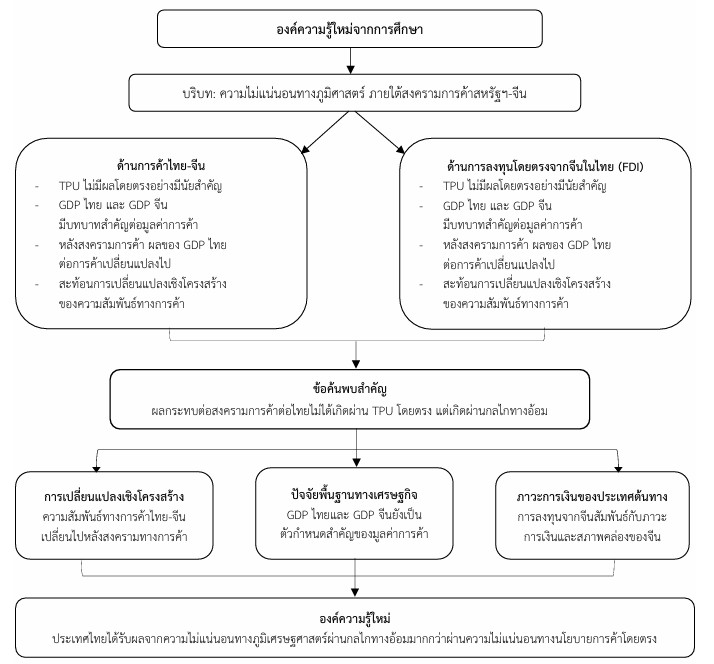
This study examines (1) the impact of geo-economic uncertainty under the context of the trade war between the United States and the People’s Republic of China on Thailand–China trade value, and (2) its impact on foreign direct investment from China to Thailand. The Trade Policy Uncertainty Index (TPU) is used as a proxy for geo-economic uncertainty in the dimension of trade policy. The study uses quarterly time-series data from the first quarter of 2009 to the fourth quarter of 2024, covering 64 quarters, and applies the Seemingly Unrelated Regression (SUR) model. The results show that TPU has no statistically significant relationship with Thailand–China trade value or foreign direct investment from China to Thailand. The interaction term between TPU and the Trade War Dummy is also not statistically significant in either the trade or investment equation. Therefore, the study does not find empirical evidence that TPU has a direct relationship with Thailand–China trade and investment under the model used. However, the final model shows that Thailand’s GDP and China’s GDP have a positive and statistically significant relationship with Thailand–China trade value. Meanwhile, the interaction term between Thailand’s GDP and the Trade War Dummy has a negative and statistically significant relationship with trade value, indicating that the relationship between Thailand’s GDP and Thailand–China trade changed after the trade war. For the investment equation, SHIBOR has a positive and statistically significant relationship with foreign direct investment from China to Thailand. The findings suggest that Thailand should strengthen its economic fundamentals, improve export competitiveness, adjust its trade structure, and monitor China’s financial conditions when designing policies to attract Chinese investment.
References
กระทรวงพาณิชย์. (2567). ข้อมูลการค้าระหว่างประเทศไทยกับสาธารณรัฐประชาชนจีน. กรุงเทพฯ: กระทรวงพาณิชย์.
สำนักงานคณะกรรมการส่งเสริมการลงทุน. (2567). รายงานภาวะการส่งเสริมการลงทุนจากต่างประเทศ. กรุงเทพฯ: สำนักงานคณะกรรมการส่งเสริมการลงทุน.
Anderson, J. E., & Van Wincoop, E. (2003). Gravity with gravitas: A solution to the border puzzle. American economic review, 93(1), 170-192.
Blackwill, R. D., & Harris, J. M. (2016). War by other means: Geoeconomics and statecraft. Cambridge, MA: Harvard University Press.
Bown, C. P. (2021). The US–China trade war and phase one agreement (Peterson Institute for International Economics Working Paper No. 21-2). Washington, DC: Peterson Institute for International Economics.
Caldara, D., Iacoviello, M., Molligo, P., Prestipino, A., & Raffo, A. (2020). The economic effects of trade policy uncertainty. Journal of monetary economics, 109, 38-59.
Chen, K., Xiao, Y., & Zha, T. (2022). China’s monetary transmission and systemic risk: A role of interbank bond markets. Georgia: Emory University and Federal Reserve Bank of Atlanta.
Dang, A. H., Krishna, K., & Zhao, Y. (2023). Winners and losers from the U.S.–China trade war (NBER Working Paper No. 31922). Cambridge, MA: National Bureau of Economic Research.
Das, S., & Song, W. (2023). Monetary policy transmission and policy coordination in China. China Economic Review, 82, 102032.
Dixit, A. K., & Pindyck, R. S. (1994). Investment under uncertainty. Princeton, NJ: Princeton University Press.
Fajgelbaum, P. D., Goldberg, P. K., Kennedy, P. J., & Khandelwal, A. K. (2020). The return to protectionism. The Quarterly Journal of Economics, 135(1), 1–55.
Farrell, H., & Newman, A. L. (2019). Weaponized interdependence: How global economic networks shape state coercion. International Security, 44(1), 42–79.
Freund, C., Mattoo, A., Mulabdic, A., & Ruta, M. (2023). Is US trade policy reshaping global supply chains? (Policy Research Working Paper No. 10593). Washington, DC: World Bank.
Handley, K., & Limão, N. (2017). Policy uncertainty, trade, and welfare: Theory and evidence for China and the United States. American Economic Review, 107(9), 2731–2783.
Keorite, M., & Pan, H. (2016). The impacts of Chinese direct investment in Thailand on the Sino-Thai bilateral trade. Journal of Chinese Economic and Foreign Trade Studies, 9(1), 24–39.
Office of the United States Trade Representative. (2018). Section 301 investigation: China’s acts, policies, and practices related to technology transfer, intellectual property, and innovation. Washington, DC: Office of the United States Trade Representative.
Sinha, A., & Ghosh, T. (2021). Impact of economic policy uncertainty on FDI inflows: Evidence from India. In W. A. Barnett & B. S. Sergi (Eds.), Recent developments in Asian economics: International symposia in economic theory and econometrics (Vol. 28, pp. 157–167). Bingley, UK: Emerald Publishing Limited.
Tinbergen, J. (1962). Shaping the world economy: Suggestions for an international economic policy. New York: The Twentieth Century Fund.
UNCTAD. (2020). World Investment Report 2020: International production beyond the pandemic. Geneva: United Nations.
Downloads
Published
How to Cite
Issue
Section
License
Copyright (c) 2026 Journal of Social Science Panyapat

This work is licensed under a Creative Commons Attribution-NonCommercial-NoDerivatives 4.0 International License.


