Buddhadhamma Integration for The Promotion of People Participation for Community Development of Mueang Mo Sub-District, Mueang Phrae District, Phrae Province
Keywords:
Aparihaniyadhamma, Political Participation, Community DevelopmentAbstract
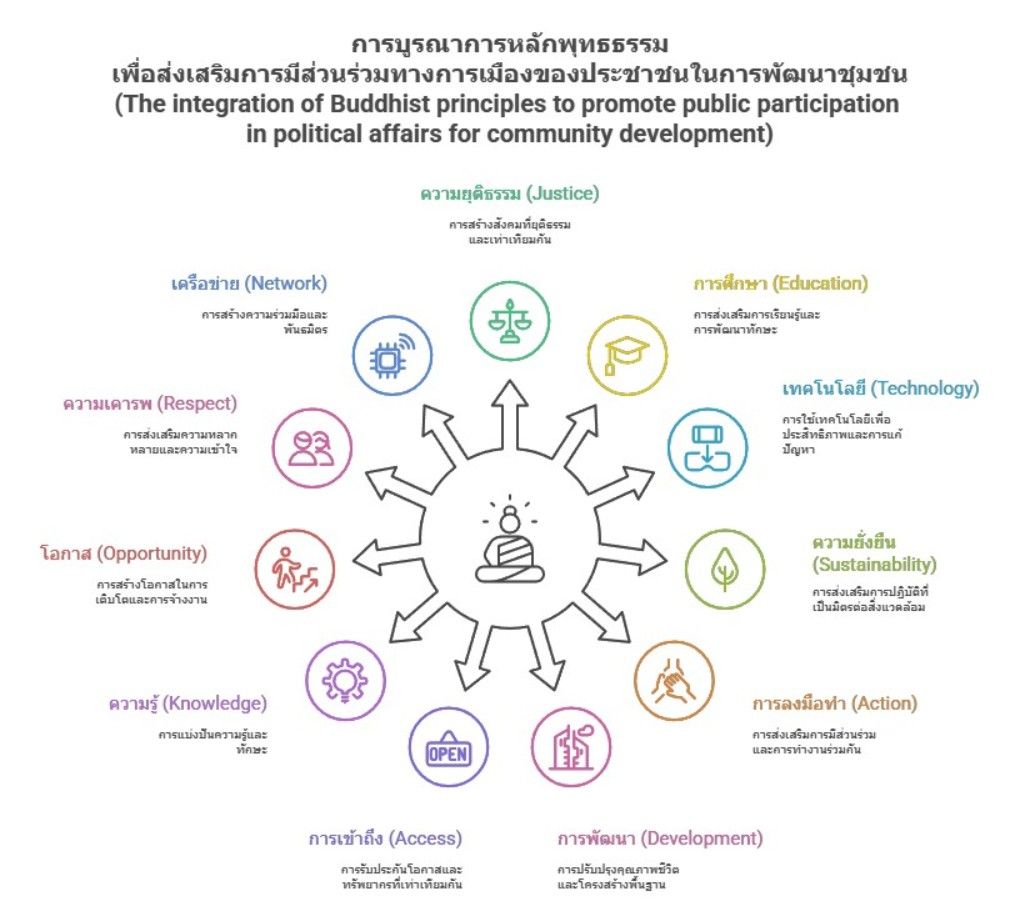
This article aims to study (1) the level of political participation of the people in the community development of Mueang Mo Subdistrict, (2) the relationship between the principles of Aparihaniyadhamma and the political participation of the people in the community development of Mueang Mo Subdistrict, and (3) the guidelines for integrating the principles of Aparihaniyadhamma to promote political participation of the people in the community development of Mueang Mo Subdistrict, Mueang Phrae District, Phrae Province. This study employs a mixed-methods research approach, involving a sample size of 379 participants and in-depth interviews with 10 key informants. Quantitative data were analyzed using descriptive statistics and Pearson correlation coefficients, while qualitative data were analyzed using content analysis methods. The findings reveal that (1) the level of political participation of the people in community development according to the seven principles of Aparihaniyadhamma is overall at a moderate level; (2) the relationship between the seven principles of Aparihaniyadhamma and political participation shows a moderate positive correlation, statistically significant; (3) the guidelines for integrating the seven principles of Aparihaniyadhamma to promote political participation are as follows: 1) community members should collaboratively establish practices to promote unity; 2) effective meetings should be organized with harmony and clear communication, including the adoption of technology in remote areas; 3) adherence to existing regulations should be maintained while being open to new ideas; 4) respect for elders with experience and virtue should be upheld; 5) equal rights and roles of women should be supported; 6) cultural traditions should be preserved as the center of development; 7) virtuous individuals in the community should be recognized as inspiration for continuous social development.
References
เขมานันท์ ขบวนฉลาด. (2564) การประยุกต์ใช้หลักอปริหานิยธรรมเพื่อการบริหารจัดการขององค์การบริหาร ส่วนตำบลประทัดบุ อำเภอปราสาท จังหวัดสุรินทร์. วารสารมหาจุฬาคชสาร, 12(2), 133–142.
ณัฏฐพันธ์ เขจรนันทน์. (2564). พฤติกรรมองค์การ. กรุงเทพฯ: ซีเอ็ดยูเคชัน.
นวลจันทร์ อนันต์ชื่น. (2561). ระเบียบวิธีวิจัยทางสังคมศาสตร์. กรุงเทพฯ: มหาวิทยาลัยเกษตรศาสตร์.
ประจวบ แสนทวีสุข. (2560). การพัฒนาชุมชน: แนวคิดและทฤษฎี. กรุงเทพฯ: มหาวิทยาลัยรามคำแหง.
พระใบฎีกาไพโรจน์ กนฺตธมฺโม (สุปินะ). (2565). การประยุกต์หลักพุทธธรรมเพื่อส่งเสริมพฤติกรรมทางการเมืองแบบมีส่วนร่วมของประชาชนในการเลือกตั้งผู้บริหารท้องถิ่นเทศบาลตำบลจริม อำเภอท่าปลา จังหวัดอุตรดิตถ์. (รัฐศาสตรมหาบัณฑิต, มหาวิทยาลัยมหาจุฬาลงกรราชวิทยาลัย).
พระมหาหน่อทราย รตนเมธี (นามแก้ว). (2565). การส่งเสริมการมีส่วนร่วมทางการเมืองภาคประชาชนตามวิถีประชาธิปไตยในชุมชนบ้านดง ตำบลสวนเขื่อน อำเภอเมืองแพร่ จังหวัดแพร่. (รัฐศาสตรมหาบัณฑิต, มหาวิทยาลัยมหาจุฬาลงกรราชวิทยาลัย).
สำนักเลขาธิการคณะรัฐมนตรี. (2560). รัฐธรรมนูญแห่งราชอาณาจักรไทย พ.ศ. 2560. สืบค้นจาก https://www.ratchakitcha.soc.go.th/DATA/PDF/2560/A/040/1.PDF.
สุภาวดี ปันเต็ม. (2565). การมีส่วนร่วมทางการเมืองของประชาชนในการเลือกตั้งผู้บริหารท้องถิ่นทศบาลตำบลห้วยอ้อ อำเภอลอง จังหวัดแพร่. (รัฐศาสตรมหาบัณฑิต, มหาวิทยาลัยมหาจุฬาลงกรราชวิทยาลัย).
องค์การบริหารส่วนตำบลเหมืองหม้อ. (2566). แผนพัฒนาท้องถิ่น (พ.ศ. 2566-2570). แพร่: องค์การบริหารส่วนตำบลเหมืองหม้อ.
Yamane, T. (1973). Statistics: An Introductory Analysis. (3rd ed.). New York: Harper & Row.
Downloads
Published
How to Cite
Issue
Section
License
Copyright (c) 2025 Journal of Social Science Panyapat

This work is licensed under a Creative Commons Attribution-NonCommercial-NoDerivatives 4.0 International License.


