Competitiveness and Factors Affecting Thai Rice Exports during 2007–2023: An Analysis using the Diamond Model Framework
Keywords:
Competitiveness, Rice Exports, Diamond Model, Prais-Winsten AR(1), Porter's FrameworkAbstract
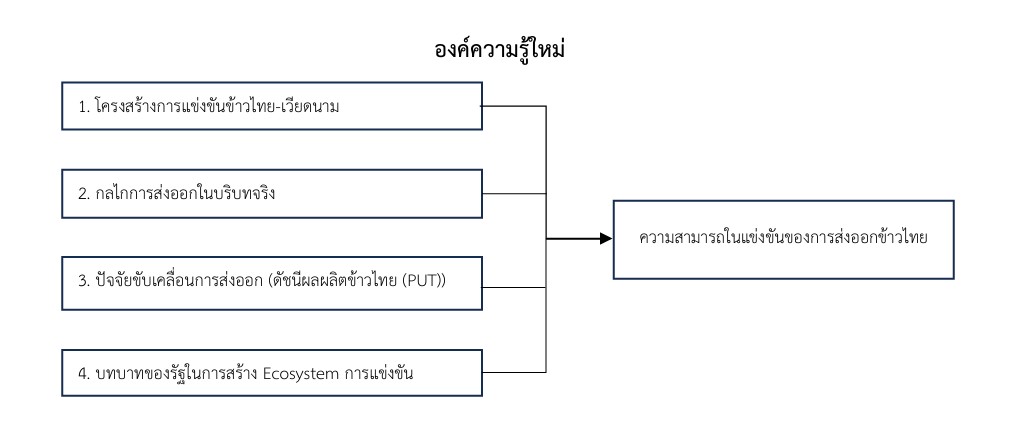
This article aimed to (1) examine Thailand’s competitiveness in rice exports by comparing it with Vietnam, and (2) analyze the factors affecting the volume of Thai rice exports to the global market and China. This study employs a mixed-methods approach. The analysis of export competitiveness is based on Porter’s Diamond Model framework, while the factors influencing Thai rice export volumes are assessed using a multiple linear regression model via the Prais-Winsten AR(1) technique, with secondary quarterly time series data from Q1 2007 to Q4 2023. The study examines Thailand’s competitiveness in rice exports by comparing it with Vietnam. The findings indicate that Thailand holds competitive advantages in financial costs, transportation and logistics infrastructure, and rice production technology. Thailand also successfully leveraged the suspension of India’s rice exports to expand its market share. On the other hand, Vietnam has advantages in labor both in terms of quantity and lower costs higher productivity per unit area, advances in rice breeding, and a proactive government role in negotiating free trade agreements (FTAs). In addition, the study also investigates factors influencing the volume of Thai rice exports to the global market and to China. The results show that Thailand’s rice production index has a positive effect on the volume of rice exports to both the global market and China. Moreover, global gross domestic product (GDP) positively affects Thailand’s rice export volume to the global market. These findings highlight the importance of improving production efficiency as a key strategy to enhance Thailand’s rice export competitiveness.
References
กรมการค้าต่างประเทศ. (2567). ข้อมูลสถานการณ์ข้าวสาธารณรัฐสังคมนิยมเวียดนามเดือนมีนาคม 2567. สืบค้นจาก https://www.dft.go.th/Portals/0/สถานการณ์สินค้า/ข้าว/ข้าวเวียดนาม%20ณ%20มี.ค.%2067.pdf.
ชัชชฎา หาญเจนลักษณ์. (2549). การวิเคราะห์การส่งออกข้าวจากไทยไปอิหร่าน. (เศรษฐศาสตรมหาบัณฑิต, จุฬาลงกรณ์มหาวิทยาลัย).
น้ำผึ้ง เทศนา. (2551). อุปสงค์การส่งออกข้าวของไทยในตลาดโลก. (เศรษฐศาสตรมหาบัณฑิต, มหาวิทยาลัยรามคำแหง).
ลงทุนแมน. (2565). ทำไมข้าวไทย ถึงโดนข้าวอินเดียและเวียดนาม แซงหน้า. สืบค้นจาก https://www.longtunman.com/37335.
ลัทธพร รัตนวรารักษ์ และ โสมรัศมิ์ จันทรัตน์. (2566). หลักประกันสินเชื่อของเกษตรกรไทย รูปแบบไหนควรถูกทบทวน?. สืบค้นจาก https://www.pier.or.th/blog/2023/1101/.
ศุภิกา พงเพ็ง. (2557). การศึกษาการเปรียบเทียบเชิงแข่งขัน และความได้เปรียบโดยเปรียบเทียบที่ปรากฏของการส่งออกข้าวของประเทศไทย ประเทศเวียดนาม และประเทศอินเดีย. (เศรษฐศาสตรมหาบัณฑิต, มหาวิทยาลัยเกษตรศาสตร์).
ศูนย์เทคโนโลยีสารสนเทศและการสื่อสาร สำนักงานปลัดกระทรวงพาณิชย์. (2567). สัดส่วนสินค้าส่งออกสำคัญของไทยประเภทสินค้ากสิกรรม ปี 2566. สืบค้นจาก https://tradereport.moc.go.th/.
ศูนย์วิจัยธนาคารกรุงศรี. (2567). แนวโน้มธุรกิจ/อุตสาหกรรม 2567-2569: อุตสาหกรรมข้าว. สืบค้นจาก https://www.krungsri.com/th/research/industry/industry-outlook/agriculture/rice/io/io-rice-2024-2026.
สมาคมผู้ส่งออกข้าวไทย. (2567). สรุปข่าวประจําวันที่ 21–27 กุมภาพันธ์ 2567: เปิดรายชื่อ ข้าวพันธุ์ใหม่ 10 สายพันธุ์ ปี 2567. สืบค้นจาก http://www.thairiceexporters.or.th/.
สุภาณี หาญพัฒนะนุสรณ์. (2562). เศรษฐศาสตร์ระหว่างประเทศ. (พิมพ์ครั้งที่ 2). กรุงเทพฯ: มหาวิทยาลัยเกษตรศาสตร์.
อัมพร สุวรรณรัตน์. (2554). การวิเคราะห์อุปสงค์ส่งออกข้าวหอมมะลิจากประเทศไทยไปยังประเทศนำเข้าที่สำคัญในสหภาพยุโรป. (วิทยาศาสตรมหาบัณฑิต, มหาวิทยาลัยเกษตรศาสตร์).
DEPA. (2020). Agriculture landscape in Thailand. Bangkok: Digital Economy Promotion Agency. Retrieved from https://www.depa.or.th/storage/app/media/Investment%20Bulletin_Final.pdf.
EIC. (2022). India rice export policy: A window of opportunity for Thai rice. Retrieved from https://www.scbeic.com/th/detail/product/7996.
FAO. (2024). Digital agriculture profile Vietnam. Retrieved from https://openknowledge.fao.org/handle/20.500.14283/cb3956en.
ILO. (2023). ILOSTAT database. Retrieved from https://ilostat.ilo.org/data/.
IRRI. (2022). Use of digital tools in sustainable rice production in the Mekong Delta, Vietnam. Laguna, Philippines: International Rice Research Institute.
ITU. (2023). Measuring digital development: The ICT Development Index 2023. Geneva: International Telecommunication Union.
Jankulovski, N., & Khan, U. E. (2024). Asian Rice Exports and the European Demand: An Application of the Modified Panel Gravity Model. Journal of Agricultural Science, 14(8), 1-18.
Krugman, P. (1994). Competitiveness: A dangerous obsession. Foreign Affairs, 73(2), 28-44.
Lac, H. (2020). An analysis of factors influencing Vietnam’s rice export to the ASEAN+3 countries. Hanoi: FPT University.
Li, S., & Luo, H. (2018). Competitiveness of Rice Industry in Hunan Province—A Diamond Model. IOP Conference Series: Earth and Environmental Science, 189(4), 42-45.
Mordor Intelligence. (2024). Southeast Asia fertilizer market – Size, share & industry analysis (2025–2030). Retrieved from https://www.mordorintelligence.com/industry-reports/south-east-asia-fertilizer-market.
The Rice Trader. (2024). Weekly Global Rice Industry Report. Retrieved from https://www.worldriceconference.com/event/8da33100-d8fd-42f8-847f-819a83ade47c/the-rice-trader-weekly-global-rice-industry-report.
Trade Map. (2023). มูลค่าการนำเข้าและส่งออกปุ๋ยของไทยและเวียดนาม. สืบค้นจาก https://m.trademap.org/#/grid/220422/764/156/export/product
Trade Map. (2024a). แนวโน้มการส่งออกข้าว ปี 2007–2023. สืบค้นจาก.https://m.trademap.org/#/grid/1006/764/156/export/product.
Trade Map. (2024b). ราคาข้าว F.O.B ไทยและเวียดนาม ปี 2007–2023. สืบค้นจาก https://m.trademap.org/#/grid/1006/764/156/export/product.
Trade Map. (2024c). อัตราการขยายตัวของการส่งออกข้าว ปี 2012–2022. สืบค้นจาก https://m.trademap.org/#/grid/1006/764/156/export/product.
USDA. (2024). Grain and Feed Annual: Thailand (TH2025-0011). Retrieved from https://apps.fas.usda.gov/newgainapi/api/Report/DownloadReportByFileName?fileName=Grain%20and%20Feed%20Annual_Bangkok_Thailand_TH2025-0011.pdf.
WageIndicator Foundation. (2023). Minimum wage database. Retrieved from https://wageindicator.org/salary/minimum-wage.
World Bank. (2023). Connecting to Compete 2023: Trade Logistics in an Uncertain Global Economy. Washington, DC: The World Bank.
World Bank. (2025). Lending interest rate (%). Retrieved from https://data.worldbank.org/indicator/FR.INR.LEND.
Downloads
Published
How to Cite
Issue
Section
License
Copyright (c) 2025 Journal of Social Science Panyapat

This work is licensed under a Creative Commons Attribution-NonCommercial-NoDerivatives 4.0 International License.


