Effects of Sandwich Generation and Financial Literacy on Over-Indebtedness of Government Officers in Office of the Permanent Secretary, Ministry of Commerce
Keywords:
Over-indebtedness, Sandwich Generation, Financial LiteracyAbstract
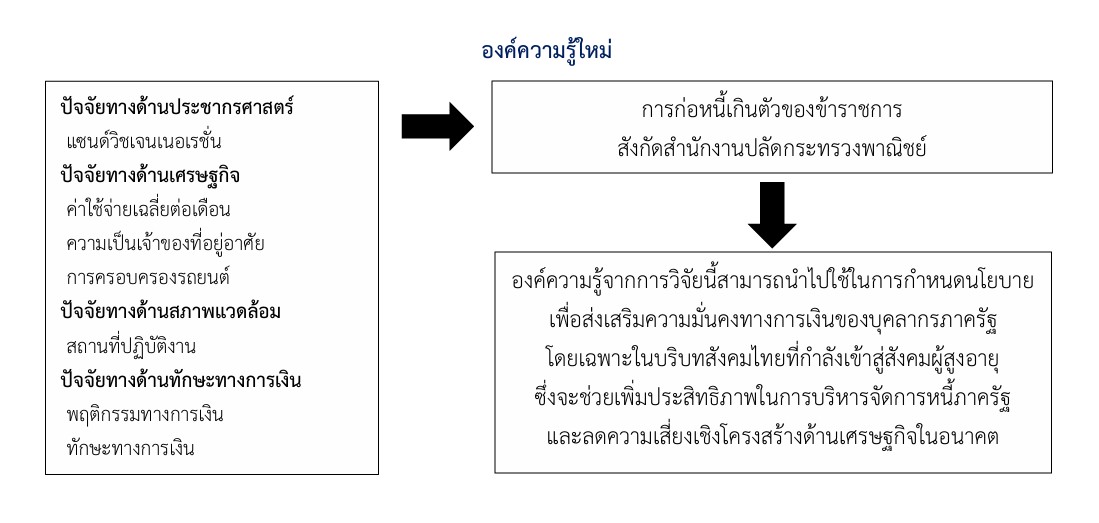
This study aims to examine the behaviors and factors influencing over-indebtedness among civil servants under the Office of the Permanent Secretary, Ministry of Commerce. Primary data were collected through 313 questionnaires and analyzed using descriptive statistics and inferential statistics through a Logit Model to explore the relationships between demographic, economic, environmental factors, and financial literacy in relation to over-indebtedness. The results revealed that statistically significant positive factors contributing to over-indebtedness include being part of the sandwich generation (i.e., individuals financially responsible for supporting at least two generations of family members), homeownership, and car ownership. On the other hand, statistically significant negative factors include average monthly expenses, workplace location, financial literacy, and financial behavior. Therefore, relevant agencies should implement targeted support measures, especially for individuals in the sandwich generation, such as financial assistance, tax relief, and financial literacy promotion. Additionally, establishing internal financial advisory services is also recommended to enhance financial discipline, reduce the risk of over-indebtedness, and sustainably strengthen the economic stability of public sector personnel.
References
ฉวีวรรณ กาบขาว. (2561). ปัจจัยที่กำหนดความเป็นไปได้ในการก่อหนี้ภาคครัวเรือน. (เศรษฐศาสตรมหาบัณฑิต, มหาวิทยาลัยเกษตรศาสตร์).
ชัญญา ประสุรักษ์. (2557). การศึกษาพฤติกรรมและปัจจัยที่ก่อให้เกิดการก่อหนี้ของข้าราชการครูในจังหวัดมหาสารคาม. (เศรษฐศาสตรมหาบัณฑิต, มหาวิทยาลัยขอนแก่น).
ธนาคารกรุงไทย. (2566). สำรวจภาระหนี้ มีแค่ไหน ถึงอยู่ในจุดปลอดภัย. สืบค้นจาก https://shorturl.asia/8dNeh.
ธนาคารแห่งประเทศไทย. (2565). รายงานผลสำรวจทักษะทางการเงินของไทยปี 2565. สืบค้นจาก https://shorturl.asia/F2eJh.
ธนาคารแห่งประเทศไทย. (2567). เงินให้กู้ยืมแก่ภาคครัวเรือน. สืบค้นจาก https://shorturl.asia/ZQkpt.
ภัทรนันท์ สงวนวัฒนารักษ์, ธีรศักดิ์ ทรัพย์วโรบล และ กนกวรรณ จันทร์เจริญชัย. (2567). ปัจจัยที่ส่งผลต่อพฤติกรรมการก่อหนี้เกินตัวตามวัฏจักรชีวิตของครัวเรือน. วารสารสังคมศาสตร์ปัญญาพัฒน์, 6(2), 26–36.
วนิดา วิศิษฎ์วรากร. (2558). ภาระหนี้สินของข้าราชการหลังนโยบายเงินเดือน พ.ศ. 2556 : กรณีศึกษา สำนักงานปลัดกระทรวงทรัพยากรธรรมชาติและสิ่งแวดล้อม. (ศิลปศาสตรมหาบัณฑิต, มหาวิทยาลัยเกษตรศาสตร์).
วิภา สำราญ. (2564). ความสัมพันธ์ระหว่างทักษะทางการเงินของประชากรและปัจจัยทางเศรษฐกิจต่อการก่อหนี้ครัวเรือนในจังหวัดเชียงราย. (บริหารธุรกิจมหาบัณฑิต, มหาวิทยาลัยแม่ฟ้าหลวง).
Adzis, A. A., Bakar, J. A., & Shahar, H. K. (2017). Factors influencing young adult's debt in Malaysia. Journal of Business and Retail Management Research, 12(1), 76-85.
Anjani, D. D., & Wulandari, S. (2024). The Influence of Income Level, Financial Behavior and Financial Management on Financial Well-Being in the Sandwich Generation (Study in Sukaragam Village, Serang Baru District). Dinasti International Journal of Economics, Finance & Accounting, 5(3), 970-981.
Downloads
Published
How to Cite
Issue
Section
License
Copyright (c) 2025 Journal of Social Science Panyapat

This work is licensed under a Creative Commons Attribution-NonCommercial-NoDerivatives 4.0 International License.


