Capabilities of Artificial Intelligence and Human Resource Competencies Influencing Operational Efficiency Development in the Automotive Industry Eastern Economic Corridor of Thailand
Keywords:
Capabilities of Artificial Intelligence, Human Resource Competencies, Operational Efficiency DevelopmentAbstract
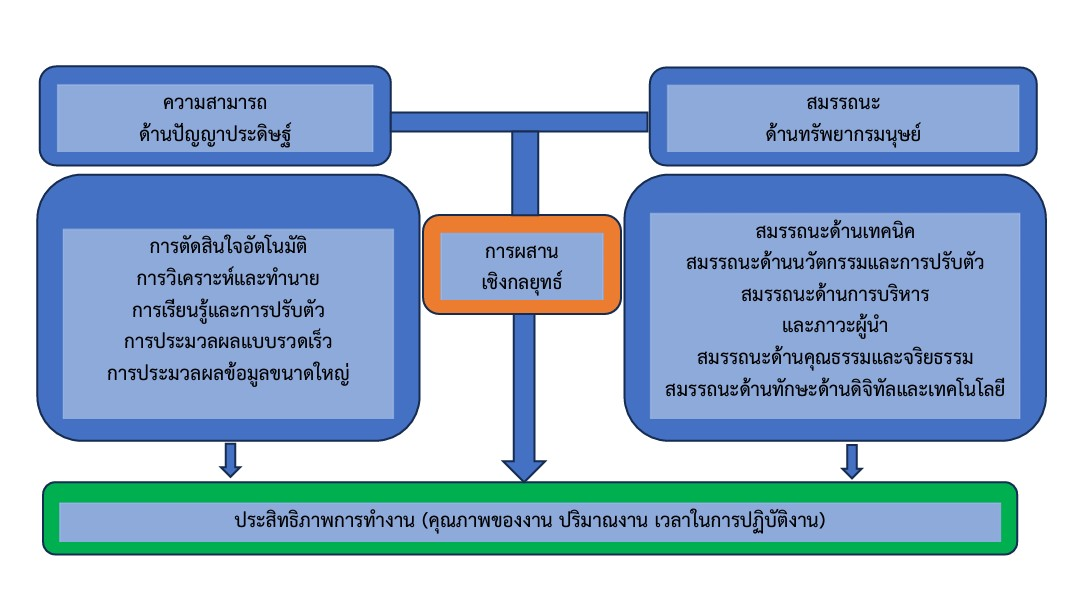
The purposes of this study were (1) to develop the causal model of enhancing operational efficiency influenced by artificial intelligence capabilities and human resources competencies, and examine model validity with the empirical data, and (2) to analyzes the direct effects of artificial intelligence capabilities and human resource competencies on operational efficiency development in the automotive industry in the eastern economic corridor of Thailand, and examine model validity with the empirical data. The tool used in this study was a questionnaire with 5-point rating scale. Participants were 400 employees working in the automotive industry eastern economic corridor of Thailand using stratified and simple random sampling. Data were analyzed by confirmatory factor analysis and structural equation modeling. The research findings indicate a structural fit between the model and the empirical data, with the following indices: x2/df = 2.236, RMSEA = 0.056, CFI = 0.987, GFI = 0.962, NFI = 0.977, TLI = 0.987, and RMR = 0.014. Moreover, the direct influences of artificial intelligence capabilities and human resource competencies on operational efficiency development were found to be 0.33 and 0.46, respectively, with the following indices: x2/df = 2.086, RMSEA = 0.052, CFI = 0.988, GFI = 0.960, NFI = 0.988, TLI = 0.982, and RMR = 0.010. The implementation suggestion is that Capabilities of Artificial Intelligence should focus on autonomous decision-making analytics and prediction, learning and adaptation, fast processing, and big data processing. In terms of human resource competency, it should focus on digital and technology, technical, innovation and adaptability, managerial and leadership, and work ethics and discipline to make operations more efficient.
References
ทิพานัน ชะเอมไทย, พัณณิตา หมายงาม, ศิราพร สาดบางเคียน, อภิสรา สีเงิน และ รัตนา สีดี. (2565). ความสัมพันธ์ระหว่างการพัฒนาสมรรถนะของทรัพยากรมนุษย์กับประสิทธิภาพการปฏิบัติงานของพนักงานในเขตนิคมอุตสาหกรรม นวนครและสวนอุตสาหกรรมโรจนะ อยุธยา. วารสารสังคมศาสตร์ปัญญาพัฒน์, 4(4), 71-86.
บัณฑิตา เพิ่มเดช. (2564). การพัฒนาทรัพยากรมนุษย์ที่ส่งผลต่อประสิทธิภาพในการปฏิบัติงาน ของบุคลากรสำนักงานการตรวจเงินแผ่นดินส่วนกลาง. (บริหารธุรกิจมหาบัณฑิต, มหาวิทยาลัยรามคำแหง).
พัฒน์ศิณีนาฎ วรรณรัตน์. (2567). การศึกษานวัตกรรมปัญญาประดิษฐ์เพื่อการบริหารทรัพยากรมนุษย์ กรณีศึกษาของ บริษัทในกลุ่มธุรกิจอุตสาหกรรมไมซ์ (MICE). (การจัดการมหาบัณฑิต, มหาวิทยาลัยมหิดล).
มงคล ปินตาโมงค์. (2561). สมรรถนะประจำกลุ่มงานของผู้ปฏิบัติงานด้านทะเบียนการศึกษามหาวิทยาลัยเชียงใหม่. (รัฐประศาสนศาสตรมหาบัณฑิต, มหาวิทยาลัยเชียงใหม่).
วสันต์ เกิดสวัสดิ์, สหพัฒน์ หอมจันทร์ และ กันต์ฐมณีญา นฤโฆษกิตติกีรติ. (2567). ปัจจัยสนับสนุนที่มีผลต่อประสิทธิผลในการปฏิบัติงานของเจ้าหน้าที่ในองค์กรภาครัฐและภาคเอกชนในยุคปัญญาประดิษฐ์. วารสารสหวิทยาการวิจัยและนวัตกรรมการศึกษา, 3(2), 31-50.
ศรัณย์ วัฒนา. (2560). การพัฒนาสมรรถนะของทรัพยากรมนุษย์ 4.0 เพื่อเพิ่มประสิทธิภาพการปฏิบัติงานไปสู่ประเทศไทย 4.0. (บริหารธุรกิจมหาบัณฑิต, มหาวิทยาลัยบูรพา).
ศักดิ์ไทย สุรกิจบวร. (2557). สมรรถนะสำคัญของผู้บริหารมืออาชีพ. วารสารมหาวิทยาลัยราชภัฏสกลนคร, 6(12), 165-184.
ศูนย์สารสนเทศยานยนต์ สถาบันยานยนต์. (2566). รายงานภาพรวมอุตสาหกรรมยานยนต์ไทย ปี 2566. สืบค้นจาก https://data.thaiauto.or.th/auto/articles-th/auto-articles-th.html?id=150.
สรชัย พิศาลบุตร, เสาวรส ใหญ่สว่าง และ ปรีชา อัศวเดชานุกร. (2550). การสร้างและประมวลผลข้อมูลจากแบบสอบถาม. กรุงเทพฯ: วิทยพัฒน์.
สำนักงานคณะกรรมการนโยบายเขตพัฒนาพิเศษภาคตะวันออก. (2567). เขตส่งเสริมเศรษฐกิจพิเศษเพื่อกิจการอุตสาหกรรม. สืบค้นจาก https://eeco.or.th/th/promotional-zone/eec-investment.
Agarwall, H., Das, C. P., & Swain, R. K. (2022). Does artificial intelligence influence the operational performance of companies? a study. In 2nd International Conference on Sustainability and Equity (ICSE-2021) (pp. 59-69). Dordrecht, The Netherlands: Atlantis Press.
Barney, J. B. (1991). Firm resources and sustained competitive advantage. Journal of Management, 17(1), 99-120.
Chen, J. R. (2019). Current status of artificial intelligence applications in urology and their potential to influence clinical practice. BJU international, 124(4), 567–577.
Diamantopoulos, A. & Siguaw, A. D. (2000). Introducing LISREL: A guide for the uninitiated. London: Sage.
Enholm, I. M., Papagiannidis, E., Mikalef, P., & Krogstie, J. (2022). Artificial intelligence and business value: A literature review. Information Systems Frontiers, 24(5), 1709-1734.
Gibson, E. J., & Pick, A. D. (2000). An ecological approach to perceptual learning and development. Oxford: Oxford University Press.
Guo, C., & Kenikasahmanworakhun, P. (2023). Transformational leadership affecting the performance of personnel in Jointown Pharmaceutical Group Co., Ltd. Journal of Value Chain Management and Business Strategy, 2(3), 1-14.
Hair, J. F., Black, W. C., Babin, B. J., & Anderson, R. E. (2010). Multivariate data analysis. (7th ed). New Jersey: Pearson Prentice Hall.
Hair, J. F., Risher, J. J., Sarstedt, M., & Ringle, C. M. (2019). When to use and how to report the results of PLS-SEM. European business review, 31(1), 2-24.
Ichdan, D. A. (2024). Analysis of employee performance through productivity: The role of kaizen culture, motivation, and work discipline in the manufacturing industry. Annals of Human Resource Management Research, 4(1), 13–28.
Klepić, I. (2022). The Influence of Human Resources Competency Management on the Business Success of Small and Medium Enterprises. Naše gospodarstvo/Our economy, 68(4), 12-27.
Lin, K. Y., & Chang, K. H. (2023). Artificial intelligence and information processing: A systematic literature review. Mathematics, 11(11), 2420.
Lindeman, R. H., Merenda, P. F., & Gold, R. Z. (1980). Introduction to Bivariate and Multivariate Analysis. Glenview, IL: Scott, Foresman and Company.
Menefee, M., Parnell, J., Powers, E., & Ziemnowicz, C. (2006). The role of human resources in the success of new businesses. Southern Business Review, 32(1), 23.
Mikalef, P., Lemmer, K., Schaefer, C., Ylinen, M., Fjørtoft, S. O., Torvatn, H. Y., Gupta, M., & Niehaves, B. (2023). Examining how AI capabilities can foster organizational performance in public organizations. Government Information Quarterly, 40(2), 1-14.
Özkan, C., & Şahin, S. (2024). AI Applications in Real-Time Edge Processing: Leveraging Artificial Intelligence for Enhanced Efficiency, Low-Latency Decision Making, and Scalability in Distributed Systems. Internation Journal of Machine Intelligence for Smart Applications, 14(8), 1-19.
Perifanis, N. A., & Kitsios, F. (2023). Investigating the influence of artificial intelligence on business value in the digital era of strategy: A literature review. Information, 14(2), 85.
Peterson, E. and Plowman, E.G. (1989). Business organization and management. llinois: Richard D. Irwin.
Priyadi, P., Migunani, M., & Sasmoko, D. (2024). Enhancing Big Data Processing Efficiency in AI-Based Healthcare Systems: A Comparative Analysis of Random Forest and Deep. Journal of Technology Informatics and Engineering, 3(3), 263-278.
Saleh, H., & Ainiah, S. (2024). Engineering Success: Training as a Catalyst for Performance in Automotive R&D. International Journal of Academic Research in Business and Social Sciences, 14(3), 573–589.
Sayed, E., Yasin, A., Elsayed, A., Ezzat, H., & Elsayed, O. (2022). Rebooting human resources: Upskilling for artificial intelligence in the Egyptian hotel sector. Journal of the Faculty of Tourism and Hotels-University of Sadat City, 6(1), 1-17.
Schwab, K. (2017). The Fourth Industrial Revolution. New York: Crown Business.
Spencer, L. M., & Spencer, S. M. (1993). Competence at work: Models for superior performance. New York: John Wiley & Sons.
Sun, Q. & Tarndamrong, P. (2024). Job Characteristics and Quality of Work Life on Employee Performance: A Case Study of Beijing Yingzhi Xinyuan Technology Co., Ltd. Procedia of Multidisciplinary Research, 2(2), 10-13.
Trávníčková, H., Ostin, V., & Mazurchenko, A. (2024). Driving Success: Unveiling Key Trends in Employee Training and Competency Development within the Automotive Industry. Central European Business Review, 13(4), 61–78.
Downloads
Published
How to Cite
Issue
Section
License
Copyright (c) 2025 Journal of Social Science Panyapat

This work is licensed under a Creative Commons Attribution-NonCommercial-NoDerivatives 4.0 International License.


