Factors Influencing the Level of Savings and Investment Among Generation Y in Thailand
Keywords:
Savings, Investment, Generation Y, Financial LiteracyAbstract
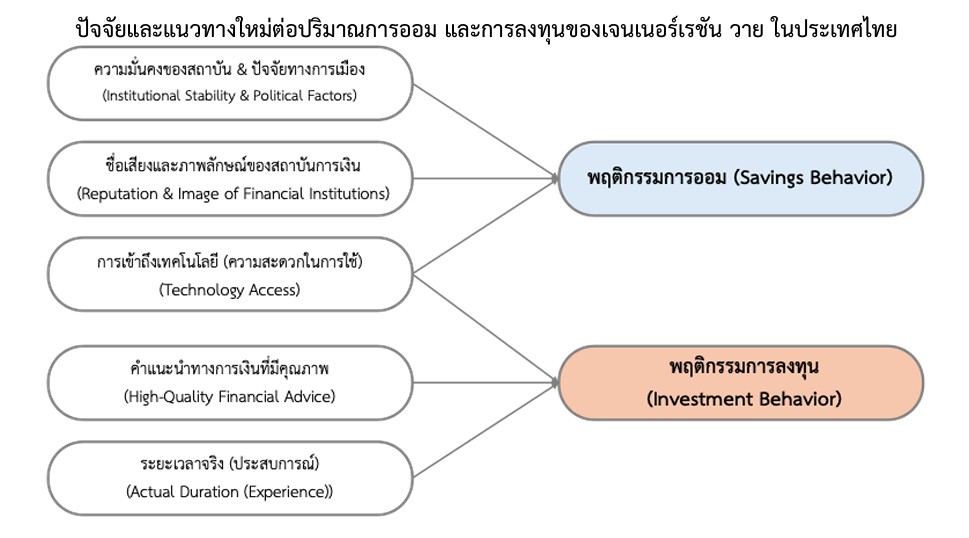
This research article aims to investigate the empirical factors influencing (1) the level of savings, and (2) the level of investment among Generation Y, defined as individuals born between 1981 and 2000. Data were collected through questionnaires (Google Forms) during January–May 2023, yielding 587 responses. The sample was divided into two groups: 400 respondents with savings and 219 respondents with investments. Respondents who failed the screening criteria—namely, those not born between 1981 and 2000 and those providing inaccurate information—were excluded. Multiple Linear Regression was employed to test the research hypotheses. The findings indicate that, at the 0.05 significance level, the factors positively influencing the savings of Generation Y include the reputation and image of financial institutions, the convenience of daily deposit and withdrawal services, saving and investing for the future, and political circumstances. Negative factors influencing savings include inflation rate, government policies and measures promoting savings, saving duration, sources of financial advice, and having debts and expenditures sufficient to offset savings. For investment, the results show that investment duration positively influences the level of investment at the 0.05 significance level, whereas investment selection criteria have a negative influence. The study suggests that promoting savings and investment among Generation Y requires collaboration among government agencies, financial institutions, and educational institutions. Specifically, the government should formulate policies and campaigns to foster financial discipline, financial institutions should develop accessible and reliable financial tools, and educational institutions should integrate personal finance into curricula and supplementary activities to cultivate sustainable financial behavior from an early age.
References
จุฬารัตน์ ศิริอังกุล. (2563). ทัศนคติการออมและการลงทุนของ generation Y ภายหลังจากการแพร่ระบาดของเชื้อไวรัส COVID-19. (บริหารธุรกิจมหาบัณฑิต, มหาวิทยาลัยธรรมศาสตร์).
ธนาคารแห่งประเทศไทย. (2565). รายงานผลการสำรวจทักษะทางการเงินของคนไทยปี 2565. สืบค้นจาก https://www.bot.or.th/content/dam/bot/image/research-and-publications/2565ThaiFLsurvey.
นิตยา ปะอินทร์. (2562). ปัจจัยที่มีอิทธิพลต่อศักยภาพในการออมของครัวเรือนจน เปรียบเทียบกับครัวเรือนรวย. (วิทยาศาสตรมหาบัณฑิต, สถาบันบัณฑิตพัฒนบริหารศาสตร์).
มัลลิกา ก่อสกุล. (2565). ปัจจัยที่มีอิทธิพลต่อระดับการออมของกลุ่มคนเจเนอเรชันวายในภาวะสังคมผู้สูงอายุไทย. (วิทยาศาสตรมหาบัณฑิต, มหาวิทยาลัยธรรมศาสตร์).
ลือรัตน์ อนุรัตน์พานิช. (2559). เจนเอ็กซ์ เจนวาย เจนแซด คืออะไร. สืบค้นจาก http://www.pharmacy.mahidol.ac.th/th/knowledge/article/330/เจนวาย-เจนแซด/.
ศรัณยา สมทรง. (2565). โครงสร้างความสัมพันธ์เชิงสาเหตุพฤติกรรมทางการเงิน ของลูกค้าสินเชื่อพิโกไฟแนนซ์ในเขตกรุงเทพมหานครและปริมณฑล. (ปรัชญาดุษฎีบัณฑิต, มหาวิทยาลัยศรีนครินทรวิโรฒ).
สถิติประชากรทางการทะเบียนราษฎร. (2568). สถิติประชากรทางการทะเบียนราษฎรแยกตามเพศ เดือนกรกฎาคม พ.ศ.2568. สืบค้นจาก https://stat.bora.dopa.go.th/stat/statnew/statMONTH/statmonth/#/displayData.
สำนักข่าวอีไฟแนนซ์ไทย. (2568). นักลงทุน Gen Y ครองตลาดหุ้นไทย. สืบค้นจาก https://www.efinancethai.com/efinReview/efinReviewMain.aspx?name=er_202503101651&utm_source=chatgpt.com.
สำนักงานสภาพัฒนาการเศรษฐกิจและสังคมแห่งชาติ. (2565). แผนพัฒนาเศรษฐกิจและสังคมแห่งชาติ ฉบับที่ 13 (พ.ศ. 2566-2570). สืบค้นจาก http://www.ratchakitcha.soc.go.th/DATA/PDF/2565/E/258/T_0001.PDF.
Dhawan, D., & Mehta, S. K. (2019). Saving and investment pattern: Assessment and prospects. ACRN Journal of Finance and Risk Perspectives, 8, 123-132.
Green, S. B. (1991). How many subjects does it take to do a regression analysis. Multivariate behavioral research, 26(3), 499-510.
Hair, J. F., Money, A. H., Samouel, P., & Page, M. (2007). Research methods for business. Education + Training, 49(4), 336-337.
Tolani, K., Sao, R., Bhadade, P., & Chandak, S. (2020). Money and generations: Financial choices made by Gen X and Gen Y. International Journal of Management, 11(4), 657-672.
Yamane, T. (1973). Statistics: an introductory analysis. New York: Harper. & Row.
Downloads
Published
How to Cite
Issue
Section
License
Copyright (c) 2025 Journal of Social Science Panyapat

This work is licensed under a Creative Commons Attribution-NonCommercial-NoDerivatives 4.0 International License.


