Factors Influencing Consumer Payment via QR Code Across Different Age Groups
Keywords:
QR Code Payment, Consumer Behavior, Marketing MixAbstract
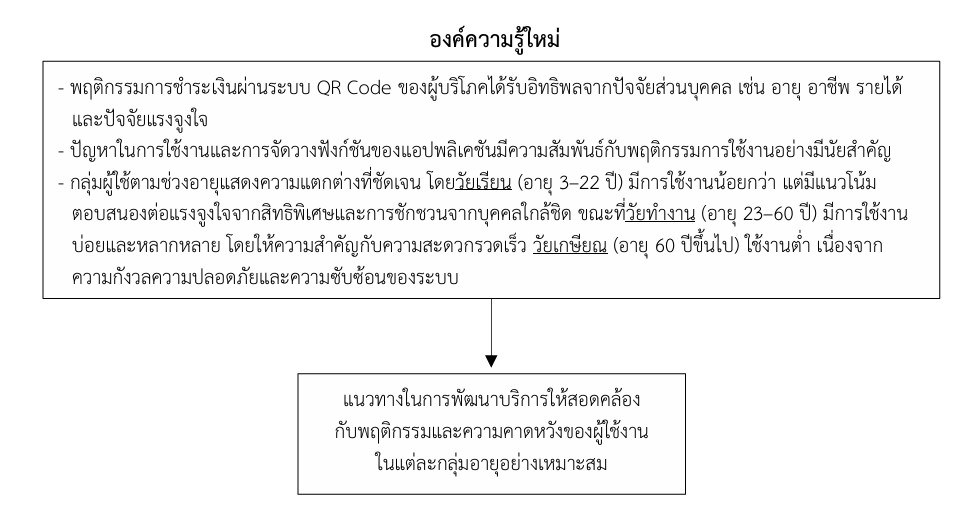
This study aims to (1) examine the payment behavior through QR Code systems across different age groups and (2) analyze the factors influencing such behavior among each age group. The target group includes individuals who have previously used QR Code payment services. A quantitative approach was used, with data collected from users experienced in QR Code payments via questionnaires. Analysis included demographic and marketing mix factors, using descriptive statistics and Chi-square tests. The findings reveal that QR Code usage behavior differs by age. The working-age group (23–60 years) is the main user segment, driven by convenience, speed, and peer influence. Students (3–22 years) are influenced by peers and interested in promotions, while retirees (60+) are limited by concerns over security and complexity. Key influencing factors include occupation, income, reference persons, and internal motivation, with usability and system design also playing significant roles. It is recommended that banks improve QR Code payment systems by enhancing speed, simplicity, and security to serve working-age users, encourage older users, and attract students through promotional campaigns.
References
ขวัญเนตร จิตรวัฒนาฤกษ์. (2561). ปัจจัยที่ส่งผลต่อการยอมรับการใช้บริการนวัตกรรมทางการเงิน (พร้อมเพย์) ของประชาชนกลุ่ม Generation X. (เศรษฐศาสตรมหาบัณฑิต, มหาวิทยาลัยธรรมศาสตร์).
ธนาคารแห่งประเทศไทย. (2566). รายงานการสำรวจพฤติกรรมการชำระเงิน. สืบค้นจาก https://www.bot.or.th/th/research-and-publications/reports/payment-insight-reports.html.
วรรณพร หวลมานพ. (2558). พฤติกรรมและความพึงพอใจของผู้ใช้แอพพลิเคชั่นเคโมบายแบงก์กิ้งพลัสของธนาคารกสิกรไทยจำกัด (มหาชน) ในเขตกรุงเทพมหานคร. (วารสารศาสตร์มหาบัณฑิต, มหาวิทยาลัยธรรมศาสตร์).
วลัญช์รัตน์ นพเก้า. (2561). ปัจจัยที่มีผลต่อพฤติกรรมการเลือกใช้บริการการชำระเงินผ่านแอพพลิเคชั่นบนโทรศัพท์เคลื่อนที่ของผู้ให้บริการที่เป็นสถาบันการเงินและให้บริการที่มิใช่สถาบันการเงิน. (เศรษฐศาสตรมหาบัณฑิต, มหาวิทยาลัยธรรมศาสตร์).
สถาบันวิจัยเศรษฐกิจป๋วย อึ๊งภากรณ์. (2566). เจาะลึกพฤติกรรมการใช้ e‑Payment ของคนไทย. สืบค้นจาก https://www.pier.or.th/abridged/2023/05/.
Cochran, W. G. (1977). Sampling Techniques. (3rd ed). New York: John Wiley & Sons.
Kotler, P. (1997). Marketing management: Analysis, planning, implementation, and control. (9th ed.). New Jersey: Prentice-Hall.
Kotler, P., & Armstrong, G. (2014). Principles of marketing. (15th ed.). London: Pearson.
Kotler, P., & Keller, K. L. (2016). Marketing management. (15th ed.). London: Pearson.
We Are Social & Meltwater. (2023). Digital 2023: Global Overview Report. Retrieved from https://everydaymarketing.co/trend-insight/thailand-data-digital-stat-insight-2023-from-we-are-social/.
Downloads
Published
How to Cite
Issue
Section
License
Copyright (c) 2025 Journal of Social Science Panyapat

This work is licensed under a Creative Commons Attribution-NonCommercial-NoDerivatives 4.0 International License.


