Exploring the importance of Irrigation on Rice Product in Thailand
Keywords:
Irrigation, Climate Change, In-Season Rice, Out-of-Season RiceAbstract
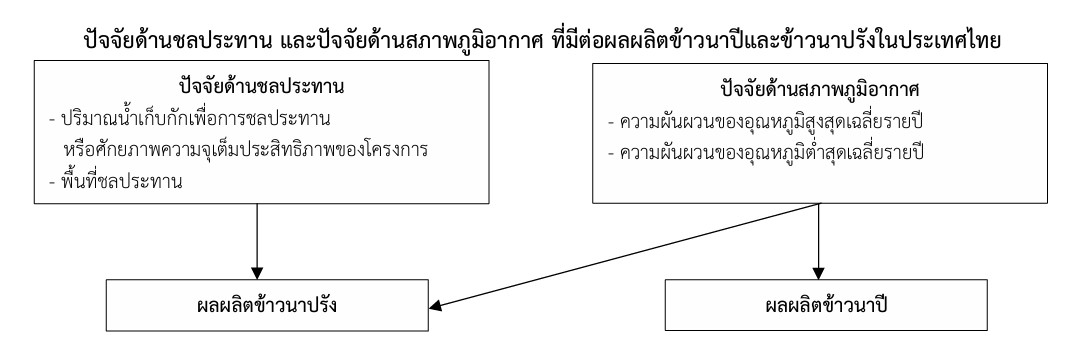
This study investigates the relationship between irrigation and other factors influencing the yields of in-season and out-of-season rice in Thailand. The study focuses exclusively on the overall quantity of rice, without distinguishing between varieties or production processes. Secondary annual time-series data spanning 27 years, from 1994 to 2020. The independent variables include water storage for irrigation, irrigated area, variability in annual average rainfall, the amount of chemical fertilizer used in rice cultivation, variability in the annual average maximum temperature, variability in the annual average minimum temperature, and dummy variables representing the occurrence of El Nino and La Nina phenomena. Testing was conducted to explain the relationships between independent variables and in-season rice yield and out-of-season rice yield through multiple regression analysis using the Ordinary Least Squares (OLS) method. The results indicate that Thailand’s annual average maximum temperature is negatively associated with in-season rice yield, suggesting that higher temperatures tend to reduce yield. For out-of-season rice, the volume of water stored for irrigation has a significant positive impact on yield. In contrast, both the irrigated area and the annual average minimum temperature are negatively correlated with out-of-season rice yield. These findings suggest that the Royal Irrigation Department should prioritize improving on-farm water delivery systems to enhance the efficiency of water distribution, rather than focusing solely on expanding irrigated areas. In addition, the agricultural and agribusiness sectors should adopt climate-resilient farming practices to better adapt to increasing variability in water availability and climatic conditions.
References
กนกพร ขุนบรรเทา. (2559). การวิจัยและผลิตภาพการผลิตโดยรวมของข้าวในประเทศไทย. (วิทยาศาสตรมหาบัณฑิต, มหาวิทยาลัยเกษตรศาสตร์).
กนกพร ภาคีฉาย, นิโรจน์ สินณรงค์, กฤตวิทย์ อัจฉริยะพานิชกุล และ พัชรินทร์ สุภาพันธ์. (2563). ผลกระทบของการเปลี่ยนแปลงสภาพภูมิอากาศต่อผลผลิตข้าวในพื้นที่ภาคกลางของประเทศไทย. วารสารเศรษฐศาสตร์และกลยุทธ์การจัดการ, 7(2), 1–22.
กรมชลประทาน. (2566). รายงานสรุปผลการดำเนินงานด้านชลประทาน ปีงบประมาณ 2566. กรุงเทพฯ: กระทรวงเกษตรและสหกรณ์.
กระทรวงเกษตรและสหกรณ์. (2561). พระราชบัญญัติทรัพยากรน้ำ พ.ศ. 2561. สืบค้นจาก https://www.moac.go.th/law_agri-files-422791791792.
จุฬารัตน์ ศรีกุล, นิศากร สังวาระนที และ ชลัมภ์ อุ่นอารีย์. (2562). ผลกระทบของความผันแปรสภาพภูมิอากาศที่มีต่อการเกิดอุทกภัยและภัยแล้งในประเทศไทย (รายงานการวิจัย). ชลบุรี: มหาวิทยาลัยเทคโนโลยีราชมงคลตะวันออก.
พิมพ์ชนก ทนะวัง, มาฆะสิริ เชาวกุล และ สัมพันธ์ เนตยานันท์. (2559). การวิเคราะห์ประสิทธิภาพการผลิตข้าวของเกษตรกรในพื้นที่รับประโยชน์เขื่อนแควน้อยบำรุงแดน ด้วยข้อมูล panel data ปีเพาะปลูก 2551, 2553 และ 2555. Journal of Business, Innovation and Sustainability, 11(1), 122–137.
สำนักงานทรัพยากรน้ำแห่งชาติ. (2562). การบริหารจัดการทรัพยากรน้ำ. สืบค้นจาก https://shorturl.at/p2x74.
สำนักงานเศรษฐกิจการเกษตร. (2566). สถานการณ์และแนวโน้มสินค้าเกษตรสำคัญของประเทศไทย ปี 2566. กระทรวงเกษตรและสหกรณ์. สืบค้นจาก https://www.oae.go.th.
สำนักงานสถิติแห่งชาติ. (2566). โครงการสำมะโนการเกษตร พ.ศ. 2566. สืบค้นจาก https://esurvey.nso.go.th/portal/apps/dashboards/83b24dd5011940689cd011e9d5259afa.
เสรีภาพ บุญรัตน์ และ อนุวัฒน์ รัตน์แก้ว. (2563). ผลของสูตรปุ๋ยเคมีและวันปลูกต่อการเจริญเติบโตของข้าวพันธุ์ กข79 (รายงานการวิจัย). พัทลุง: วิทยาลัยเกษตรและเทคโนโลยีพัทลุง, สถาบันการอาชีวศึกษาภาคใต้.
โสมรัศมิ์ จันทรัตน์, วิษณุ อรรถวานิช, ภูมิสิทธิ์ มหาสุวีระชัย, กรรณิการ์ ธรรมพานิชวงค์ และ จิรัฐ เจนพึ่งพร. (2562). ภูมิทัศน์ภาคเกษตรไทย จะพลิกโฉมอย่างไรสู่การพัฒนาที่ยั่งยืน. สืบค้นจาก https://www.bot.or.th/th/research-and-publications/articles-and-publications/articles/Article_26Sep2019.html.
อัญชลี ประเสริฐศักดิ์, นิพนธ์ มาฆทาน, ลิลลี่ กาวีต๊ะ, ณัฐหทัย เอพานิช, อ่วม คงชู และ วารินทร์ ศรีถัด. (2544). ความแปรปรวนด้านพัฒนาการของดอกและเมล็ดข้าวพันธุ์ดี. ใน เอกสารการประชุมวิชาการข้าวและธัญพืชเมืองหนาว ประจำปี 2544. การประชุมวิชาการข้าวและธัญพืชเมืองหนาว ประจำปี 2544 (น. 1-55). ปทุมธานี: กรมวิชาการเกษตร สถาบันวิจัยข้าว ศูนย์วิจัยข้าวปทุมธานี สถานีทดลองข้าวคลองหลวง.
อาทิตยา ทองพรหม. (2561). ความรู้เบื้องต้นด้านนิเวศเกษตรเพื่อการประยุกต์ใช้ในระบบเกษตรกรรมยั่งยืน. กรุงเทพฯ: สำนักงานพัฒนาและถ่ายทอดเทคโนโลยี สำนักงานการปฏิรูปที่ดินเพื่อเกษตรกรรม.
Boonchai, T., Kaewsompong, N., & Chitkasame, T. (2022, January). Impacts of Climate Variability on Rice Production in Thailand. In International Conference of the Thailand Econometrics Society (pp. 519-527). Cham: Springer International Publishing.
Brown, J. R. (2017). Irrigation development as an instrument for economic growth in Saskatchewan: An economic impact analysis. (Doctoral dissertation, University of Saskatchewan).
CIMMYT. (2023). While you were sleeping: increasing nighttime temperatures and their effects on plant productivity. Retrieved from https://www.cimmyt.org/news/while-you-were-sleeping-increasing-nighttime-temperatures-and-their-effects-on-plant-productivity/.
FAO. (2021). Irrigation and Agricultural Productivity: Guidelines for Sustainable Water Use in Agriculture. Rome: Food and Agriculture Organization of the United Nations.
Heady, E. O., and Dillon, J. L. (1961). Agricultural Production Functions. Ann Arbor: Iowa State University Press.
Lobell, D. B., Schlenker, W., & Costa-Roberts, J. (2011). Climate trends and global crop production since 1980. Science, 333(6042), 616-620.
Nguyen, P. T. M., Ho, P. T., & Pham, H. X. (2024). Impacts of seasonal climate variation on rice yield: Evidence from the Central Coast of Vietnam. Cogent Economics & Finance, 12(1), 2421894.
Ostrom, E. (1990). Governing the commons: The evolution of institutions for collective action. Cambridge: Cambridge university press.
PPTV Wealth. (2567). จับตา “เอลนีโญ” สู่ “ลานีญา” กระทบอัตราเงินเฟ้อไทย กระทรวงพาณิชย์ ติดตามปรากฏการณ์จาก “เอลนีโญ” สู่ “ลานีญา” ส่งผลกระทบต่ออัตราเงินเฟ้อของไทย. สืบค้นจาก https://www.pptvhd36.com/wealth/economic/225111.
Small, L. E., & Svendsen, M. (1990). A framework for assessing irrigation performance. Irrigation and drainage systems, 4(4), 283-312.
Smit, B., & Wandel, J. (2006). Adaptation, adaptive capacity and vulnerability. Global environmental change, 16(3), 282-292.
Waqas, M., Naseem, A., Humphries, U. W., Hlaing, P. T., Shoaib, M., & Hashim, S. (2025). A comprehensive review of the impacts of climate change on agriculture in Thailand. Farming System, 3(1), 100114.
World Bank. (2016). Thailand Systematic Country Diagnostic: Getting Back on Track – Reviving Growth and Securing Prosperity for All. Washington, DC: World Bank Group.
Zhao, C., Liu, B., Piao, S., Wang, X., Lobell, D. B., Huang, Y., Asseng, S. (2017). Temperature increase reduces global yields of major crops in four independent estimates. Proceedings of the National Academy of Sciences, 114(35), 9326-9331.
Downloads
Published
How to Cite
Issue
Section
License
Copyright (c) 2025 Journal of Social Science Panyapat

This work is licensed under a Creative Commons Attribution-NonCommercial-NoDerivatives 4.0 International License.


