Integrative Buddhism to Promote The Political Participation for The Community Development of People in Nam Cham Subdistrict, Mueang Phrae District, Phrae Province
Keywords:
Buddhist Integration, Participation, Community DevelopmentAbstract
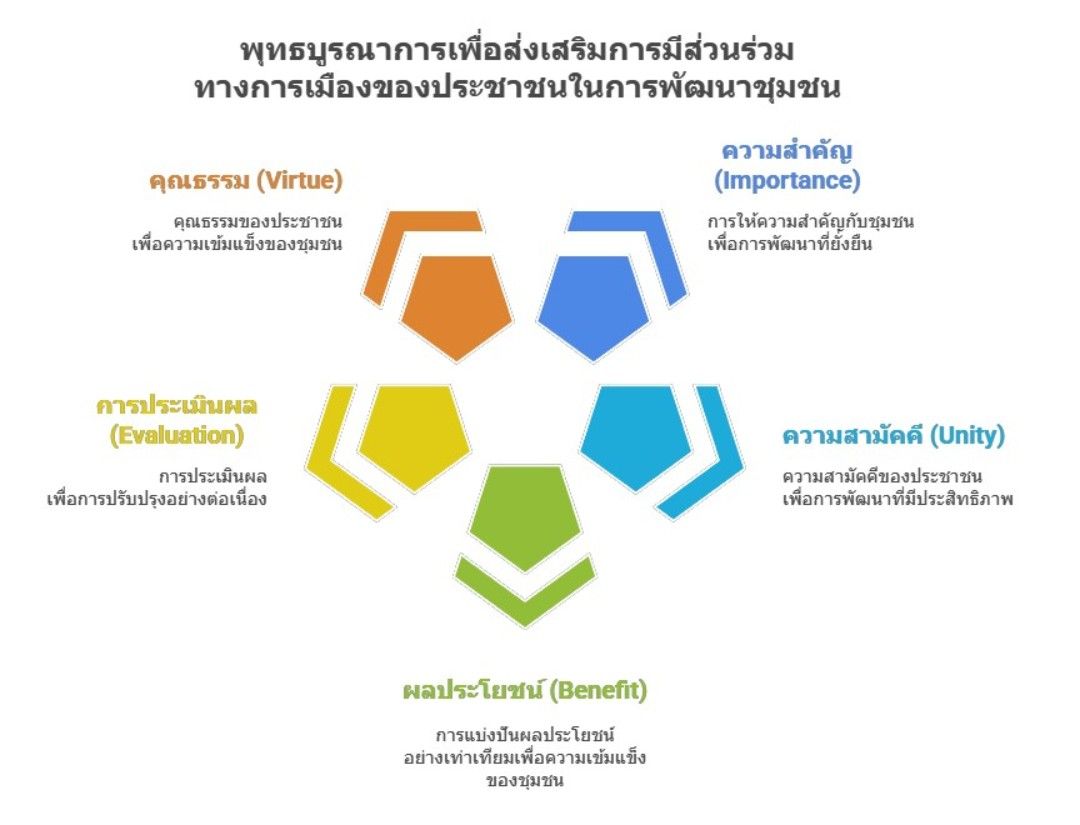
This research article aims to (1) investigate the level of political participation among people in community development; (2) study factors affecting people’s political participation in community development; and (3) present integrative Buddhism to enhance people’s political participation in community development in Nam Cham Subdistrict, Mueang Phrae District, Phrae Province. This study employs a mixed-methods research design. The tools used for data collection include questionnaires and in-depth interviews. The statistical methods used for data analysis include frequency, percentage, mean, standard deviation, and stepwise multiple regression analysis. The findings of the study reveal that: 1) People's political participation in community development was overall at a moderate level. However, the level of Aparihaniyadhamma and people's political participation in community development was high. 2) The factors influencing the political participation of citizens in the development of Nam Cham Subdistrict, Mueang Phrae District, Phrae Province are identified in seven areas: (1) the principle of convening meetings in unison, (2) the principle of providing care and attention to visitors, (3) the principle of holding regular meetings, (4) the principle of not establishing regulations that contradict existing rules, (5) the principle of respecting women, (6) the principle of respecting places, and (7) the principle of respecting superiors, all of which are statistically significant. 3) The Buddhist integration approach to promote the political participation of citizens in community development consists of seven key principles: (1) holding regular meetings to strengthen participation, (2) beginning and ending meetings in unison, (3) avoiding the establishment of rules that conflict with existing agreements, (4) respecting community leaders, (5) supporting the role of women in the community, (6) emphasizing the importance of venues for development activities, and (7) providing care and attention to visitors.
References
พรชัย สารสุวรรณ์. (2567). การประยุกต์หลักพุทธธรรมเพื่อเสริมสร้างวัฒนธรรมทางการเมืองแบบมีส่วนร่วมของประชาชนในจังหวัดอุทัยธาน. (ปรัชญาดุษฎีบัณฑิต, มหาวิทยาลัยมหาจุฬาลงกรณราชวิทยาลัย).
พระปัญญา สุจิตฺโต (สีงาม). (2564). การบูรณาการหลักพุทธธรรมเพื่อส่งเสริมจิตสำนึกการมีส่วนร่วม ทางการเมืองของประชาชนในอำเภอเมืองระยอง จังหวัดระยอง. (รัฐศาสตรมหาบัณฑิต, มหาวิทยาลัยมหาจุฬาลงกรณราชวิทยาลัย).
พระมหาธีระยุทธ ฐานรโต (รักสกุล). (2564). การมีส่วนร่วมทางการเมืองของผู้สูงอายุในอำเภอเมืองระยอง จังหวัดระยอง. (รัฐศาสตรมหาบัณฑิต, มหาวิทยาลัยมหาจุฬาลงกรณราชวิทยาลัย).
พระมหายุทธพิชัย สิริชโย และ ธิติวุฒิ หมั่นมี. (2561). การบริหารงานตามหลักอปหานิยธรรม. วารสารสมาคมศิษย์เก่า มหาวิทยาลัยมหาจุฬาลงกรณราชวิทยาลัย, 7(2), 139-147.
พระยุทธนา ชยเมธี (ไกรนารถ). (2566). การมีส่วนร่วมทางการเมืองในระดับท้องถิ่นตามแนวพระพุทธศาสนาของประชาชนในตำบลบ้านโตก อำเภอเมือง จังหวัดเพชรบูรณ์. (รัฐศาสตรมหาบัณฑิต, หาวิทยาลัยมหาจุฬาลงกรณราชวิทยาลัย).
ไพบูลย์ สุขเจตนี. (2563). การพัฒนาความไว้วางใจทางการเมืองของประชาชนที่มีต่อนักการเมืองระดับท้องถิ่นในจังหวัดนนทบุรี. (ปรัชญาดุษฎีบัณฑิต, มหาวิทยาลัยมหาจุฬาลงกรณราชวิทยาลัย).
สมยุทธิ์ เรือนงาม. (2567). การประยุกต์หลักพุทธธรรมเพื่อส่งเสริมการมีส่วนร่วมของประชาชนในการแก้ไขปัญหาน้ำท่วมในกรุงเทพมหานครและปริมณฑล. (ปรัชญาดุษฎีบัณฑิต, มหาวิทยาลัยมหาจุฬาลงกรณราชวิทยาลัย).
องค์การบริหารส่วนตำบลร่องฟอง. (2567). แผนพัฒนาท้องถิ่น (พ.ศ. 2566-2570). สืบค้นจาก https://shorturl.asia/sG6oC.
อุเชนทร์ เชียงเสน. (2561). การเมืองภาคประชาชน. กรุงเทพฯ: มติชน.
Yamane, T. (1973). Statistics: An Introductory Analysis. (3rd ed.). New York: Harper and Row.
Downloads
Published
How to Cite
Issue
Section
License
Copyright (c) 2025 Journal of Social Science Panyapat

This work is licensed under a Creative Commons Attribution-NonCommercial-NoDerivatives 4.0 International License.


