Second Order Confirmatory Components of a Measurement Model of Challenges in Adopting Artificial Intelligence in Human Resource Management in the MICE Industry
Keywords:
Artificial Intelligence, Human Resource Management, MICE Industry, Second-Order Confirmatory Factor AnalysisAbstract
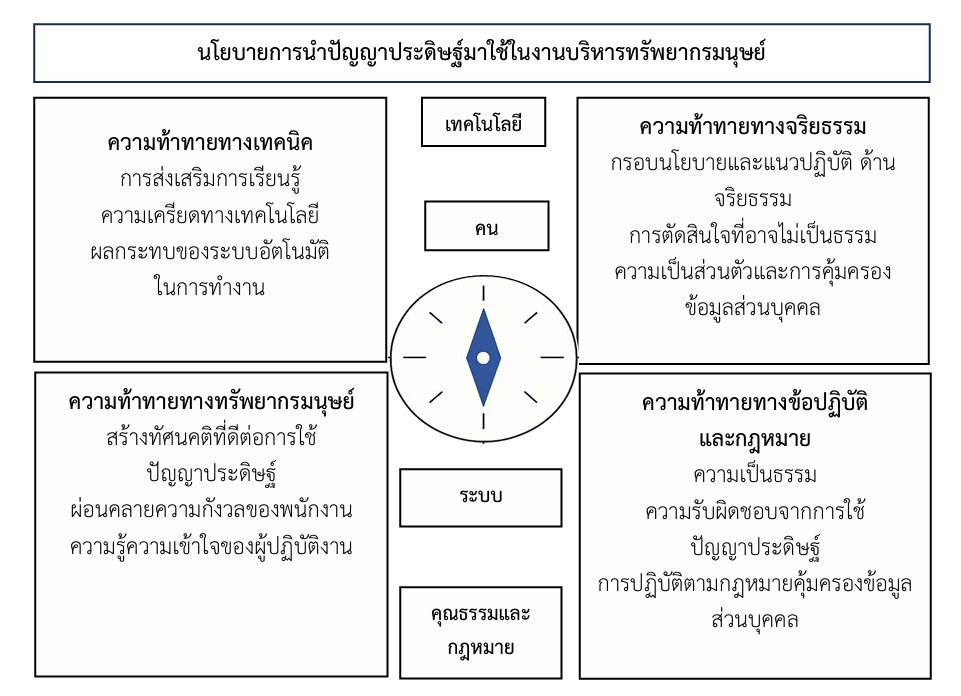
The objectives of this study were: (1) to analyze the second-order confirmatory factor structure of a measurement model of challenges in adopting artificial intelligence (AI) in human resource management within the MICE industry, and (2) to examine the goodness-of-fit of the proposed measurement model. The sample comprised 400 employees, ranging from operational staff to senior executives, working in human resource management departments of MICE businesses located in Bangkok and its metropolitan area. The sample was selected using purposive sampling. The research instrument was a structured questionnaire. Data were analyzed using descriptive statistics, the Kaiser-Meyer-Olkin (KMO) measure of sampling adequacy, and second-order confirmatory factor analysis (CFA). The results revealed that: (1) the measurement model of challenges in adopting AI in human resource management within the MICE industry consisted of four key components, namely technological challenges (TEC), ethical challenges (ETH), human resource challenges (HRM), and legal and regulatory challenges (LAW), with all subcomponent factor loadings meeting established criteria; and (2) the model demonstrated a good fit to the empirical data, as indicated by the fit indices: χ² = 293.941, df = 126, CMIN/df = 2.333, RMSEA = 0.058, RMR = 0.024, GFI = 0.935, CFI = 0.979, and NFI = 0.965. These findings suggest that the model for measuring the challenges of applying artificial intelligence in human resource management in the MICE industry is consistent with the model and empirical data.
References
ชลลดา มงคลวนิช และ รัตนาภรณ์ ชาติวงศ์. (2560). แนวทางการพัฒนาบุคลากรที่ขาดแคลนในอุตสาหกรรมไมซ์ กรณีศึกษา : สถานที่จัดงานประเภทโรงแรม. วารสารการบริการและการท่องเที่ยวไทย, 12(1), 50-65.
นิธิกิตติกานต์ เหมสุวรรณ, เกิดศิริ เจริญวิศาล และ สันติธร ภูริภักดี. (2567). ศักยภาพและความพร้อม: การเป็นจุดหมายปลายทางสำหรับอุตสาหกรรมไมซ์ของ ประเทศไทย. วารสารการบริการและการท่องเที่ยวไทย, 19(2), 54-66.
พัฒน์ศิณีนาฎ วรรณรัตน์. (2567). การศึกษานวัตกรรมปัญญาประดิษฐ์เพื่อการบริหารทรัพยากรมนุษย์กรณีศึกษา ของบริษัทในกลุ่มธุรกิจอุตสาหกรรมไมซ์ (MICE). (การจัดการมหาบัณฑิต, มหาวิทยาลัยมหิดล).
Abdeldayem, M. M., & Aldulaimi, S. H. (2020). Trends and opportunities of artificial intelligence in human resource management: Aspirations for public sector in Bahrain. International journal of scientific and technology research, 9(1), 3867-3871.
Adeyelu, O. O., Ugochukwu, C. E., & Shonibare, M. A. (2024). The impact of artificial intelligence on accounting practices: Advancements, challenges, and opportunities. International Journal of Management & Entrepreneurship Research, 6(4), 1200-1210.
Barney, J. (1991). Firm resources and sustained competitive advantage. Journal of management, 17(1), 99-120.
Brown, T. A. (2015). Confirmatory Factor Analysis for Applied Research. (2nd ed.). New York: Guilford Press.
Diamantopoulos, A., Sarstedt, M., Fuchs, C., Wilczynski, P., & Kaiser, S. (2012). Guidelines for choosing between multi-item and single-item scales for construct measurement: a predictive validity perspective. Journal of the Academy of Marketing Science, 40(3), 434-449.
Ekuma, K. (2024). Artificial intelligence and automation in human resource development: A systematic review. Human Resource Development Review, 23(2), 199-229.
Field, A. (2018). Discovering Statistics Using IBM SPSS Statistics. (5th ed.). California: Sage Publications.
Hair, J. F., Black, W. C., Babin, B. J., Anderson, R. E., & Tatham, R. L. (2019). Multivariate Data Analysis. (8th ed.). Hampshire: Cengage Learning, EMEA.
Hu, L. T., & Bentler, P. M. (1999). Cutoff criteria for fit indexes in covariance structure analysis: Conventional criteria versus new alternatives. Structural equation modeling: a multidisciplinary journal, 6(1), 1-55.
Kaur, M., & Gandolfi, F. (2023). Artificial intelligence in human resource management-challenges and future research recommendations. Revista de Management Comparat International, 24(3), 382-393.
Khan, F. A., Khan, N. A., & Aslam, A. (2024). Adoption of artificial intelligence in human resource management: an application of TOE-TAM model. Research and review: human resource and labour management, 5(1), 22-36.
Kline, R. B. (2023). Principles and Practice of Structural Equation Modeling. New York: Guilford Publications.
Lutfi, L., & Mohammadi, A. (2025). Opportunity of Implementation Artificial Intelligence in Human Resources Management. International Journal of Academic Reserach in Economics and Management Sciences, 14(1), 212-228.
Matos, F., Vairinhos, V., Salavisa, I., Edvinsson, L., & Massaro, M. (2020). Knowledge, people, and digital transformation. Cham: Springer.
Mice Intelligence Center. (2019). ปัญญาประดิษฐ์ (AI) คือ กุญแจสู่อนาคตสำหรับธุรกิจไมซ์. สืบค้นจาก https://intelligence.businesseventsthailand.com/files/insights/57315573724821.pdf.
Mintz, Y., & Brodie, R. (2019). Introduction to artificial intelligence in medicine. Minimally Invasive Therapy & Allied Technologies, 28(2), 73-81.
Nawaz, N., Arunachalam, H., Pathi, B. K., & Gajenderan, V. (2024). The adoption of artificial intelligence in human resources management practices. International Journal of Information Management Data Insights, 4(1), 100208.
Niehueser, W., & Boak, G. (2020). Introducing artificial intelligence into a human resources function. Industrial and commercial training, 52(2), 121-130.
Nimmagadda, B., Vangaveti, Y., Aaluri, S., & Rao, C. M. (2024). An Analytical study on Navigating Sustainability Challenges and Opportunities in the era of AI and the Gig Economy. Retrieved from https://www.matec-conferences.org/articles/matecconf/pdf/2024/04/matecconf_icmed2024_01044.pdf
Paigude, S., Pangarkar, S. C., Hundekari, S., Mali, M., Wanjale, K., & Dongre, Y. (2023). Potential of artificial intelligence in boosting employee retention in the human resource industry. International Journal on Recent and Innovation Trends in Computing and Communication, 11(3s), 01-10.
Palos-Sánchez, P. R., Baena-Luna, P., Badicu, A., & Infante-Moro, J. C. (2022). Artificial intelligence and human resources management: A bibliometric analysis. Applied Artificial Intelligence, 36(1), 2145631.
Qiu, L., & Zhao, L. (2018). Opportunities and challenges of artificial intelligence to human resource management. Academic Journal of Humanities & Social Sciences, 2(1), 144-153.
Sanyaolu, E., & Atsaboghena, R. (2022). Role of Artificial Intelligence in Human Resource Management: Overview of its benefits and challenges. Retrieved from https://www.researchgate.net/profile/Eniola-Sanyaolu/publication/366307222_Role_of_Artificial_Intelligence_in_Human_Resource_Management_Overview_of_its_benefits_and_challenges/links/639b490fe42faa7e75c5888c/Role-of-Artificial-Intelligence-in-Human-Resource-Management-Overview-of-its-benefits-and-challenges.pdf.
Schumacker, E., & Lomax, G. (2016). A beginner’s guide to structural equation modelling. (4th ed). London: Routledge.
Shahzad, M. F., Xu, S., Naveed, W., Nusrat, S., & Zahid, I. (2023). Investigating the impact of artificial intelligence on human resource functions in the health sector of China: A mediated moderation model. Heliyon, 9(11), 1-17.
Sirivadhanawaravachara, A. (2025). The role and impact of MICE (Meetings, Incentives, Conferences, and Exhibitions) industry in Thailand. World Journal of Advanced Research and Reviews, 25(1), 708-719.
Tewari, I., & Pant, M. (2020). Artificial intelligence reshaping human resource management: A review. In 2020 IEEE international conference on advent trends in multidisciplinary research and innovation (ICATMRI) (pp. 1-4). New York: IEEE.
Venkatesh, V., & Davis, F. D. (2000). A theoretical extension of the technology acceptance model: Four longitudinal field studies. Management science, 46(2), 186-204.
Vishwakarma, L. P., & Singh, R. K. (2023). An analysis of the challenges to human resource in implementing artificial intelligence. In The adoption and effect of artificial intelligence on human resources management, Part B (pp. 81-109). Leeds: Emerald Publishing Limited.
Vrontis, D., Christofi, M., Pereira, V., Tarba, S., Makrides, A., & Trichina, E. (2021). Artificial intelligence, robotics, advanced technologies and human resource management: a systematic review. The International Journal of Human Resource Management, 33(6), 1237–1266.
Yanamala, K. K. R. (2023). Transparency, privacy, and accountability in AI-enhanced HR processes. Journal of Advanced Computing Systems, 3(3), 10-18.
Downloads
Published
How to Cite
Issue
Section
License
Copyright (c) 2025 Journal of Social Science Panyapat

This work is licensed under a Creative Commons Attribution-NonCommercial-NoDerivatives 4.0 International License.


