Human Capital Management Guidelines to Create Employee Motivation, Case Study: Boly Pipe Company Limited
Keywords:
Human Capital Management, Work Motivation, EmployeesAbstract
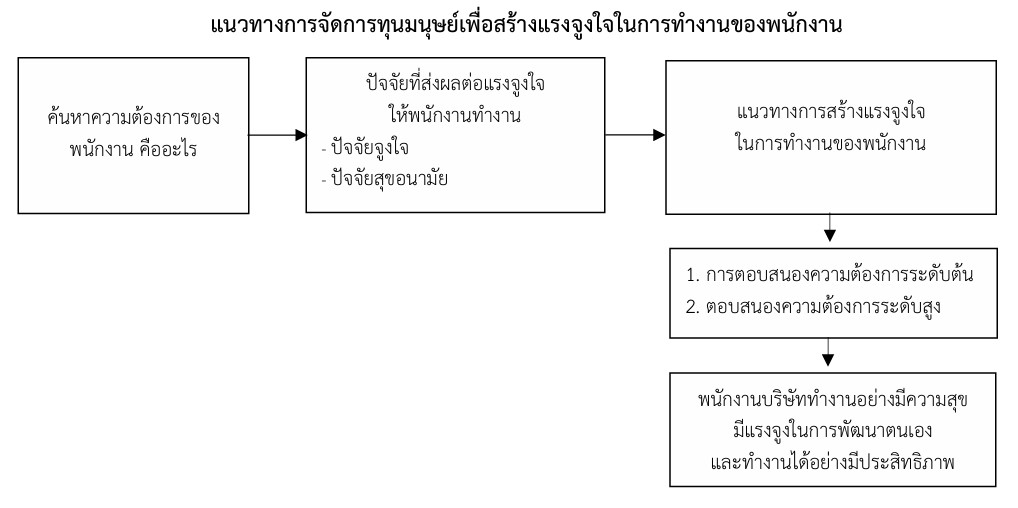
This research article aims to study (1) the general condition of motivational factors in employee work and (2) the human capital management strategies regarding motivational factors in the work of employees at Boly Pipe Company Limited. This research is qualitative in nature. The tool used for data collection is a semi-structured interview. Key informants include 18 individuals from various levels: management personnel, managerial staff, team leaders, and employees who are involved, selected purposefully. Data analysis was conducted through content analysis. The study's findings reveal that (1) the general condition of motivational factors in employee work includes job characteristics that affect satisfaction and effort in performance, such as achievement, recognition, responsibility, and opportunities for advancement. These factors promote good mental health and a positive attitude toward work, leading employees to be committed, dedicated, and enthusiastic about their work, as well as willing to effectively develop themselves. Additionally, factors related to hygiene, such as the work environment, company policies, compensation, interpersonal relationships, and job security, are also important components that enhance job satisfaction and reduce dissatisfaction, which in turn affects overall performance effectiveness. (2) The human capital management strategies regarding motivational factors in employee work include addressing basic needs and higher-level needs. The company should consider overall compensation, plan and organize employee skill development activities, encourage employee participation in the company, and develop technology-related skills to effectively enhance employee motivation, leading to the success of the private company.
References
กรมพัฒนาฝีมือแรงงาน. (2567). แผนยุทธศาสตร์กรมพัฒนาฝีมือแรงงาน (พ.ศ. 2567). สืบค้นจาก https://www.dsd.go.th/DSD/Doc.
ชัญญานุช อาจคำ. (2566). แนวทางการสร้างแรงจูงใจให้พนักงานทำงานอย่างมีประสิทธิภาพภายใต้นโยบายการพัฒนาคุณภาพชีวิตแรงงาน กรณีศึกษาบริษัทเอกชนแห่งหนึ่งในจังหวัดพะเยา. (รัฐประศาสนศาสตรมหาบัณฑิต, มหาวิทยาลัยพะเยา).
พิเชษฐ์ ซิ้มเจริญ. (2564). แรงจูงใจและความจงรักภักดีที่ส่งผลต่อพนักงานในองค์กรขนาดเล็ก กรณีศีกษาบริษัท จงฟู่ (กรุงเทพ) จำกัด. (บริหารธุรกิจมหาบัณฑิต, มหาวิทยาลัยศิลปากร).
ภูดิศ สุชาติพงศ์. (2562). การศึกษาความพึงพอใจในการปฏิบัติงานของพนักงานจำหน่ายอุปกรณ์ดับเพลิงวิศวกรรมแห่งหนึ่งในประเทศไทยที่มีต่อการเติบโตขององค์กรในมิติของพนักงาน. (การจัดการมหาบัณฑิต, มหาวิทยาลัยมหิดล).
ภูริพัฒน์ ชาญกิจ. (2564). พฤติกรรมระดับบุคคล. ในเอกสารการสอนชุดวิชาภาวะผู้นำและพฤติกรรมองค์การ หน่วยที่ 10. (พิมพ์ครั้งที่ 5). นนทบุรี: มหาวิทยาลัยสุโขทัยธรรมาธิราช.
รัตติกรณ์ จงวิศาล. (2560). มนุษยสัมพันธ์ พฤติกรรมมนุษย์ในองค์การ. (พิมพ์ครั้งที่ 4). กรุงเทพฯ: มหาวิทยาลัยเกษตรศาสตร์.
สิรินทร์ ชุ่มอินทรจักร. (2566). ปัจจัยที่ส่งผลต่อการคงอยู่ของพนักงานบริษัทลีสซิ่งแห่งหนึ่งในประเทศ. (การจัดการมหาบัณฑิต, มหาวิทยาลัยมหิดล).
อุษา ศิระสากร. (2562). แรงจูงใจในการปฏิบัติงานของพนักงานฝ่ายผลิตของบริษัทเอ็นยิเนียริ่งรีสอร์ทเซส (ประเทศไทย) จำกัด. (ศิลปศาสตรมหาบัณฑิต, มหาวิทยาลัยเกริก).
Armstrong, M. (2020). Armstrong's Handbook of Human Resource Management Practice. (15th ed.). London: Kogan Page.
Deci, E. L., & Ryan, R. M. (2000). The “what” and “why” of goal pursuits: Human needs and the self-determination of behavior. Psychological Inquiry, 11(4), 227–268.
Herzberg, F. (1959). The Motivation to Work. New York: John Wiley & Sons.
Herzberg, F. (1968). One More Time: How Do You Motivate Employees?. Harvard Business Review, 46, 53-62.
Maslow. (1943). A Theory of Human Motivation. Psychological Review, 50, 370-396.
Nastasi, B. K., & Schensul, S. L. (2005). Contributions of qualitative research to the validity of intervention research. Journal of school psychology, 43(3), 177-195.
UNESCO. (1978). Indicators of Environmental Quality and Quality of Life. Paris: UNESCO.
Downloads
Published
How to Cite
Issue
Section
License
Copyright (c) 2025 Journal of Social Science Panyapat

This work is licensed under a Creative Commons Attribution-NonCommercial-NoDerivatives 4.0 International License.


