The Development of a System of Criteria for Assessment and Standardization of Innovative Technology Skills Training Courses for Youth Workers
Keywords:
Evaluation Framework System, Training Curriculum, Youth Labor, Innovative Technology SkillsAbstract
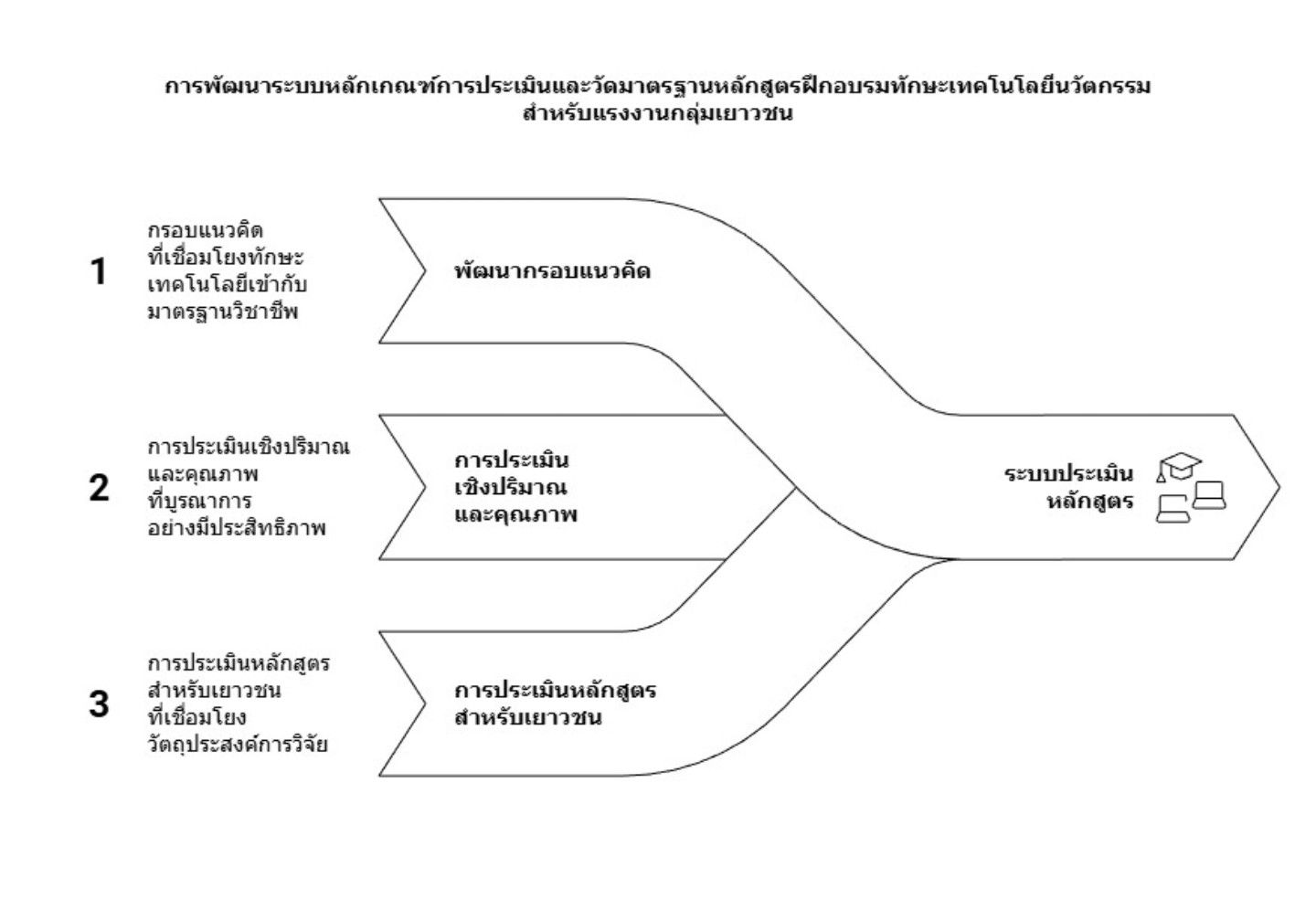
The objective of this study was to (1) study the information on the needs and necessities for developing technology skills, (2) create and develop a system of criteria for evaluating and measuring the standards of innovative technology skills training courses for the youth labor group, and (3) test and disseminate the developed system. The research utilized a research and development (R&D) model by evaluating and measuring the standards of two sub-projects across two dimensions: the dimension of evaluating training course standards and the dimension of evaluating the standards of trainees. Data were collected through questionnaires from 400 youth workers and 200 trainees and data analysis was conducted using descriptive statistics such as percentages, means, and standard deviations. Additionally, data were collected through interviews with 24 individuals, including academics, officials from the Chachoengsao Provincial Industry Office, and representatives from the smart electronics industry. The study found that 1) the youth labor group had a high demand for developing innovative technology skills and there is a necessity to develop youth labor for adapting about digital economy literacy. 2) The developed system of criteria for evaluating and measuring training course standards was appropriate and covers the content to be measured with an I-CVI value between 0.80 - 1.00. The first sub-project in the training course dimension includes 5 standards 7 indicators and 23 criteria. The second sub-project the trainee dimension includes 2 standards, 3 indicators, and 9 criteria. The third sub-project in the training course dimension includes 5 standards 8 indicators and 25 criteria the trainee dimension includes 2 standards 3 indicators and 9 criteria. 3) The trial implementation of the aforementioned criteria system was found to be practically applied in ensuring the quality of training courses and can be used effectively. Policy implications suggest that the assessment and evaluation of training curriculum standards for technological and innovation skills should be aligned with each professional standard, with the establishment of a national standard to serve as a unified guideline across the country.
References
กระทรวงแรงงาน. (2568). จำนวนแรงงานเยาวชนในพื้นที่เขตพัฒนาพิเศษภาคตะวันออก. สืบค้นจาก https://www.mol.go.th/academician
กัลยา วานิชย์บัญชา. (2555). การใช้ SPSS for Windows ในการวิเคราะห์ข้อมูล. (พิมพ์ครั้งที่ 20). กรุงเทพฯ: ภาควิชาสถิติ คณะพาณิชยศาสตร์และการบัญชี จุฬาลงกรณ์ลงกรณ์มหาวิทยาลัย.
คม แรงสูงเนิน. (2565). การศึกษาทักษะของนักศึกษาระดับปริญญาตรีในศตวรรษที่ 21 ของสถาบันการอาชีวศึกษาตามความต้องการของสถานประกอบการ: การศึกษาทักษะของนักศึกษาระดับปริญญาตรีในศตวรรษที่ 21. วารสารวิจัยและนวัตกรรมการอาชีวศึกษา, 6(1), 150–156.
พีรพงษ์ พันธ์โสดา. (2563). การประเมินโครงการการฝึกอบรมเชิงปฏิบัติการการพัฒนาเครื่องมือและประเมินผลออนไลน์สำหรับครูผู้สอน วิทยาลัยอาชีวศึกษาเทคโนโลยีฐานวิทยาศาสตร์ (ชลบุรี) (รายงานวิจัย). ชลบุรี: วิทยาลัยอาชีวศึกษาเทคโนโลยีฐานวิทยาศาสตร์ (ชลบุรี) สำนักงานคณะกรรมการการอาชีวศึกษา.
โพสต์ทูเดย์. (2566). TSCCI ดัชนีชี้วัดความสามารถในการแข่งขันเมืองอัจฉริยะประเทศไทย. สืบค้นจาก https://www.posttoday.com/smart-city/710268.
วรธา มงคลสืบสกุล. (2565). แนวทางการขับเคลื่อนนโยบายสู่การพัฒนาทักษะแรงงาน เพื่อรองรับการเปลี่ยนแปลงหลังยุคโควิด-19. วารสารวิจัยมหาวิทยาลัยเวสเทิร์น มนุษยศาสตร์และสังคมศาสตร์, 8(1), 267–282.
วัชรภัทร เตชะวัฒนศิริดำรง. (2563). การพัฒนาหลักสูตรฝึกอบรมความรู้เกี่ยวกับการออกแบบหน่วยการเรียนรู้ อิงมาตรฐาน ของครูกลุ่มสาระการเรียนรู้วิทยาศาสตร์และเทคโนโลยี. วารสารวิทยาลัยนครราชสีมา สาขามนุษยศาสตร์และสังคมศาสตร์, 14(3), 30–44.
สายพิน ราชลํา. (2560). การพัฒนาแบบวัดทักษะชีวิตและอาชีพในศตวรรษที่ 21 ของนักเรียนชั้นมัธยมศึกษาตอนต้นในโรงเรียนสังกัดสํานักงานเขตพื้นที่การศึกษามัธยมศึกษาเขต 39. (ศึกษาศาสตรมหาบัณฑิต, มหาวิทยาลัยสุโขทัยธรรมาธิราช).
สำนักงานคณะกรรมการการอาชีวศึกษา. (2560). แรงงานและการอาชีวศึกษา พุทธศักราช 2560. กรุงเทพฯ: สำนักงานคณะกรรมการการอาชีวศึกษา.
สำนักงานรับรองมาตรฐานและประเมินคุณภาพการศึกษา (องค์การมหาชน). (2567). คู่มือกรอบแนวทางการประกันคุณภาพภายนอก (พ.ศ. 2567-2571) ฉบับสถานศึกษาและผู้ประเมินภายนอก ด้านการอาชีวศึกษา. สืบค้นจาก https://www.onesqa.or.th/th/contentdownload-view/1168/3559/.
สำนักงานสภาพัฒนาการเศรษฐกิจและสังคมแห่งชาติ. (2566). รายงานทักษะแรงงานแห่งอนาคต (Future Skills Thailand). กรุงเทพฯ: สำนักงานสภาพัฒนาการเศรษฐกิจและสังคมแห่งชาติ.
สุวิมล ติรกานันท์. (2551). การวิจัยทางการศึกษา. (พิมพ์ครั้งที่ 10). กรุงเทพฯ: จุฬาลงกรณ์มหาวิทยาลัย.
Buganza, T., Kalchschmidt, M., Bartezzaghi, E., & Amabile, D. (2013). Measuring the impact of a major project management educational program: The PMP case in Finmeccanica. International Journal of Project Management, 31(2), 285-298.
Cronbach, L. J. (1970). Essentials of psychological test. (5th ed.). New York: Harper Collins.
International Society for Technology in Education. (2016). ISTE standards for students. ISTE. Retrieved from https://www.iste.org/standards/for-students.
Kirkpatrick, D. L., & Kirkpatrick, J. D. (2006). Evaluating Training Programs: The Four Levels. (3rd ed.). San Francisco, CA: Berrett-Koehler Publishers.
Krejcie, R.V., & Morgan, D. W. (1975). Determining Sample Size for Research Activities. Educational and Psychological Measurement, 30(3), 607–610.
Mason, S. E., Auerbach, C., Zeitlin, W., & LaPorte, H. H. (2015). Validation of the T-SAT-R-2: A Reaction to Training Scale for Use in Child Welfare and Human Service Trainings. Journal of Social Service Research, 41(1), 64-74.
Tyler, R. (2013) Basic principles of curriculum and instruction. In Flinders, D. J. & Thornton, S. J. (eds.), Curriculum Studies Reader (4th ed.) (pp. 60-68). New York: Routledge.
World Economic Forum. (2023). The Future of Jobs Report 2023. Geneva: World Economic Forum.
Downloads
Published
How to Cite
Issue
Section
License
Copyright (c) 2025 Journal of Social Science Panyapat

This work is licensed under a Creative Commons Attribution-NonCommercial-NoDerivatives 4.0 International License.


