Efficiency of governance-based administration of the Huai Phung Subdistrict Municipality, Huai Phung District, Kalasin Province
Keywords:
Efficiency, Administration, Principles of Good GovernanceAbstract
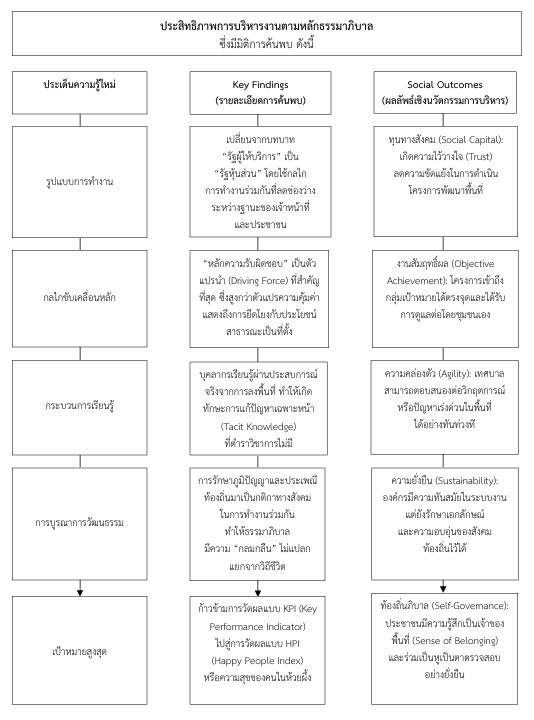
This article aims to study 1) the efficiency of public administration based on the principles of Good Governance in Huai Phueng Subdistrict Municipality, Huai Phueng District, Kalasin Province, and 2) the recommendations for improving public administration efficiency based on the principles of Good Governance in the same municipality. This research employed a quantitative research methodology. The sample consisted of 99 personnel from Huai Phueng Subdistrict Municipality, selected through purposive sampling. The research instruments included a 5-point Likert scale questionnaire and open-ended questions. Data were analyzed using statistical methods, including percentage, mean, and standard deviation. The research findings revealed that: 1) The overall efficiency of public administration based on the principles of Good Governance was at a high level. When considering each dimension, the rankings from highest to lowest mean scores were: Accountability, Morality, Participation, Transparency, and Efficiency, respectively. 2) The findings regarding recommendations for enhancing public administration efficiency based on Good Governance revealed that: (1) The “Electronic Information Center” system should be developed to consistently and immediately disclose all essential information to the public; (2) The public consultation format should be transformed into a “Co-think, Co-plan, and Co-decide” approach for local development planning; (3) A rigorous “Merit System” should be implemented in local personnel management; (4) Local administrators and officials must recognize and strictly adhere to the fair enforcement of laws, regulations, and local ordinances (Rule of Law); and (5) A “One-Stop Service” grievance system should be developed with a clear and transparent follow-up process.
References
จินดารัตน์ สมคะเณย์. (2557). ระเบียบวิธีวิจัยและสถิติทางรัฐศาสตร์. มหาสารคาม: มหาวิทยาลัยราชภัฏ มหาสารคาม.
ราชกิจจานุเบกษา. (2560). รัฐธรรมนูญแห่งราชอาณาจักรไทย พุทธศักราช 2560. สืบค้นจาก https://www.ratchakitcha.soc.go.th/DATA/PDF/2560/A/040/1.PDF.
สละ เจริญผล. (2551). การนำหลักธรรมาภิบาลไปใช้ในการบริหารงานเทศบาล : ศึกษาเฉพาะกรณีเทศบาลตำบลรางหวาย อำเภอพนมทวน จังหวัดกาญจนบุรี. (รัฐประศาสนศาสตรมหาบัณฑิต, มหาวิทยาลัยขอนแก่น).
สำนักงานคณะกรรมการป้องกันและปราบปรามการทุจริตแห่งชาติ. (2566). รายงานประเมินคุณธรรมและความโปร่งใสในการดำเนินงานของหน่วยงานภาครัฐ (ITA) ประจำปี พ.ศ. 2566. นนทบุรี: สำนักงาน ป.ป.ช.
สำนักงานคณะกรรมการพัฒนาระบบราชการ. (2562). คู่มือการจัดระดับการพัฒนาธรรมาภิบาลภาครัฐ. กรุงเทพฯ: วิซชั่น พริ้นท์ แอนด์ มีเดีย.
โอฬาร อ่องฬะ. (2564). การกระจายอำนาจและปฏิบัติการของการใช้อำนาจท้องถิ่น กรณีการออกเทศบัญญัติตำบลในการจัดการทรัพยากรธรรมชาติ. วารสารรัฐศาสตร์และรัฐประศาสนศาสตร์, 12(1), 95–114.
Kerlinger, F.N. (1986). Foundations of Behavioral Research. (3rd Edition). Fort Worth: Harcourt Brace Jovanovich College Publishers.
Kimmet, P. (2005). The Politics of Good Governance in the Asian 4. (Master of Philosophy, Griffith University).
Downloads
Published
How to Cite
Issue
Section
License
Copyright (c) 2026 Journal of Social Science Panyapat

This work is licensed under a Creative Commons Attribution-NonCommercial-NoDerivatives 4.0 International License.


