Financial Analysis on Smart Cricket Farm Investment
Keywords:
Financial Analysis, Cricket, Project FeasibilityAbstract
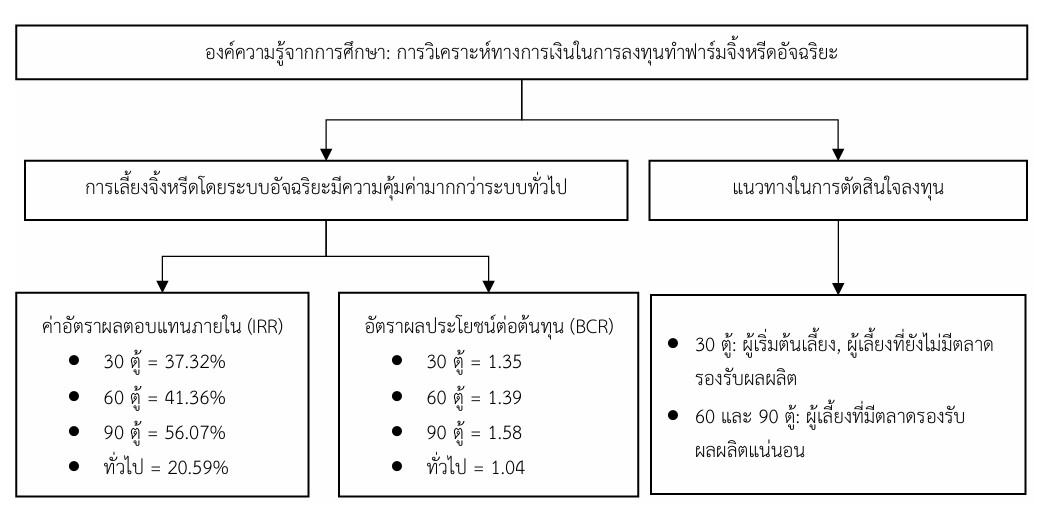
This article aimed to study the smart cricket farm system in three sizes: 30, 60, and 90 boxes. It then compared these with a normal cricket farm system through four analytical results: 1) cost and benefit analysis, 2) financial analysis, 3) sensitivity analysis of smart farm investment in four scenarios (yield decreased to 30 kg per box, yield increased to 40 kg per box, feed price increased by 10%, sale price decreased by 10%), and 4) switching value test (SVT). The study cases were purposively selected, including 32 Innovative Company Limited as the smart farm and Hero Crickets Farm as the normal farm, both located in the Bangkok metropolitan area. Data were collected through in-depth interviews, and the financial analyses used four indicators: 1) Payback Period (PB), 2) Net Present Value (NPV), 3) Internal Rate of Return (IRR), and 4) Benefit-Cost Ratio (BCR) under a 6.125% discount rate. The results of the study found that: 1) The production cost for the smart farm (30 boxes) was 128.03 Baht/kg, while the normal farm's cost was 108.44 Baht/kg. Additionally, the production profit of the smart farm (30 boxes) was 44.97 Baht/kg, compared to 0.56 Baht/kg for the normal farm. 2) The financial analysis results showed that the smart farm had a payback period of 2.55 years, an NPV of 2,782,104.29 Baht, an IRR of 37.32%, and a BCR of 1.35, while the normal farm indicated a payback period of 4.09 years, an NPV of 149,297.41 Baht, an IRR of 20.59%, and a BCR of 1.04. 3) The sensitivity analysis results indicated that all four scenarios were feasible. 4) The switching value test for costs indicated that costs could increase by 44.19% while the investment remained feasible, whereas the switching test for revenue showed that revenue could decrease by 26.16% while the investment could still be considered feasible.
References
กนกวรรณ จันทร์เจริญชัย. (2562). หลักการวิเคราะห์ความเป็นไปได้เชิงเศรษฐศาสตร์และธุรกิจ. กรุงเทพฯ: มหาวิทยาลัยเกษตรศาสตร์.
กรมปศุสัตว์. (2564). คู่มือการเลี้ยงจิ้งหรีดฉบับประชาชน. กรุงเทพฯ: กรมปศุสัตว์.
กรมส่งเสริมการเกษตร (2563). “เฉลิมชัย” ตั้งเป้าไทยเป็นฮับโปรตีนแมลงโลก ส่งเสริมเกษตรทางเลือกใหม่ให้เกษตรกรยุคโควิด. สืบค้นจาก https://www.moac.go.th/news-preview-422791791552?utm_source=chatgpt.com.
เกียรติสิน กาญจนวนิชกุล, จุมพล แก้วสีหาวงค์, วุฒิยา อุตราชา และ สุพรรณ ยั่งยืน. (2563). การทำฟาร์มจิ้งหรีดอัจฉริยะโดยใช้อินเทอร์เน็ตของสรรพสิ่ง. วารสารวิศวกรรมฟาร์มและเทคโนโลยีควบคุมอัตโนมัติ, 6(2), 98-112.
คณะเกษตรศาสตร์ มหาวิทยาลัยเชียงใหม่. (2565). คู่มือปฏิบัติการเพาะเลี้ยงจิ้งหรีดให้ได้มาตรฐานสำหรับฟาร์ม. เชียงใหม่: คณะเกษตรศาสตร์ มหาวิทยาลัยเชียงใหม่
ดนัย จันทร์อรุณ, ธนกฤต นนท์กระโทก และ ธีรนาฏ กุสารัมย์. (2566). ชุดฝึกแขนกลออัตโนมัติระบบนิวแมติกส์ควบคุมด้วย PLC. (ครุศาสตร์อุตสาหกรรมบัณฑิต, มหาวิทยาลัยเทคโนโลยีพระจอมเกล้าพระนครเหนือ).
ศูนย์วิเคราะห์เศรษฐกิจทีทีบี. (2567). ttb analytics เตือนแรงงานภาคเกษตรหายไปกว่า 4 ล้านคนในรอบ 10 ปี. สืบค้นจาก https://www.ttbbank.com/th/newsroom/detail/ttba-agricultural-labor-2024.
สำนักงานพัฒนาการวิจัยเกษตร. (2568). เกษตรอัจฉริยะ (Smart Agriculture) พลิกโฉมการทำเกษตรด้วยเทคโนโลยีและนวัตกรรม. สืบค้นจาก https://www.arda.or.th/detail/6195.
อภิชาติ พงศ์สุพัฒน์. (2555). การเงินธุรกิจ. (พิมพ์ครั้งที่ 12). กรุงเทพฯ: ภาควิชาการเงิน คณะบริหารธุรกิจ มหาวิทยาลัยเกษตรศาสตร์.
อรุณี การะเกตุ, จักรกฤษณ์ พจนศิลป์ และ ศานิต เก้าเอี้ยน. (2567). การวิเคราะห์เปรียบเทียบการลงทุนทางการเงินของการเลี้ยงจิ้งหรีดในจังหวัดขอนแก่น. วารสารสังคมศาสตร์ปัญญาพัฒน์, 6(2), 153–164.
Ibitoye, O., Ayeni, O., Ayanniyi, O., Wealth, A., Kolejo, O., Adenika, O. A., Murtala, M., Oyediji, O., Aremu, A., & Muritala, D. (2025). Advancing urban insect farming: integrating automation, vertical farming, and sustainable waste management systems. Discover Agriculture, 3(1), 1-15.
Downloads
Published
How to Cite
Issue
Section
License
Copyright (c) 2025 Journal of Social Science Panyapat

This work is licensed under a Creative Commons Attribution-NonCommercial-NoDerivatives 4.0 International License.


