Online Marketing Mix and Technology Acceptance that Affects Loyalty in Using the Agoda Application of Consumers in Hatyai District, Songkhla Province
Keywords:
Online Marketing Mix, Technology Acceptance, Customer LoyaltyAbstract
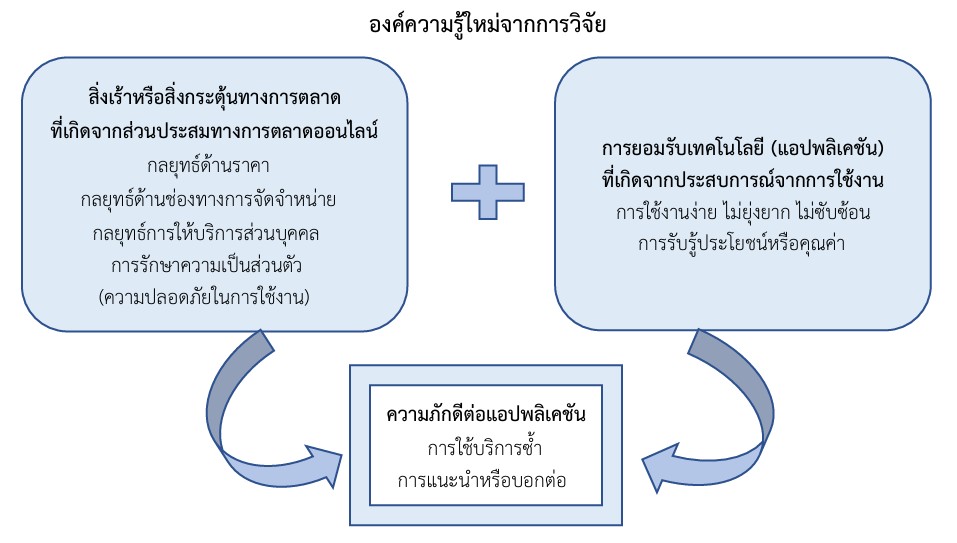
This research article aims to (1) examine the factors of the online marketing mix (6Ps) affecting loyalty in using the Agoda application, and (2) study the influence of technology acceptance on loyalty in using the Agoda application. The sample group consisted of 400 Agoda application users in Hat Yai District, Songkhla Province, selected through purposive sampling. The research instrument was a questionnaire comprising multiple-choice questions and five-point Likert scale items. Data were analyzed using percentages, means, standard deviations, correlation analysis, and multiple regression analysis. The research findings revealed that factors in the online marketing mix—including product, price, place (distribution channel), and personalization—had a positive effect on loyalty to the Agoda application at the 0.05 significance level. Moreover, privacy and promotion factors also had a positive effect on loyalty, but at the 0.10 significance level. Additionally, technology acceptance factors—namely, perceived ease of use and perceived usefulness—positively influenced loyalty to the Agoda application at the 0.05 significance level.
References
ขวัญชนก สังข์ทอง และ อนุวัต สงสม. (2567). การยอมรับเทคโนโลยีและคุณภาพบริการทางอิเล็กทรอนิกส์ที่ส่งผลต่อความจงรักภักดีในการใช้บริการแอปพลิเคชัน Netflix ของกลุ่ม Gen Y ในอำเภอเมืองสงขลา. ใน การประชุมทางวิชาการระดับปริญญาตรีด้านมนุษยศาสตร์และสังคมศาสตร์ระดับชาติ ครั้งที่ 9 (น. 267-281). สงขลา: มหาวิทยาลัย สงขลานครินทร์.
ชัชภณ สินภัทรชาต และ ทิพย์รัตน์ แสงเรืองรอบ. (2562). การเปรียบเทียบการกลับมาใช้บริการซ้ำของบัดเจ็ทโฮเทล และโฮสเทลของเมืองท่องเที่ยวหลักในประเทศไทย. วารสารวิทยาลัยดุสิตธานี, 13(1), 140-150.
ทิพวรรณ ศรีจันทร์โพธิคุณ และ วีระ วีระโสภณ. (2566). กลยุทธ์การตลาดกับการบริหารจัดการจองห้องพักผ่านตัวแทนผู้ให้บริการจองที่พักออนไลน์ในยุคดิจิทัล. วารสารเซนต์จอห์น (สาขามนุษยศาสตร์และสังคมศาสตร์), 26(38), 207-220.
ธนพล อินประเสริฐกลุ และ จิตรลดา ปิ่นทอง. (2566). แนวทางการพัฒนาแอปพลิเคชันจองที่พักออนไลน์ของธุรกิจโรงแรมและที่พัก. วารสารวิเทศศึกษา มหาวิทยาลัยสงขลานครินทร์, 13(2), 39-52.
นัทธมน ปรียวาณิชย์. (2566). อิทธิพลสื่อสังคมออนไลน์ การยอมรับเทคโนโลยี ความไว้วางใจ และทัศนคติต่อการใช้บริการ ส่งผลต่อความตั้งใจใช้บริการจองที่พักผ่านแอปพลิเคชัน Agoda ของผู้ใช้บริการในพื้นที่ 14 จังหวัดภาคใต้. (บริหารธุรกิจมหาบัณฑิต, มหาวิทยาลัยรามคำแหง).
พรประชา โตโส. (2562). ปัจจัยที่มีอิทธิพลต่อการกลับมาจองห้องพักผ่านแอปพลิเคชัน อโกด้า ซ้ำของนักท่องเที่ยวชาวไทยในเขตกรุงเทพมหานครและปริมณฑล. (บริหารธุรกิจมหาบัณฑิต, มหาวิทยาลัยรามคำแหง).
พัฏฐ์ณิชา พัฒนศิริ. (2566). ปัจจัยที่มีอิทธิพลต่อการเลือกซื้อเสื้อกล้ามทอมของกลุ่มเพศทางเลือก (LGBTIQ) ผ่านทางแอปพลิเคชันออนไลน์. บริหารธุรกิจมหาบัณฑิต, มหาวิทยาลัยศิลปากร).
สมเกียรติ ภู่พัฒน์วิบูลย์. (2564). ปัจจัยส่วนประสมทางการตลาดออนไลน์และความภักดีของลูกค้า: ข้อมูลป้อนกลับจากบทรีวิวโดยลูกค้าลาซาด้า. วารสารวิจัยวิทยาการจัดการ มหาวิทยาลัยราชภัฏสุรินทร์, 5(2), 88-100.
อนันต์กันต์ ชมภูทีป. (2561). ปัจจัยทางด้านนวัตกรรมที่มีอิทธิพลต่อความสำเร็จของบริษัทผู้ให้บริการด้านการจองที่พักออนไลน์ (Online Travel Agent) ในประเทศไทย กรณีศึกษาความคิดเห็นของพนักงานในบริษัทผู้ให้บริการด้านการจองที่พักออนไลน์แห่งหนึ่ง. (วิทยาศาสตรมหาบัณฑิต, มหาวิทยาลัยธรรมศาสตร์).
Belsley, D.A. (1991). A Guide to Using Collinearity Diagnostics. Computer Science in Economics and Management, 4(1), 33-50.
Chu, A. Z. C. & Chu, R. J. C. (2011). The intranet’s role in newcomer socialization in the hotel industry in Taiwan: A technology acceptance model analysis. The International Journal of Human Resource Management, 22(5), 1163-1179
Cochran, W.G. (1977). Sampling Techniques. (3rd ed.). New York: Wiley.
Davis, F. (1989). Perceived Usefulness, Perceived Ease of Use, and User Acceptance of Information Technology. MIS Quarterly, 13(3), 319-340.
Erdoğan, G. (2024). Antecedents of Customer Loyalty in Mobile Hotel Reservation Applications. OPUS– Journal of Society Research, 21(1), 5-16.
Hair Jr., J.F., Black, W.C., Babin, B.J., & Anderson, R.F. (2010). Multivariate Data Analysis: A Global Perspective. (7th ed.). New Jersey: Pearson Prentice Hall.
Joshi, A., Kale, S., Chandel, S., & Pal, D. K. (2015). Likert Scale: Explored and Explained. British Journal of Applied Science & Technology, 7(4), 396–403.
Kotler, P. (2000). Marketing management. (9th Edition). Boston: Prentice Hall.
Rovinelli, R. J. & Hambleton, R. K. (1977). On the Use of Content Specialists in the Assessment of Criterion-referenced Test Item Validity. Tijdschrift Voor Onderwijsresearch, 2(2), 49-60.
Swani, K., & Yoo, B. (2010). Interactions Between Price and Price Deal. Journal of Product and Brand Management, 19(2), 143–152.
Downloads
Published
How to Cite
Issue
Section
License
Copyright (c) 2025 Journal of Social Science Panyapat

This work is licensed under a Creative Commons Attribution-NonCommercial-NoDerivatives 4.0 International License.


