Synthesis results of the development process for enhancing competency in multi-grade teaching in early childhood education based on lesson study approach with transformative learning theory for student teachers
Keywords:
Competency in Multi-Grade Teaching in Early Childhood Education, Lesson Study Approach, Transformative Learning Theory, Student teacherAbstract
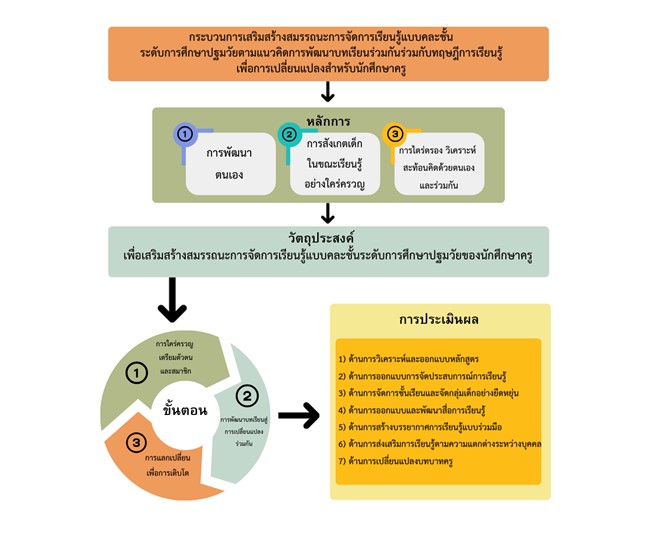
This research aimed to synthesize and present the conceptual framework of a process for enhancing competency in multi-grade teaching in early childhood education based on the lesson study approach combined with transformative learning theory for student teachers. The research methodology involved qualitative data collection through the study of relevant documents, research, concepts, and theories for synthesis of the research conceptual framework, which was divided into four steps as follows: 1) studying documents, research, concepts, and theories related to competency in multi-grade teaching in early childhood education, the lesson study approach, and transformative learning theory; 2) designing data collection research tools, namely the Index of Item-Objective Congruence (IOC) and the assessment form for appropriateness and feasibility; 3) analyzing qualitative data through data synthesis using content analysis method; and 4) examining the quality of the process from five experts and analyzing quantitative data using mean and standard deviation. The results of the study revealed that the process consisted of the following components: 1) objectives of the process to enhance competency in multi-grade teaching in early childhood education; 2) principles of the process; 3) steps of the process, comprising three stages as follows: Stage 1: Reflection and preparation of self and members; Stage 2: Collaborative lesson development for transformative change; Stage 3: Exchange for growth; and 4) evaluation to assess competency in multi-grade teaching in early childhood education for student teachers across all seven domains. The quality examination results by five experts found that the Index of Item-Objective Congruence (IOC) ranged from 0.60 to 1.00 and met all criteria. The overall appropriateness of the process was at a high level (M = 4.40, S.D. = 0.49) and the overall feasibility of the process was at a high level (M = 4.28, S.D. = 0.45).
References
กระทรวงศึกษาธิการ. (2560). หลักสูตรการศึกษาปฐมวัย พุทธศักราช 2560. กรุงเทพฯ: โรงพิมพ์ชุมนุมสหกรณ์การเกษตรแห่งประเทศไทย จำกัด.
กระทรวงศึกษาธิการ. (2562ก). พระราชบัญญัติการพัฒนาเด็กปฐมวัย พ.ศ. 2562. สืบค้นจาก https://www.moe.go.th/%E0%B8%9E%E0%B8%A3%E0%B8%B0%E0%B8%A3%E0%B8%B2%E0%B8%8A%E0%B8%9A%E0%B8%B1%E0%B8%8D%E0%B8%8D%E0%B8%B1%E0%B8%95%E0%B8%B4%E0%B8%81%E0%B8%B2%E0%B8%A3%E0%B8%9E%E0%B8%B1%E0%B8%92%E0%B8%99%E0%B8%B2%E0%B9%80/.
กระทรวงศึกษาธิการ. (2562ข). ประกาศกระทรวงศึกษาธิการ เรื่อง มาตรฐานคุณวุฒิระดับปริญญาตรี พ.ศ. 2562 สาขาครุศาสตร์และสาขาศึกษาศาสตร์ (หลักสูตรสี่ปี). สืบค้นจาก https://www.ratchakitcha.soc.go.th/DATA/PDF/2562/E/056/T_0012.PDF.
กระทรวงศึกษาธิการ. (2568). คู่มือหลักสูตรการศึกษาปฐมวัย พุทธศักราช 2568 สำหรับ เด็กอายุ 3-6 ปี. สืบค้นจาก https://academic.obec.go.th/web/images/mission/1744086483_d_2.pdf.
กองทุนเพื่อความเสมอภาคทางการศึกษา. (2567). คู่มือการฝึกประสบการณ์วิชาชีพครูรัก(ษ์)ถิ่น. สืบค้นจาก https://elementary.kpru.ac.th/contents/edms/EDMS-6303-202305031683048432.pdf.
คณะศึกษาศาสตร์และนวัตกรรมการศึกษา มหาวิทยาลัยกาฬสินธุ์. (2562). หลักสูตรครุศาสตรบัณฑิต สาขาวิชาการศึกษาปฐมวัย (หลักสูตรปรับปรุง พ.ศ. 2562) (เอกสารอัดสำเนา). กาฬสินธุ์: มหาวิทยาลัยกาฬสินธุ์.
ฆนัท ธาตุทอง. (2552). การจัดการชั้นเรียนห้องเรียนแห่งความสุข. นครปฐม: เพชรเกษม.
ชาริณี ตรีวรัญญู. (2560). การสร้างชุมชนแห่งการเรียนรู้เชิงวิชาชีพด้วยการพัฒนาบทเรียนร่วมกัน: แนวคิดและแนวทางสู่ความสำเร็จ. Journal of Education Studies, Chulalongkorn University, 45(1), 299–319.
ชาริณี ตรีวรัญญู. (2562). การพัฒนาบทเรียนร่วมกัน (Lesson Study: LS). สืบค้นจาก https://shorturl.asia/oDLfV.
ดิลกะ ลัทธพิพัฒน์ และ ลา ซองเดอร์การ์ด. (2559). ประเด็นท้าทายเกี่ยวกับโรงเรียนขนาดเล็ก และทางเลือกในการพัฒนาคุณภาพการศึกษาของประเทศไทย. (Worldbank). สืบค้นจาก https://blogs.worldbank.org/th/eastasiapacific/thailand-s-small-school-challenge-and-options-quality-education.
เทียมจันทร์ พานิชย์ผลินไชย. (2559). การเรียนรู้เพื่อการเปลี่ยนแปลง: การจัดการเรียนรู้ด้านการผลิตครู. สักทอง : วารสารมนุษยศาสตร์และสังคมศาสตร์, 22(2), 1-11.
บุญชม ศรีสะอาด. (2560). การวิจัยเบื้องต้น. (พิมพ์ครั้งที่ 10). กรุงเทพฯ: สุวีริยาสาส์น.
วิจารณ์ พานิช. (2558). เรียนรู้สู่การเปลี่ยนแปลง Transformative Learning. กรุงเทพฯ: มูลนิธิสยามกัมมาจล
สถาบันวิจัยประชากรและสังคม มหาวิทยาลัยมหิดล. (2568). จำนวนเด็กไทยเกิดต่ำสุดเป็นประวัติการณ์ สวนทางนโยบายมีลูกเพื่อชาติ. สืบค้นจาก https://www.theprachakorn.com/newsDetail.php?id=1002.
สถาบันวิจัยเพื่อการพัฒนาประเทศไทย. (2567). ระเบิดเวลาประชากร: เกิดน้อย แก่มาก ความท้าทายอนาคตไทย. สืบค้นจาก https://tdri.or.th/2024/07/population-crisis/.
สรวงพร กุศลส่ง. (2566). การพัฒนารูปแบบ ATEP MODEL เพื่อเสริมสร้างสมรรถนะครูปฐมวัยในการจัดการเรียนรู้แบบรวมชั้นเรียนของโรงเรียนขนาดเล็ก. วารสารพัฒนาการเรียนการสอน มหาวิทยาลัยรังสิต, 17(2), 173-191.
สํานักงานคณะกรรมการการศึกษาขั้นพื้นฐาน และคณะครุศาสตร์ จุฬาลงกรณ์มหาวิทยาลัย. (2568). เอกสารหลักสูตรอบรมแบบ e-Training หลักสูตรการสอนแบบบูรณาการสําหรับโรงเรียนขนาดเล็กและห้องเรียนคละชั้น. สืบค้นจาก http://www.krukird.com/55302.pdf.
สุรเดช โสมาบุตร และ พัฒนานุสรณ์ มถาพรวงศ์. (2560). แนวทางการพัฒนาคุณภาพโรงเรียนขนาดเล็ก สังกัดสำนักงานเขตพื้นที่การศึกษาประถมศึกษาขอนแก่น เขต 4. วารสารมนุษยศาสตร์และสังคมศาสตร์ มหาวิทยาลัยมหาสารคาม, 36(6), 28-41.
สุรศักดิ์ ปาเฮ. (2553). คู่มือการบริหารและนิเทศการศึกษา เรื่อง การสอนแบบคละชั้นเรียนในโรงเรียนขนาดเล็ก. (พิมพ์ครั้งที่ 2). แพร่: แพร่ไทยอุตสาหการพิมพ์.
Braud, W., & Anderson, R. (1998). Transpersonal research methods for the social sciences. Thousand Oaks, CA: SAGE.
Copple, C., & Bredekamp, S. (2009). Developmentally appropriate practice in early childhood programs serving children from birth through age 8. (3rd ed.). Washington, DC: National Association for the Education of Young Children.
Darling-Hammond, L., & Bransford, J. (Eds.). (2005). Preparing teachers for a changing world: What teachers should learn and be able to do. San Francisco, CA: Jossey-Bass.
Dirkx, J. M. (2000). Transformative learning and the journey of individuation (ERIC Digest No. 223). Retrieved from https://files.eric.ed.gov/fulltext/ED448305.pdf.
Ghamrawi, N., Ghamrawi, N. A. R., & Shal, T. (2024). Cultivating teacher leadership: Evidence from a transformative professional development model. School Leadership & Management, 44(2), 182-203.
Hervas, G., & Medina, J. L. (2023). Lesson study: A practice for teachers' training and professional development at any educational level. In R. J. Tierney & K. Ercikan (Eds.), International encyclopedia of education (4th ed.) (pp. 570-580). Amsterdam, Netherlands: Elsevier.
Hokkaido University. (2020). HUE RISE Resource series no.1: Brief introduction to multi-grade teaching in Japan. Hokkaido, Japan: Hokkaido University of Education- Research Institute for Remote and Small School Education (HUE RISE). Retrieved from https://www.hokkyodai.ac.jp/files/00005800/00005864/20221215145345.pdf.
Inprasitha, M., & Changsri, N. (2022). Lesson study and open approach development in Thailand: A longitudinal study. International Journal for Lesson and Learning Studies, 11(2), 119-134.
Kamali, J. (2024). Collaborative reflection as a means to improve teachers' reflective skills: A community of practice perspective. Reflective Practice, 26(2), 234-251.
Mezirow, J. (2000). Learning to think like an adult: Core concepts of transformation theory. In J. Mezirow & Associates (Eds.), Learning as transformation: Critical perspectives on a theory in progress (pp. 3-33). San Francisco, CA: Jossey-Bass.
Mezirow, J. (2003). Transformative learning as discourse. Journal of Transformative Education, 1(1), 58-63.
National Association for the Education of Young Children. (2020). Developmentally appropriate practice in early childhood programs serving children from birth through age 8. (4th ed.). Washington, DC: Author.
Rock, T. C., & Wilson, C. (2005). Improving teaching through lesson study. Teacher Education Quarterly, 32(1), 77-92.
Sims, L., & Walsh, D. (2009). Lesson study with preservice teachers: Lessons from lessons. Teaching and Teacher Education, 25(5), 724-733.
Smit, R., & Engeli, E. (2015). An empirical model of mixed-age teaching. International Journal of Educational Research, 74, 136-145.
Stigler, J., & Hiebert, J. (1999). The teaching gap: Best ideas from the world's teachers for improving education in the classroom. New York: The Free Press.
United Nations Educational, Scientific and Cultural Organization. (2015). Practical tips for teaching multigrade classes. Paris, France: UNESCO.
Veenman, S. (1995). Cognitive and noncognitive effects of multigrade and multi-age classes: A best evidence synthesis. Review of Educational Research, 65(4), 319-381.
Downloads
Published
How to Cite
Issue
Section
License
Copyright (c) 2025 Journal of Social Science Panyapat

This work is licensed under a Creative Commons Attribution-NonCommercial-NoDerivatives 4.0 International License.


