Policies on the Use of Information and Communication Technology in Organizational Operations: A Case Study of Now Twentyfour Seven Co., Ltd.
Keywords:
Information and Communication Technology, Organizational Policy, Knowledge Sharing, Cybersecurity, Human Resource DevelopmentAbstract
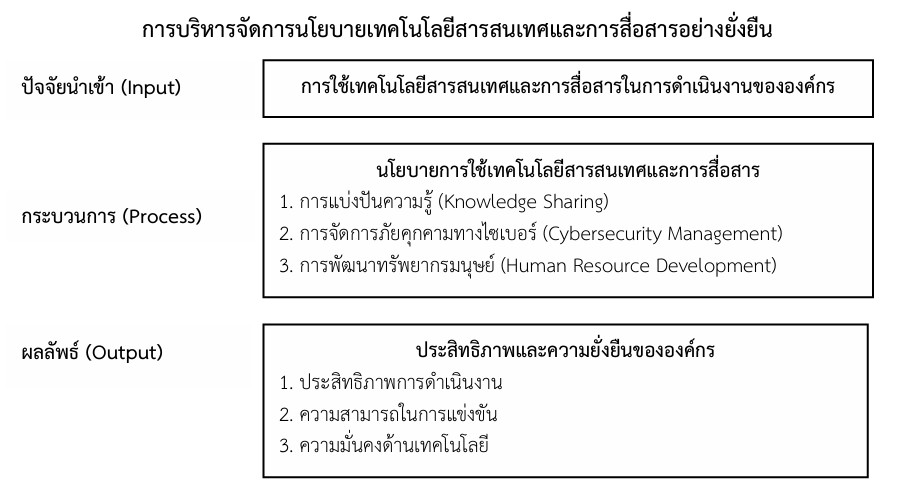
This article aimed to study (1) the impacts of information and communication technology (ICT) utilization on the operations of business organizations, and (2) the organizational policies regarding the application of ICT in knowledge sharing, cyber threat management, and human resource development, The sample was executives and employees of Now Twentyfour Seven Co., Ltd., who were selected by purposive sampling. The instruments for collecting data were in-depth interviews and documentary review. Data were analyzed by descriptive statistics and content analysis. The results of the study found that: 1) ICT adoption had both positive and negative impacts on organizational performance. Positively, it enhanced data management efficiency, improved communication, promoted teamwork collaboration, increased service quality, and supported human resource capability through continuous training and online learning. However, the negative impacts included data security risks, high maintenance costs, employee resistance to change, overreliance on technology, and stress from constant technology use. 2) The company’s ICT policies were clearly implemented in three key areas: (1) Knowledge Sharing through digital collaboration tools and cloud systems, (2) Cybersecurity Management through preventive, detection, and responsive measures, and (3) Human Resource Development through continuous training programs, learning culture promotion, and managerial support. The organization still faced significant challenges such as system integration difficulties, cybersecurity vulnerabilities, resistance to technological change, and high operating costs. These findings highlight the importance of developing sustainable ICT management strategies to strengthen competitiveness in the digital era. The findings offer important policy implications by highlighting the necessity of integrated organizational ICT policies that simultaneously address knowledge sharing, cybersecurity management, and human resource development. Such an integrated approach can support sustainable organizational performance and long-term competitiveness in the digital era.
References
Alavi, M., & Leidner, D. E. (2001). Knowledge management and knowledge management systems: Conceptual foundations and research issues. MIS quarterly, 25(1), 107-136.
Daft, R. L., & Lane, P. G. (2015). The leadership experience. (6th ed.). Boston, MA: Cengage Learning, Inc.
Laudon, K. C., & Laudon, J. P. (2016). Management information systems: Managing the digital firm. London: Pearson Education.
National Institute of Standards and Technology. (2013). Cybersecurity Framework (CSF). Retrieved from https://www.nist.gov/cyberframework.
Noe, R. A. (2020). Employee training and development. (8th ed.). New York: McGraw-Hill.
Nonaka, I. (2009). The knowledge-creating company. In Siesfeld, T., Cefola, J., & Neef, D. (Eds.), The economic impact of knowledge (pp. 175-187). Oxfordshire: Routledge.
Nonaka, I., & Takeuchi, H. (2007). The knowledge-creating company. Harvard Business Review, 85(7/8), 162.
Ragu-Nathan, T. S., Tarafdar, M., Ragu-Nathan, B. S., & Tu, Q. (2008). The consequences of technostress for end users in organizations: Conceptual development and empirical validation. Information systems research, 19(4), 417-433.
Rogers, E. (2003). Diffusions of Innovations. (5th ed.). New York: Free Press.
Senge, P. M. (1994). The Fifth Discipline: The Art and Practice of The Learning Organization. New York: Doubleday Currency.
Venkatesh, V., Morris, M. G., Davis, G. B., & Davis, F. D. (2003). User Acceptance of Information Technology: Towards a Unified View. MIS Quarterly, 27, 425-478.
Whitman, M. E., & Mattord, H. J. (2018). Principles of information security. (6th ed.). Boston, MA: Cengage Learning, Inc.
World Bank. (2021). World development report 2021: Data for better lives. Retrieved from https://openknowledge.worldbank.org/entities/publication/7a8f3bf4-c1ca-5512-bb16-7dcd5eb71007.
Downloads
Published
How to Cite
Issue
Section
License
Copyright (c) 2025 Journal of Social Science Panyapat

This work is licensed under a Creative Commons Attribution-NonCommercial-NoDerivatives 4.0 International License.


