ปัจจัยที่ส่งผลต่อหนี้ที่ไม่ก่อให้เกิดรายได้ของธนาคารพาณิชย์ในประเทศไทย
คำสำคัญ:
หนี้ที่ไม่ก่อให้เกิดรายได้, ธนาคารพาณิชย์, ประเภทธุรกิจ, ประเทศไทยบทคัดย่อ
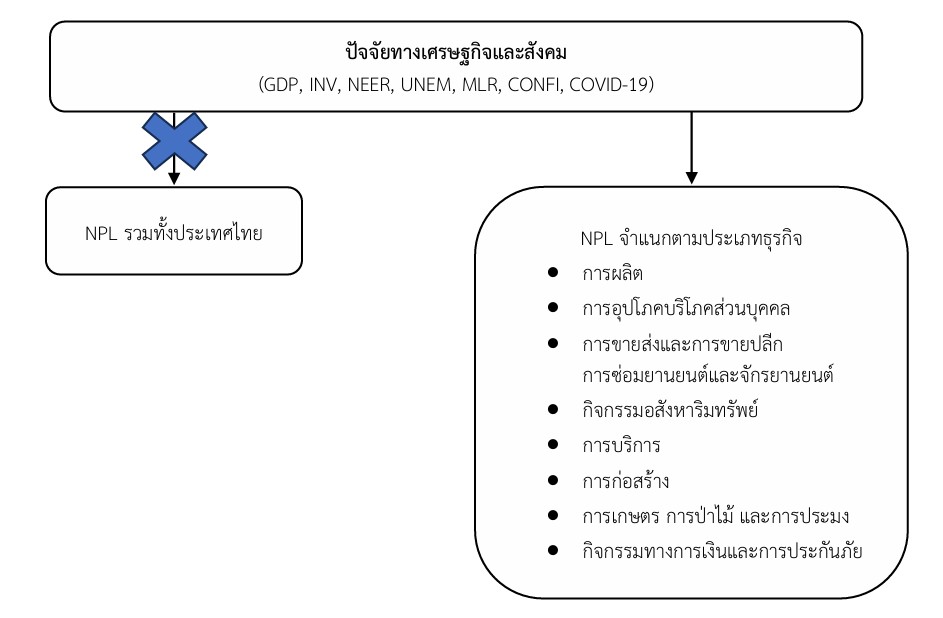
บทความวิจัยนี้มีวัตถุประสงค์เพื่อศึกษา 1) ปัจจัยที่ส่งผลต่อหนี้ที่ไม่ก่อให้เกิดรายได้ของธนาคารพาณิชย์ที่จดทะเบียนในประเทศไทยโดยรวม 2) ปัจจัยที่ส่งผลต่อหนี้ที่ไม่ก่อให้เกิดรายได้ของธนาคารพาณิชย์ที่จดทะเบียนในประเทศไทยจำแนกตามประเภทธุรกิจจำนวน 10 ประเภท โดยใช้ข้อมูลทุติยภูมิแบบอนุกรมเวลารายไตรมาสตั้งแต่ปี พ.ศ. 2544 ถึง 2567 สถิติที่ใช้ในการวิเคราะห์ข้อมูล คือ วิธีกำลังสองน้อยสุด (Ordinary Least Square) ผลการศึกษาพบว่า ปัจจัยทางเศรษฐกิจและสังคมไม่ส่งผลต่อหนี้ที่ไม่ก่อให้เกิดรายได้ในภาพรวม อย่างไรก็ตามเมื่อพิจารณาในระดับประเภทธุรกิจ พบว่า ปัจจัยที่ส่งผลในทิศทางบวกต่อหนี้ที่ไม่ก่อให้เกิดรายได้ของธุรกิจการผลิต ธุรกิจกิจกรรมอสังหาริมทรัพย์ ธุรกิจการเกษตร การป่าไม้ และการประมง ธุรกิจการอุปโภคบริโภคส่วนบุคคล ธุรกิจการขายส่งและการขายปลีก การซ่อมยานยนต์และจักรยานยนต์ และธุรกิจการก่อสร้าง ได้แก่ ผลิตภัณฑ์มวลรวมในประเทศ อัตราแลกเปลี่ยน อัตราการว่างงาน และดัชนีความเชื่อมั่นทางธุรกิจ สำหรับปัจจัยที่ส่งผลในทิศทางลบต่อหนี้ที่ไม่ก่อให้เกิดรายได้ของธุรกิจการอุปโภคบริโภคส่วนบุคคล ธุรกิจการผลิต การบริการ และกิจกรรมทางการเงินและการประกันภัย ได้แก่ การลงทุนภาคเอกชน อัตราดอกเบี้ยเงินกู้ และสถานการณ์การแพร่ระบาดของโรคโควิด-19 จากผลการศึกษามีข้อเสนอแนะว่า เมื่อภาครัฐดำเนินนโยบายเศรษฐกิจควรคำนึงถึงความเสี่ยงที่แตกต่างกันของธุรกิจแต่ละประเภท และสนับสนุนการลงทุนภาคเอกชนในช่วงเศรษฐกิจผันผวน สำหรับธนาคารพาณิชย์ควรกำหนดนโยบายสินเชื่อและบริหารความเสี่ยง พร้อมติดตามปัจจัยทางเศรษฐกิจอย่างใกล้ชิด ในส่วนของผู้ประกอบการควรมุ่งเน้นการปรับกลยุทธ์เพื่อลดความเสี่ยงในการเกิดหนี้ที่ไม่ก่อให้เกิดรายได้
เอกสารอ้างอิง
ชนกกานต์ เมฆยงค์. (2564). ผลของการเปลี่ยนแปลงส่วนต่างอัตราดอกเบี้ยต่อเงินทุนเคลื่อนย้ายต่างชาติในหลักทรัพย์ไทย. สืบค้นจาก https://www.bot.or.th/content/dam/bot/documents/th/research-and-publications/research/faq/FAQ_190.pdf.
ชัชวลัย ใจธีรภาพกุล. (2554). ปัจจัยที่ส่งผลต่อปริมาณหนี้ที่ไม่ก่อให้เกิดรายได้ (NPL) ของธนาคารพาณิชย์ในประเทศไทย. (เศรษฐศาสตรมหาบัณฑิต, มหาวิทยาลัยศรีนครินทรวิโรฒ).
ธนาคารทหารไทยธนชาต. (2567). รู้ทันหนี้เสีย (NPL) คืออะไร แก้ยังไงให้ประวัติไม่เสียชื่อ. สืบค้นจาก https://www.ttbbank.com/th/fin-tips/detail/pl-what-is-npl.
ธนาคารเพื่อการส่งออกและนำเข้าแห่งประเทศไทย. (2561). EXIM BANK จัดสัมมนาโครงการบริหารความเสี่ยง FX ของ SMEs กระตุ้นผู้ส่งออก SMEs ใช้เครื่องมือปิดความเสี่ยงด้านอัตราแลกเปลี่ยน. สืบค้นจาก https://www.exim.go.th/TH/Newsroom/newsactivities/EXIM-BANK-%E0%B8%88%E0%B8%94%E0%B8%AA%E0%B8%A1%E0%B8%A1%E0%B8%99%E0%B8%B2%E0%B9%82%E0%B8%84%E0%B8%A3%E0%B8%87%E0%B8%81%E0%B8%B2%E0%B8%A3%E0%B8%9A%E0%B8%A3%E0%B8%AB%E0%B8%B2%E0%B8%A3%E0%B8%84%E0%B8%A7%E0%B8%B2%E0%B8%A1%E0%B9%80%E0%B8%AA%E0%B8%A2%E0%B8%87-FX-%E0%B8%82%E0%B8%AD%E0%B8%87-S-(7).aspx.
ธนาคารโลก. (2563). รายงานตามติดเศรษฐกิจไทย. สืบค้นจาก https://www.worldbank.org/th/country/thailand/publication/thailand-economic-monitor-productivity-for-prosperity.
ธนาคารแห่งประเทศไทย. (2563). สถานการณ์การระบาดของ COVID-19 ส่งผลกระทบทางเศรษฐกิจต่อภาคธุรกิจและประชาชนในวงกว้าง. สืบค้นจาก https://www.bot.or.th/th/our-roles/special-measures/covid-19.html.
ธนาคารแห่งประเทศไทย. (2565). ผลกระทบจากไวรัส COVID-19 ต่อภาคธุรกิจไทย. สืบค้นจาก https://www.bot.or.th/content/dam/bot/documents/th/thai-economy/econ-publication/business-sentiment-index/bsi-reports/BSI-COVID-2565-09.pdf.
นงนุช อินทรวิเศษ, ถวิล นิลใบ, ธัญญารัตน์ ทองพาศน์ และ อภิวีร์ อันตรเสน. (2565). ผลกระทบของปัจจัยด้านเศรษฐกิจและสังคมของครัวเรือนที่มีต่อหนี้ครัวเรือนของประเทศไทย. วารสารวิทยาการจัดการ, 9(1), 115-138.
บุญญภัสร์ พจนานันทกุล และ วรรณรพี บานชื่นวิจิตร. (2561). ปัจจัยทางเศรษฐกิจที่มีผลกระทบต่อหนี้ที่ไม่ก่อให้เกิดรายได้ (NPL) ในกลุ่มธนาคารพาณิชย์. ใน การประชุมนําเสนอผลงานวิจัยระดับบัณฑิตศึกษาระดับชาติ ครั้งที่ 13 ประจำปีการศึกษา 2561 กลุ่มสาขาวิชาบริหารและการจัดการ (น. 1261-1269). ปทุมธานี: มหาวิทยาลัยรังสิต.
ปิยะภูมิ เกียรติวีระศักดิ์. (2562). การพยากรณ์ปริมาณหนี้ที่ไม่ก่อให้เกิดรายได้ (NPL) ของธนาคารพาณิชย์ในประเทศไทย. (บริหารธุรกิจมหาบัณฑิต, มหาวิทยาลัยธรรมศาสตร์).
พัชรินทร์ มาบุญ และ พัชรี สุริยะ. (2559). ปัจจัยที่มีผลต่อการค้างชำระหนี้ของสมาชิกสหกรณ์การเกษตรภูเวียง จำกัด จังหวัดขอนแก่น. วารสารแก่นเกษตร, 44(4), 605-614.
พิมพ์สิริ ไชยมนัส. (2559). ปัจจัยทางเศรษฐกิจที่มีผลต่อหนี้ที่ไม่ก่อให้เกิดรายได้ (NPL) ของธนาคารทั้งหมดในประเทศไทย (จำแนกตามประเภทธุรกิจ). (บริหารธุรกิจมหาบัณฑิต, มหาวิทยาลัยหอการค้าไทย).
วัศพล ภัทรรัมภา. (2566). ปัจจัยที่ส่งผลต่อปริมาณหนี้ที่เสีย (NPL) ทั้งระบบภายในประเทศ. (เศรษฐศาสตรมหาบัณฑิต, มหาวิทยาลัยหอการค้าไทย).
ศูนย์ข้อมูลอสังหาริมทรัพย์. (2566). NPA-NPL สถาบันการเงินพุ่ง! อสังหาแห่ลุย ธุรกิจบริหารสินทรัพย์. สืบค้นจาก https://reic.or.th/News/RealEstate/467305.
ศูนย์วิจัยกสิกรไทย. (2568). หนี้เสียธุรกิจไทย แก้อย่างไรให้ยั่งยืน?. สืบค้นจาก https://www.kasikornresearch.com/th/analysis/k-social-media/Pages/IDP103-NCB-FB-2025-10-08.aspx.
สถาบันวิจัยเศรษฐกิจป๋วย อึ๊งภากรณ์. (2567). การเปลี่ยนแปลงสภาพอากาศที่รุนแรงกับการผิดนัดชำระหนี้เกษตร. สืบค้นจาก https://www.pier.or.th/blog/2024/0501/.
เอนกพงศ์ ตู๋ปาน. (2563). อัตราดอกเบี้ยนโยบายมีผลอย่างมีนัยสำคัญต่อระดับ NPL ของ SMEs ในช่วง 17 ปีที่ผ่านมา (พ.ศ. 2545-2562) ในประเทศไทยหรือไม่?. (ศิลปศาสตรมหาบัณฑิต, จุฬาลงกรณ์มหาวิทยาลัย).
Ariccia, G. D., Laeven, L., & Suarez, G. (2013). Bank Leverage and Monetary Policy's Risk-Taking Channel: Evidence from the United States (IMF Working Paper). Washington, DC: International Monetary Fund.
Arnold, L. G. (2002). Business Cycle Theory. Oxford: Oxford University Press.
Bangkok Post (2024). Banking on responsible lending. Retrieved from https://www.bangkokpost.com/business/general/2687553/banking-on-responsible-lending.
Bank of Thailand. (2025). Monetary Policy Report Q2/2568. Bangkok: Bank of Thailand.
Brooks, C. (2008). Introductory Econometrics for Finance. (Second Edition). Cambridge: Cambridge University Press.
Doerr, S., Kabas, G., & Ongena, S. (2022). Population aging and bank risk-taking (BIS Working Papers 1050). Basel: Bank for International Settlements.
International Monetary Fund (2023). World Economic Outlook. Retrieved from https://www.imf.org/en/publications/weo/issues/2023/04/11/world-economic-outlook-april-2023.
Kryzanowski, L., Liu, J., & Zhang, J. (2023). Effect of COVID-19 on non-performing loans in China. Finance Research Letters, 20(52), 103372.
Long, V. M., Yen N. T., & Long, P. D. (2020). Factors affecting Non-Performing Loans (NPLs) of banks: The case of Vietnam. Journal of Science Ho Chi Minh City Open University, 10(4), 83-93.
Mankiw, N. G. (1989). Real Business Cycles: A New Keynesian Perspective. Journal of Economic Perspectives, American Economic Association, vol. 3(3), 79-90.
Mohanty, A. R., Das B. R., & Kumar, S. (2018). Determinants of Non-Performing Loans in India: A System GMM Panel Approach. Prajnan: Journal of Banking and Financial Management, 47(1), 37-56.
Mukhibad, H., Anisykurlillah, I., & Jayanto, P. Y. (2020). The relationship between human capital investment, non-performing financing and profitability. Humanities & Social Sciences Reviews, 8(1), 837-843.
OECD. (2023). OECD Economic Surveys: Thailand 2023. Retrieved from https://www.oecd.org/en/publications/oecd-economic-surveys-thailand-2023_4815cb4b-en.html.
Pancotto, L., Gwilym O. A., & Williams, J. (2024). The evolution and determinants of the non-performing loan burden in Italian banking. Pacific-Basin Finance Journal, 32(84), 102306.
Plikas, J. H., Kenourgios, D., & Savvakis, G. A. (2024). COVID-19 and Non-Performing Loans in Europe. Journal of Risk and Financial Management, 17(7), 271.
Saba, I., Kouser, R., & Azeem, M., (2012). Determinants of Non-Performing Loans: Case of US Banking Sector. The Romanian Economic Journal, 15(44), 141-152.
Srimanchanda, M., (2023). The Influence of Interest Rates on Small and Medium Enterprises in Thailand. (Master of Science, Chulalongkorn University).
Tilleke & Gibbins. (2021). Thailand’s BOI Introduces New COVID-19 Economic Stimulus Measures. Retrieved from https://www.tilleke.com/insights/thailands-boi-introduces-new-covid-19-economic-stimulus-measures/28/.
ดาวน์โหลด
เผยแพร่แล้ว
รูปแบบการอ้างอิง
ฉบับ
ประเภทบทความ
สัญญาอนุญาต
ลิขสิทธิ์ (c) 2026 วารสารสังคมศาสตร์ปัญญาพัฒน์

อนุญาตภายใต้เงื่อนไข Creative Commons Attribution-NonCommercial-NoDerivatives 4.0 International License.


