Artificial Intelligence Literacy of School Administrators Affecting the Development of Learning Management in Educational Institutions under Nakhon Phanom Primary Educational Service Area Office 1
Keywords:
Artificial Intelligence Literacy, The Development of Learning Management, Educational AdministratorAbstract
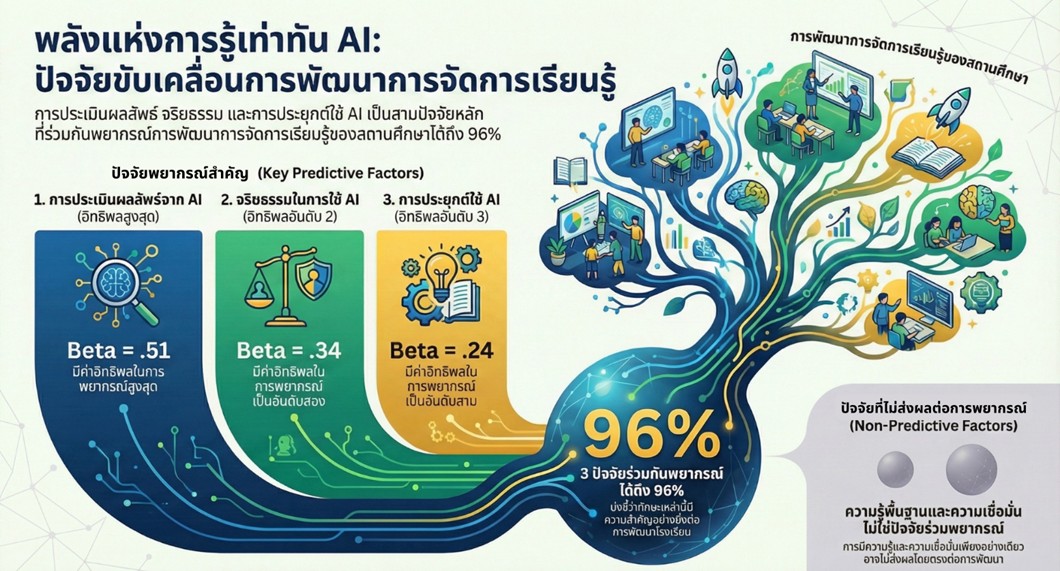
This research article aims to 1) study and compare the artificial intelligence (AI) literacy of school administrators, 2) study and compare the development of learning management in educational institutions, 3) examine the relationship between the AI literacy of school administrators and the development of learning management in educational institutions, and 4) investigate the predictive power of the AI literacy of school administrators on the development of learning management in educational institutions under Nakhon Phanom Primary Educational Service Area Office 1. The total sample consisted of 260 individuals, including 90 school administrators and 170 teachers. The sample size was determined using percentage criteria and stratified random sampling. The research instruments used were two 5-point Likert scale questionnaires: (1) a questionnaire on the AI literacy of school administrators, which had a consistency index of .60-1.00, item discrimination power ranging from .60 to .91, and an overall reliability of .96; (2) a questionnaire on the development of learning management in educational institutions, which had a consistency index of .60-1.00, item discrimination power ranging from .29 to .88, and an overall reliability of .97. The statistics used included mean, standard deviation, percentage, hypothesis testing using t-values, Pearson correlation analysis, one-way ANOVA, and stepwise multiple regression analysis. The research findings revealed that 1) the AI literacy of school administrators was at a high level, and comparisons based on the status and size of the educational institutions showed no significant differences overall or in specific aspects; 2) the development of learning management in educational institutions was also at a high level, with no significant differences overall or in specific aspects based on status and size; 3) there was a significant positive correlation between the AI literacy of school administrators and the development of learning management in educational institutions at the .01 level; 4) the AI literacy of school administrators that influenced the development of learning management in educational institutions included three variables: the evaluation of outcomes resulting from the use of AI (X4), the ethics of using AI (X2), and the application of AI (X1), which together predicted 96% of the variance.
References
กระทรวงศึกษาธิการ. (2560). นโยบายการพัฒนาการจัดการเรียนรู้ในสถานศึกษา. กรุงเทพฯ: กระทรวงศึกษาธิการ.
ทรงศักดิ์ ภูสีอ่อน. (2563). การวิจัยและพัฒนาทางการศึกษา. (พิมพ์ครั้งที่ 2). มหาสารคาม: ตักสิลาการพิมพ์.
ทิศนา แขมมณี. (2566). ศาสตร์การสอน : องค์ความรู้เพื่อการจัดกระบวนการเรียนรู้ที่มีประสิทธิภาพ. (พิมพ์ครั้งที่ 26). กรุงเทพฯ: สำนักพิมพ์แห่งจุฬาลงกรณ์มหาวิทยาลัย.
บุญชม ศรีสะอาด. (2560). การวิจัยเบื้องต้น. (พิมพ์ครั้งที่ 10). กรุงเทพฯ: สุวีริยาสาส์น.
ประเวศ เวชชะ. (2561). การบริหารหลักสูตร การสอน การวัดและประเมินผลการเรียนรู้. เชียงราย: โรงพิมพ์มหาวิทยาลัยราชภัฏเชียงราย.
พิมพันธ์ เดชะคุปต์. (2558). การบริหารจัดการการศึกษาในสถานศึกษา. กรุงเทพฯ: สำนักพิมพ์แห่งจุฬาลงกรณ์มหาวิทยาลัย.
วรพงศ์ ผูกภู่. (2561). แนวทางการพัฒนาการเรียนการสอนในสถานศึกษา. กรุงเทพฯ: สำนักพิมพ์มหาวิทยาลัยธรรมศาสตร์.
ศุภลักษณ์ ทองจีน. (2558). การออกแบบและการจัดการเรียนรู้. อุดรธานี: มหาวิทยาลัยราชภัฎอุดรธานี.
สมนึก ภัททิยธนี. (2567). การวัดผลการศึกษา. (พิมพ์ครั้งที่ 14). กาฬสินธุ์: ประสานการพิมพ์.
สำนักงานเขตพื้นที่การศึกษาประถมศึกษานครพนม เขต 1. (2568). แผนปฏิบัติการประจำปีงบประมาณ พ.ศ. 2568: โครงการส่งเสริมและพัฒนาการยกระดับคุณภาพการศึกษา ด้วยเทคโนโลยีปัญญาประดิษฐ์. นครพนม: สำนักงานเขตพื้นที่การศึกษาประถมศึกษานครพนม เขต 1.
สำนักงานพัฒนารัฐบาลดิจิทัล. (2563). ยุทธศาสตร์การพัฒนารัฐบาลดิจิทัลของประเทศไทย (พ.ศ. 2563–2565). กรุงเทพฯ: สำนักงานพัฒนารัฐบาลดิจิทัล.
สำนักงานเลขาธิการสภาการศึกษา. (2563). ปัญญาประดิษฐ์กับการศึกษาไทย: ความท้าทายและแนวทางการพัฒนา. กรุงเทพฯ: สำนักงานเลขาธิการสภาการศึกษา.
Carolus, A., Koch, M. J., Straka, S., Latoschik, M. E., & Wienrich, C. (2023). MAILS-Meta AI literacy scale: Development and testing of an AI literacy questionnaire based on well-founded competency models and psychological change-and meta-competencies. Computers in Human Behavior: Artificial Humans, 1(2), 100014.
Digital Promise. (2024). AI Literacy: A framework to understand, evaluate, and use emerging technology. Digital Promise. https://digitalpromise.org/2024/06/18/ai-literacy-a-framework-to-understand-evaluate-and-use-emerging-technology/.
Gagne, R. M., Wager, W. W., Golas, K. C., Keller, J. M., & Russell, J. D. (2005). Principles of instructional design. (5th ed.). Wadsworth/Thomson Learning.
Gorshenin, A. (2018). Toward modern educational IT-ecosystems: from learning management systems to digital platforms. In 2018 10th International Congress on Ultra Modern Telecommunications and Control Systems and Workshops (ICUMT) (pp. 1-5). Moscow, Russia: IEEE.
Hermann, E. (2022). Artificial intelligence and mass personalization of communication content—An ethical and literacy perspective. New media & society, 24(5), 1258-1277.
Kline, R. B. (2023). Principles and practice of structural equation modeling. (5thed.). New York: Guilford Publications.
Leo, S. (2025). AI Literacy: A Guide for Academic Libraries. College & Research Libraries News, 85(6), 310–312.
Liu, M., Ren, Y., Nyagoga, L. M., Stonier, F., Li, H., & Zhang, Y. (2023). Future of education in the era of generative artificial intelligence: Consensus among Chinese scholars on applications of ChatGPT in schools. Future in Educational Research, 1(1), 72-101.
Luckin, R., Holmes, W., Griffiths, M., & Forcier, L. B. (2016). Intelligence unleashed: An argument for AI in education. London: Pearson.
Taba, H. (1962). Curriculum development: Theory and practice. New York: Harcourt, Brace & World.
UNESCO. (2020). Education in a post-COVID world: Nine ideas for public action. Retrieved from https://unesdoc.unesco.org/ark:/48223/pf0000373717.
UNESCO. (2021). Artificial intelligence and education: Guidance for policy-makers. Retrieved from https://unesdoc.unesco.org/ark:/48223/pf0000376709.
United States Department of Education. (2022). Artificial Intelligence and the future of teaching and learning. Retrieved from https://www.ed.gov/sites/ed/files/documents/ai-report/ai-report.pdf.
Wang, Y., & Thompson, R. (2020). When artificial intelligence meets educational leaders’ data-informed decision making: A review. Studies in Educational Evaluation, 66, 89-100.
Zawacki-Richter, O., Marín, V. I., Bond, M., & Gouverneur, F. (2019). Systematic Review of Research on Artificial Intelligence Applications in Higher Education – Where Are the Educators. International Journal of Educational Technology in Higher Education, 16(1), 1-27.
Downloads
Published
How to Cite
Issue
Section
License
Copyright (c) 2026 Journal of Social Science Panyapat

This work is licensed under a Creative Commons Attribution-NonCommercial-NoDerivatives 4.0 International License.


