From Expertise to Purpose: Institutional Legitimacy, Stakeholder Trust, and Long-Term Organizational Sustainability
Keywords:
Purpose-driven Leadership, Expertise, Legitimacy, Trust, Good Governance, Organizational ResilienceAbstract
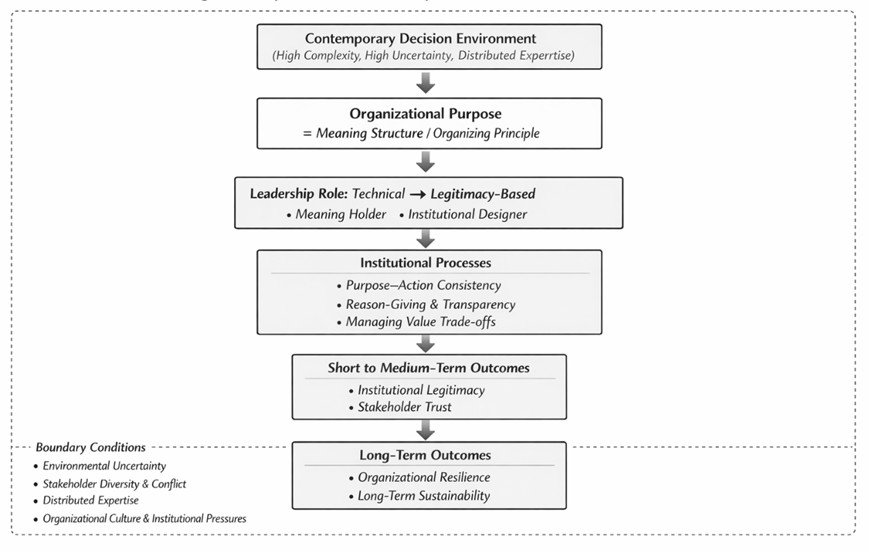
This conceptual article develops a framework for explaining leadership driven by purpose rather than expertise to address contemporary organizational contexts characterized by complexity, uncertainty, and distributed knowledge across teams and networks rather than concentrated in any single individual. While many organizations continue to treat technical excellence as the primary basis of leadership legitimacy, the article argues that relying on expertise as the sole source of authority has important limitations when decisions must confront incomplete information, multiple and competing goals, and moral consequences for stakeholders. The article proposes understanding purpose as a meaning structure that guides the interpretation of situations, the prioritization of values, and the use of knowledge in ways that are consistent with the organization’s reason for existence. From an institutional perspective, the author distinguishes between leaders’ technical authority and their authority based on meaning or legitimacy and explains how purpose functions as a justificatory basis for the exercise of authority. The developed framework suggests that alignment between purpose and actual decision-making constitutes a key mechanism for accumulating stakeholder trust. Such trust, in turn, enhances organizational adaptability, strengthens resilience, and supports long-term sustainability under conditions in which expertise has become a widely accessible resource. Finally, the article advances conceptual propositions for future empirical testing and outlines theoretical and practical implications for the design of governance, the selection and development of leaders, and the management of stakeholder relationships in highly uncertain environments.
References
Adler, P. S., & Borys, B. (1996). Two types of bureaucracy: Enabling and coercive. Administrative Science Quarterly, 41(1), 61–89.
Alvesson, M., & Spicer, A. (2012a). A stupidity-based theory of organizations. Journal of management studies, 49(7), 1194-1220.
Alvesson, M., & Spicer, A. (2012b). Critical leadership studies: The case for critical performativity. Human relations, 65(3), 367-390.
Ansell, C., & Gash, A. (2008). Collaborative governance in theory and practice. Journal of public administration research and theory, 18(4), 543-571.
Ansell, C., & Trondal, J. (2018). Governing complexity: The global challenge for democratic governance. Cambridge: Cambridge University Press.
Ansell, C., Sørensen, E., & Torfing, J. (2017). Improving policy implementation through collaborative policymaking. Policy & politics, 45(3), 467-486.
Bachmann, R., & Inkpen, A. C. (2011). Understanding institutional-based trust building processes in inter-organizational relationships. Organization Studies, 32(2), 281–301.
Beetham, D. (1991). The legitimation of power. London: Palgrave Macmillan.
Beetham, D. (2013). The legitimation of power. (2nd ed.). London: Palgrave Macmillan.
Bitektine, A., & Haack, P. (2015). The macro and the micro of legitimacy: Toward a multilevel theory of the legitimacy process. Academy of Management Review, 40(1), 49–75.
Boin, A., & van Eeten, M. (2013). The resilient organization. Public Management Review, 15(3), 429–445.
Bolden, R. (2011). Distributed leadership in organizations: A review of theory and research. International Journal of Management Reviews, 13(3), 251–269.
Bovens, M., Goodin, R. E., & Schillemans, T. (2014). Accountability and public governance. Oxford: Oxford University Press.
Brown, M. E., & Treviño, L. K. (2006). Ethical leadership: A review and future directions. The Leadership Quarterly, 17(6), 595–616.
Carton, A. M. (2018). I’m not mopping the floors, I’m putting a man on the moon. Administrative Science Quarterly, 63(2), 323–369.
Cornelissen, J. (2017). Corporate communication: A guide to theory and practice. (5th ed.). London: SAGE.
Creed, W. D., DeJordy, R., & Lok, J. (2010). Being the change: Resolving institutional contradiction through identity work. Academy of Management Journal, 53(6), 1336–1364.
Crevani, L., Lindgren, M., & Packendorff, J. (2010). Leadership, not leaders. Scandinavian Journal of Management, 26(1), 77–86.
Deephouse, D. L., & Suchman, M. C. (2008). Legitimacy in organizational institutionalism. In Greenwood, R., Oliver, C., Lawrence, T. B., & Meyer, R. E. (Eds.), The SAGE handbook of organizational institutionalism (pp. 49–77). London: SAGE.
Denis, J. L., Langley, A., & Sergi, V. (2012). Leadership in the plural. Academy of Management Annals, 6(1), 211–283.
Dirks, K. T., & Ferrin, D. L. (2001). The role of trust in organizational settings. Organization Science, 12(4), 450–467.
Duchek, S. (2020). Organizational resilience. Business Research, 13(1), 215–246.
Easterby-Smith, M., Lyles, M. A., & Tsang, E. W. K. (2008). Inter-organizational knowledge transfer: Current themes and future prospects. Journal of Management Studies, 45(4), 677–690.
Emerson, K., & Nabatchi, T. (2015). Collaborative governance regimes. Washington, DC: Georgetown University Press.
Faraj, S., Jarvenpaa, S. L., & Majchrzak, A. (2011). Knowledge collaboration in online communities. Organization Science, 22(5), 1224–1239.
Flyvbjerg, B. (2014). What you should know about megaprojects and why: An overview. Project Management Journal, 45(2), 6–19.
Flyvbjerg, B. (2017). The Oxford handbook of megaproject management. Oxford: Oxford University Press.
Friedrich, T. L., Vessey, W. B., Schuelke, M. J., Ruark, G. A., & Mumford, M. D. (2009). A framework for understanding collective leadership. The Leadership Quarterly, 20(6), 933–958.
Fulmer, C. A., & Gelfand, M. J. (2012). At what level (and in whom) we trust: Trust across multiple organizational levels. Journal of management, 38(4), 1167-1230.
Fulmer, C. A., & Ostroff, C. (2016). Convergence and emergence in organizations: An integrative framework and review. Journal of Organizational Behavior, 37(S1), S122–S145.
Gartenberg, C., Prat, A., & Serafeim, G. (2019). Corporate purpose and financial performance. Organization Science, 30(1), 1–18.
George, B., Sims, P., McLean, A. N., & Mayer, D. (2021). Discover your true north. Hoboken, New Jersey: Wiley.
Gillespie, N., & Dietz, G. (2009). Trust repair after an organization-level failure. Academy of Management Review, 34(1), 127–145.
Gioia, D. A., Patvardhan, S. D., Hamilton, A. L., & Corley, K. G. (2013). Organizational identity formation and change. Academy of Management Annals, 7(1), 123–193.
Greenleaf, R. K. (1977). Servant leadership: A journey into the nature of legitimate power and greatness. New York: Paulist Press.
Grint, K. (2005). Problems, problems, problems: The social construction of leadership. Human Relations, 58(11), 1467–1494.
Gronn, P. (2002). Distributed leadership as a unit of analysis. The Leadership Quarterly, 13(4), 423–451.
Habermas, J. (1996). Between facts and norms: Contributions to a discourse theory of law and democracy. Cambridge, Massachusetts: MIT Press.
Hannah, S. T., Avolio, B. J., & Walumbwa, F. O. (2011). Relationships between authentic leadership, moral courage, and ethical and pro-social behaviors. Business Ethics Quarterly, 21(4), 555–578.
Hardin, R. (2002). Trust and trustworthiness. New York: Russell Sage Foundation.
Head, B. W., & Alford, J. (2015). Wicked problems: Implications for public policy and management. Administration & Society, 47(6), 711–739.
Heifetz, R. A., Grashow, A., & Linsky, M. (2009). The practice of adaptive leadership. Boston, Massachusetts: Harvard Business Press.
Henderson, R., & Van den Steen, E. (2015). Why do firms have purpose? The firm’s role as a carrier of identity and reputation. American Economic Review, 105(5), 326–330.
Hernes, T., & Irgens, J. (2013). Keeping things mindfully on track: Organizational learning as a situated and mindfully dis/achieved accomplishment. Organization, 20(5), 673–696.
Hollensbe, E., Wookey, C., Hickey, L., George, G., & Nichols, C. V. (2014). Organizations with purpose. Academy of Management Journal, 57(5), 1227–1234.
Hosking, D. M. (2011). Moving relationality: Meditations on a relational approach to leadership. In Bryman, A., Collinson, D. L., Grint, K., Jackson, B., & Uhl-Bien, M. (Eds.), The SAGE handbook of leadership (pp. 455–467). London: SAGE.
Hosmer, L. T. (1995). Trust: The connecting link between organizational theory and philosophical ethics. Academy of Management Review, 20(2), 379–403.
Janis, I. L. (1982). Groupthink: Psychological studies of policy decisions and fiascoes. (2nd ed.). Boston, Massachusetts: Houghton Mifflin.
Kahneman, D. (2011). Thinking, fast and slow. New York: Farrar, Straus and Giroux.
Katz, R. L. (1974). Skills of an effective administrator. Harvard Business Review, 52(5), 90–102.
Klijn, E. H., & Koppenjan, J. F. M. (2012). Governance network theory: Past, present and future. Policy & Politics, 40(4), 587–606.
Kornberger, M., Justesen, L., & Mouritsen, J. (2011). When accounting acts. Critical Perspectives on Accounting, 22(5), 414–427.
Legood, A., van der Werff, L., Lee, A., & Den Hartog, D. (2021). A meta-analysis of the role of trust in the leadership-performance relationship. European Journal of Work and Organizational Psychology, 30(1), 1–22.
Lengnick-Hall, C. A., Beck, T. E., & Lengnick-Hall, M. L. (2011). Developing a capacity for organizational resilience through strategic human resource management. Human Resource Management Review, 21(3), 243–255.
Levi, M., & Stoker, L. (2000). Political trust and trustworthiness. Annual Review of Political Science, 3, 475–507.
Maak, T., & Pless, N. M. (2006). Responsible leadership in a stakeholder society. Journal of Business Ethics, 66(1), 99–115.
Maitlis, S., & Sonenshein, S. (2010). Sensemaking in crisis and change. Journal of Management Studies, 47(3), 551–580.
March, J. G., & Olsen, J. P. (1989). Rediscovering institutions: The organizational basis of politics. New York: Free Press.
March, J. G., & Simon, H. A. (1958). Organizations. New York: Wiley.
Mayer, R. C., Davis, J. H., & Schoorman, F. D. (1995). An integrative model of organizational trust. Academy of Management Review, 20(3), 709–734.
McEvily, B., Perrone, V., & Zaheer, A. (2003). Trust as an organizing principle. Organization science, 14(1), 91-103.
McKenna, E. (2020). Business psychology and organizational behaviour. (6th ed.). London: Routledge.
Mintzberg, H. (1973). The nature of managerial work. New York: Harper & Row.
Mumford, M. D., Zaccaro, S. J., Harding, F. D., Jacobs, T. O., & Fleishman, E. A. (2000). Leadership skills for a changing world. The Leadership Quarterly, 11(1), 11–35.
Nicolini, D. (2012). Practice theory, work, and organization: An introduction. Oxford: Oxford University Press.
Olsen, J. P. (2017). Democratic accountability, political order, and change. Oxford: Oxford University Press.
Ouchi, W. G. (1979). A conceptual framework for the design of organizational control mechanisms. Management Science, 25(9), 833–848.
Park, H., & Blenkinsopp, J. (2011). The roles of transparency and trust in the relationship between corruption and citizen satisfaction. International Review of Administrative Sciences, 77(2), 381–401.
Patriotta, G., Gond, J.-P., & Schultz, F. (2011). Maintaining legitimacy: Controversies, orders of worth, and public justifications. Journal of Management Studies, 48(8), 1804–1836.
Pfeffer, J. (1981). Power in organizations. Marshfield, Massachusetts: Pitman.
Pirson, M. (2019). Trust in organizations: A behavioral and ethical perspective. Cambridge: Cambridge University Press.
Pirson, M., & Malhotra, D. (2011). Foundations of organizational trust: What matters to different stakeholders?. Organization Science, 22(4), 1087–1104.
Power, M. (2007). Organized uncertainty: Designing a world of risk management. Oxford: Oxford University Press.
Provan, K. G., & Kenis, P. (2008). Modes of network governance: Structure, management, and effectiveness. Journal of Public Administration Research and Theory, 18(2), 229–252.
Rawls, J. (1993). Political liberalism. New York: Columbia University Press.
Reinecke, J., & Ansari, S. (2015). What is a “fair” price? Ethics as sensemaking. Organization Science, 26(3), 867–888.
Reinecke, J., Van Bommel, K., & Spicer, A. (2017). When orders of worth clash: Negotiating legitimacy in situations of moral multiplexity. Research in the Sociology of Organizations, 52, 33–72.
Rhodes, R. A. W. (2017). Understanding governance: Policy networks, governance, reflexivity and accountability. Maidenhead, UK: Open University Press.
Schmidt, V. A. (2009). Putting the political back into political economy by bringing the state back yet again. World Politics, 61(3), 516–548.
Schoorman, F. D., Mayer, R. C., & Davis, J. H. (2007). An integrative model of organizational trust: Past, present, and future. Academy of Management Review, 32(2), 344–354.
Scott, W. R. (2014). Institutions and organizations: Ideas, interests, and identities. (4th ed.). Los Angeles, California: SAGE.
Selznick, P. (1957). Leadership in administration: A sociological interpretation. New York: Harper & Row.
Six, F. (2013). Trust in regulatory relations: How new insights from trust research improve regulation theory. Public Management Review, 15(2), 163-185.
Snowden, D. J., & Boone, M. E. (2007). A leader’s framework for decision making. Harvard Business Review, 85(11), 68–76.
Stirling, A. (2010). Multicriteria diversity analysis: A novel heuristic framework for appraising energy portfolios. Energy Policy, 38(4), 1622–1634.
Suchman, M. C. (1995). Managing legitimacy. Academy of Management Review, 20(3), 571–610.
Suddaby, R., Bitektine, A., & Haack, P. (2017). Legitimacy. Academy of Management Annals, 11(1), 451–478.
Tost, L. P. (2011). An integrative model of legitimacy judgments. Academy of Management Review, 36(4), 686–710.
Tourish, D. (2013). The dark side of transformational leadership. London: Routledge.
Tourish, D. (2019). Management studies in crisis. Cambridge: Cambridge University Press.
Tsoukas, H. (2009). A complex view of organizational knowledge. Management Learning, 40(4), 407–417.
Uhl-Bien, M., Marion, R., & McKelvey, B. (2007). Complexity leadership theory. The Leadership Quarterly, 18(4), 298–318.
Vogus, T. J., & Sutcliffe, K. M. (2007, October). Organizational resilience: Towards a theory and research agenda. In 2007 IEEE international conference on systems, man and cybernetics (pp. 3418-3422). New York: IEEE.
Weber, M. (1978). Economy and society: An outline of interpretive sociology. Berkeley, California: University of California Press.
Weick, K. E. (1995). Sensemaking in organizations. Thousand Oaks, California: SAGE.
Yukl, G. (2013). Leadership in organizations. (8th ed.). Boston, Massachusetts: Pearson Education.
Zaccaro, S. J., Kemp, C., & Bader, P. (2004). Leader traits and attributes. In Antonakis, J., Cianciolo, A. T., & Sternberg, R. J. (Eds.), The nature of leadership (pp. 101–124). Thousand Oaks, California: SAGE.
Downloads
Published
How to Cite
Issue
Section
License
Copyright (c) 2026 Journal of Social Science Panyapat

This work is licensed under a Creative Commons Attribution-NonCommercial-NoDerivatives 4.0 International License.


