Approaches to Developing the Potential for Self-Directed Chinese Language Learning among Students at Private Universities in Pathum Thani Province
Keywords:
Developing the Potential, Chinese Self-Learning, Private Universities, Pathum Thani ProvinceAbstract
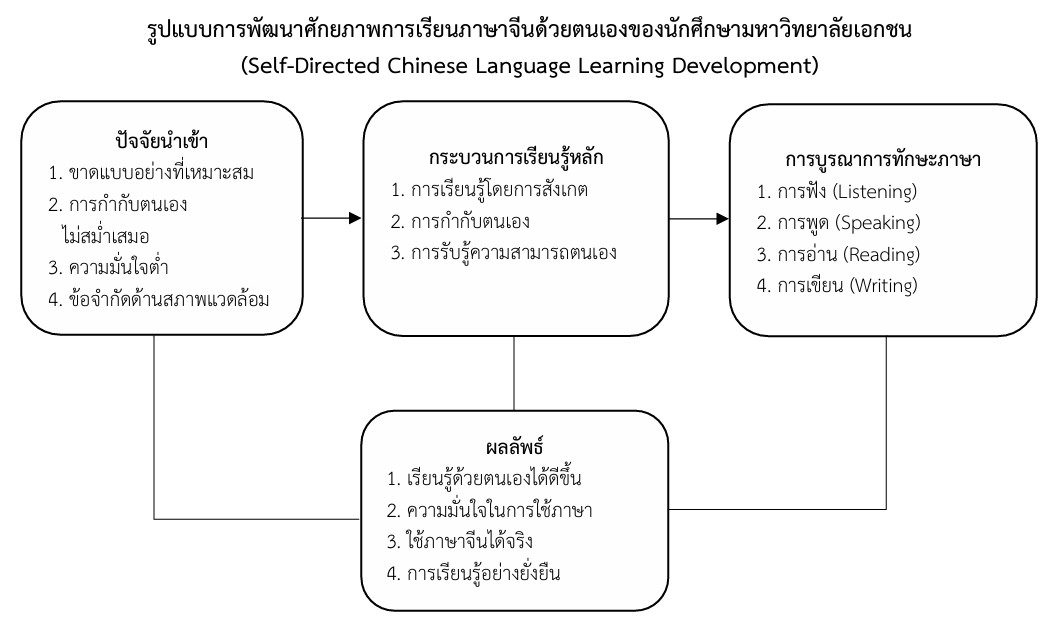
This article aimed to study (1) the problems in self-directed Chinese language learning among students at private universities in Pathum Thani Province, and (2) to propose approaches to enhancing the effectiveness of self-directed Chinese language learning. This study employed a qualitative research design. Data were collected using semi-structured interviews, and the data were analyzed through content analysis. The results of the study found that: 1) Regarding problems in self-directed Chinese language learning, the skill with the greatest difficulty was speaking, followed by listening, writing, and reading, respectively. The main problems identified included a lack of continuous observation and appropriate role models, inconsistency in planning and regulating self-directed learning, and a lack of confidence in using Chinese, particularly in speaking and writing. The key recommendations included organizing group-based and peer-to-peer speaking and listening activities, developing weekly writing exercises with feedback, and utilizing online media and Chinese language clubs to build learners’ confidence, along with providing guidance on systematic planning and monitoring of self-directed learning. 2) The approaches to developing the potential for self-directed Chinese language learning consisted of: (1) developing observational learning, whereby students should be provided with appropriate and continuous models from various sources, enabling them to connect knowledge gained through observation with the use of Chinese language skills in real-life situations; (2) developing self-regulation, in which students should be taught to plan their weekly learning and consistently monitor their learning progress; and (3) enhancing perceived self-efficacy by starting with simple tasks that can be successfully accomplished to build confidence. Along with the systematic integration of all four language skills, this approach helps students develop their Chinese language abilities sustainably and enables them to use the language effectively in communication. The findings provide practical guidelines for designing learning activities and institutional support systems to enhance self-directed Chinese language learning among students in private higher education institutions.
References
ปราณีต ม่วงนวล, อรุณวรรณ ชูสังกิจ, ยอร์ช เสมอมิตร, สุวรรณ ม่วงนวล และ วิโรจน์ เจษฎาดิลก. (2568). กลยุทธ์การสื่อสารในสังคมโลกาภิวัตน์. วารสารส่งเสริมและพัฒนาวิชาการสมัยใหม่, 3(2), 185-210.
พรชัย เจดามาน, นิตยาพร กินบุญ และ ไพฑูรย์ พิมดี. (2560). ทรัพยากรมนุษย์ มิติการบริหารจัดการ ศตวรรษที่ 21 อย่างยั่งยืน. กรุงเทพฯ: สูตรไพศาลบิวเดอร์.
พระครูปลัดสุริยะ ชวนปญฺโญ และ ประวิทย์ ธงชัย. (2566). โลกาภิวัฒน์กับแนวโน้มการเปลี่ยนแปลงของสังคมและวัฒนธรรมไทย. วารสารสังคมศาสตร์และวัฒนธรรม, 7(10), 286-299.
ภัทรภณ ศิลารักษ์. (2564). การปรับตัวบทบาทภาษาจีนภายใต้บริบทวิถีชีวิตปกติใหม่ในยุคศตวรรษที่ 21. วารสารวิชาการภาษาและวัฒนธรรมจีน, 8(1), 61-72.
เยว่เหิง เฉิน. (2565). การพัฒนาตนเองในการเรียนภาษาจีนของนักศึกษาไทยในมหาวิทยาลัยแห่งหนึ่งในภาคตะวันออก. (ศิลปศาสตรมหาบัณฑิต, มหาวิทยาลัยบูรพา).
เยาวพร ศรีระษา. (2561). การจัดกิจกรรมการเรียนการสอนแบบภาษาเพื่อการสื่อสาร (CLT) ประกอบชุดสื่อประสมเพื่อส่งเสริมทักษะการพูดภาษาจีนของนักเรียนชั้นมัธยมศึกษาปีที่ 2. (การศึกษามหาบัณฑิต, มหาวิทยาลัยมหาสารคาม).
วรากร แซ่พุ่น, ภากร นพฤทธิ์, วราลี รุ่งบานจิต, วรทา รุ่งบานจิต, วรนาถ แซ่เซ่น และ ชุติมา คำแก้ว. (2560). การศึกษาสภาพและปัญหาการเรียนการสอนภาษาจีนของโรงเรียนมัธยมศึกษาในจังหวัดยะลา. วารสารมหาวิทยาลัยราชภัฏยะลา, 12(ฉบับพิเศษ), 126-136.
วริศรา สารบูรณ์ และ ชยุตม์ ภิรมย์สมบัติ. (2567). การสังเกตพฤติกรรมการเรียนรู้ทางสังคมอารมณ์ของนักเรียน : การเปรียบเทียบซีเอฟเอแบบกลุ่มพหุ. วารสารการวัดผลการศึกษา สำนักทดสอบทางการศึกษาและจิตวิทยา, 41(110), 1-11.
Bandura, A. (1986). Social foundations of thought and action: A social cognitive theory. Englewood Cliffs, NJ: Prentice-Hall.
Creswell, J. W. (2013). Qualitative inquiry & research design: Choosing among five approaches. Los Angeles: Sage.
Zhang, H., & Chinokul, S. (2023). Chinese Learning Motivation and Academic Self-Efficacy of Thai Senior High School Students. LEARN Journal: Language Education and Acquisition Research Network, 16(2), 77-93.
Downloads
Published
How to Cite
Issue
Section
License
Copyright (c) 2026 Journal of Social Science Panyapat

This work is licensed under a Creative Commons Attribution-NonCommercial-NoDerivatives 4.0 International License.


