Development of instructional model of 2S3A Model to enhance Analytical Thinking Ability and Mathematical Connection Ability of Primary students
Keywords:
Instructional Model of 2S3A Model, Analytical Thinking Ability, Mathematical Connection AbilityAbstract
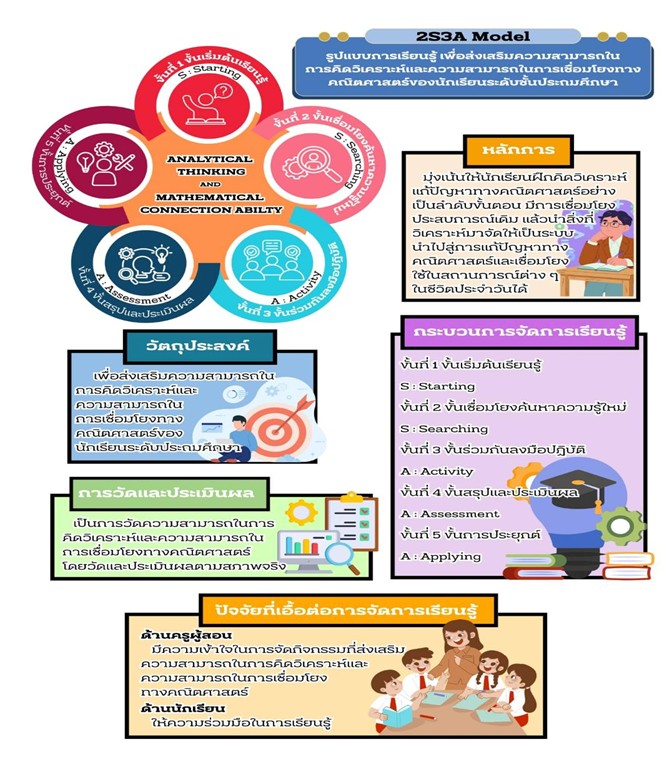
The purposes of this research were to: 1) develop and determine the effectiveness of the 2S3A instructional model in enhancing the Analytical Thinking Ability and Mathematical Connection Ability of primary students; 2) compare Analytical Thinking Ability before and after learning; and 3) compare Mathematical Connection Ability before and after learning. The samples used in this research consisted of 40 third-grade students from Phratamnaksuankularb Mahamongkhon School, Nakhonpathom Primary Educational Service Area District Office 2, during the first semester of the academic year 2025. The research instruments included the 2S3A instructional model developed by the researcher, a handbook for the model, lesson plans, an analytical thinking ability assessment test, and a mathematical connection ability assessment test. Data were analyzed using mean, standard deviation, and dependent t-test statistics. The research results indicated that: 1) the 2S3A instructional model consisted of five elements: principles, objectives, learning processes, evaluations, and learning factors. The learning process included five stages: Starting, Searching, Activity, Assessment, and Applying. The efficiency of the model was 84.60/82.75, which was higher than the required 80/80; 2) students’ scores in Analytical Thinking Ability after learning were significantly higher at the .05 level than before learning; and 3) students’ scores in Mathematical Connection Ability after learning were significantly higher at the .05 level than before learning.
References
กระทรวงศึกษาธิการ. (2560). ตัวชี้วัดและสาระการเรียนรู้แกนกลาง กลุ่มสาระการเรียนรู้คณิตศาสตร์ (ฉบับปรับปรุง พ.ศ. 2560) ตามหลักสูตรแกนกลางการศึกษาขั้นพื้นฐาน พุทธศักราช 2551. กรุงเทพฯ: โรงพิมพ์ชุมนุมสหกรณ์การเกษตรแห่งประเทศไทย.
ทิศนา แขมมณี. (2545). ศาสตร์การสอน องค์ความรู้เพื่อการจัดการเรียนการสอนอย่างมีประสิทธิภาพ. กรุงเทพฯ: จุฬาลงกรณ์มหาวิทยาลัย.
นิรันดร์ แสงกุหลาบ. (2547). การเปรียบเทียบผลการเรียนรู้เรื่องโจทย์ปัญหาทศนิยมและร้อยละ ของนักเรียนชั้นประถมศึกษาปีที่ 5 ที่จัดการเรียนรู้ด้วยเทคนิค เค ดับเบิ้ลยู ดี แอล และตามแนว สสวท. (ศึกษาศาสตรมหาบัณฑิต, มหาวิทยาลัยศิลปากร).
ปพนวัจน์ ลภัสภิญโญโชค. (2558). การพัฒนารูปแบบการสอน เพื่อส่งเสริมมโนทัศน์และกระบวนการทางคณิตศาสตร์ สำหรับนักเรียนระดับประถมศึกษา. (ปรัชญาดุษฎีบัณฑิต, มหาวิทยาลัยศิลปากร).
พรพิทักษ์ หมู่หัวนา. (2561). การพัฒนาการจัดกิจกรรมการเรียนรู้แบบซิปปา กลุ่มสาระการเรียนรู้คณิตศาสตร์ เรื่อง เงิน สำหรับนักเรียนชั้นประถมศึกษาปีที่ 4. (ครุศาสตรมหาบัณฑิต, มหาวิทยาลัยราชภัฏมหาสารคาม).
มาเรียม นิลพันธุ์. (2555). วิจัยทางการศึกษา. นครปฐม: ศูนย์วิจัยและพัฒนาการทางการศึกษา คณะศึกษาศาสตร์ มหาวิทยาลัยศิลปากร.
โรงเรียนบ้านแห่ประชานุเคราะห์. (2567). รายงานผลการทดสอบระดับชาติ RT, NT และ O-NET ประจำปีการศึกษา 2567. สืบค้นจาก https://share.google/RSnvPbdUOv25si1JJ.
วรรณวิสา จันทร์สุนทราพร. (2557). การพัฒนากิจกรรมการจัดการเรียนดรู้ด้วยกระบวนการสืบเสาะหาความรู้เพื่อส่งเสริมความสามารถในการแก้ปัญหาและความสามารถในการเชื่อมโยงทางคณิตศาสตร์ เรื่อง ความคล้าย ของนักเรียนชั้นมัธยมศึกษาปีที่ 3. (การศึกษามหาบัณฑิต, มหาวิทยาลัยศรีนครินทรวิโรฒ).
สถาบันส่งเสริมการสอนวิทยาศาสตร์และเทคโนโลยี. (2560). คู่มือการใช้หลักสูตรกลุ่มสาระการเรียนรู้คณิตศาสตร์ (ฉบับปรับปรุง พ.ศ. 2560) ตามหลักสูตรแกนกลางการศึกษาขั้นพื้นฐาน พุทธศักราช 2551. กรุงเทพฯ: สถาบันส่งเสริมการสอนวิทยาศาสตร์และเทคโนโลยี กระทรวงศึกษาธิการ.
อัมพร ม้าคนอง. (2557). คณิตศาสตร์สำหรับครูมัธยม. กรุงเทพฯ: โรงพิมพ์แห่งจุฬาลงกรณ์มหาวิทยาลัย.
Joyce, B. R., Weil, M., & Calhoun, E. (2009). Models of teaching. (8th ed.). Boston, Massachusetts: Pearson.
Kruse, K. (2007). Instruction to Instruction Design and ADDIE Model. Retrieved from http://www.e-learningguru.com/artcles/art_1.htm.
Downloads
Published
How to Cite
Issue
Section
License
Copyright (c) 2026 Journal of Social Science Panyapat

This work is licensed under a Creative Commons Attribution-NonCommercial-NoDerivatives 4.0 International License.


