Enhancing Household Income through the Cultivation of Coprinopsis cinerea (Hed-cone-noi) Mushroom with Appropriate Technology to Promote the Grassroots Economy: the Case Study of Nong Faek Subdistrict, Saraphi District, Chiang Mai Province
Keywords:
Household Income, Grassroots Economy, Coprinopsis cinerea (Hed-cone-noi) MushroomAbstract
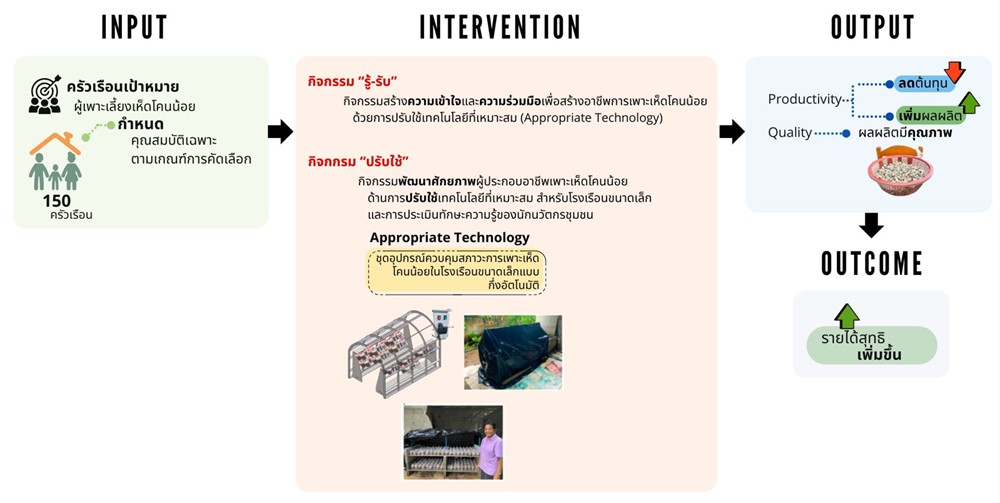
This study aimed to strengthen the local community economy by enhancing the net household income of Coprinopsis cinerea (Hed-cone-noi) mushroom cultivators in Nong Faek Subdistrict, Saraphi District, Chiang Mai Province, Thailand. A mixed methods research design was employed, integrating Participatory Action Research (PAR) to promote experiential learning, community engagement, and capacity building among 75 target households. Quantitative data were collected using pre- and post-intervention assessments measuring participants’ knowledge and understanding of income generation through Hed-cone-noi cultivation, along with performance-based evaluations of operational skills related to the appropriate technology for controlling temperature and humidity. Data analysis primarily utilized descriptive statistics, including mean values and percentage distributions. The findings revealed that: 1) the target households demonstrated a significant improvement in knowledge, understanding, and collaborative capacity following the intervention (p < 0.05), with mean scores increasing from 3.6 to 4.7, reflecting enhanced capacity to effectively operate the technological system; 2) although households gained a solid understanding of cultivation principles and key factors affecting production efficiency, they continued to require expert guidance in certain contexts. In terms of operational skills and system adjustments, households remained dependent on expert support and were unable to independently link production outputs with system performance. Additionally, maintenance and troubleshooting skills were limited, particularly for advanced system management; and 3) the average net income of participating households showed a substantial increase, with monthly net income ranging from 6,148 to 12,650 Thai Baht, and an average increase of 6,870 Baht per household. These findings underscore the pivotal role of appropriate technology integration and participatory learning processes in improving agro-based livelihoods. The study provides empirical evidence that combining PAR with context-specific technological interventions can strengthen agro-based household economic resilience and contribute to sustainable community-based development in local farming communities in Thailand.
References
กรมการพัฒนาชุมชน กระทรวงมหาดไทย. (2565). แผนปฏิบัติราชการระยะ 5 ปี พ.ศ.2566-2570. สืบค้นจาก https://plan.cdd.go.th/th/content/category/detail/id/601/iid/279581.
กิตติ สัจจาวัฒนา. (2567). ทางออก “ความยากจน” กับ ‘กิตติ สัจจาวัฒนา’ ใช้กลไก Change Agent เจาะ Area Development 20 จังหวัดแบบมุ่งเป้า-แม่นยำ. สืบค้นจาก https://thaipublica.org/2024/06/thailands-structural-problems-poverty.
คณะอนุกรรมการยุทธศาสตร์เศรษฐกิจฐานราก. (2559). คู่มือการส่งเสริมการพัฒนา “ระบบเศรษฐกิจฐานราก”. กรุงเทพฯ: กระทรวงการพัฒนาสังคมและความมั่นคงของมนุษย์.
ณัฐชยา เลาหรอดวิทย์. (2560). ระเบียบวิธีวิจัยทางสังคมศาสตร์. นครปฐม: โรงพิมพ์มหาวิทยาลัยศิลปากร.
เทศบาลตำบลหนองแฝก. (2566). หน้าแรก. สืบค้นจาก https://nongfag.go.th/index.php.
ลัทธพร รัตนวรารักษ์, โสมรัศมิ์ จันทรัตน์, ชนกานต์ ฤทธินนท์, บุญธิดา เสงี่ยมเนตร, อุกฤษ อุณหเลขกะ, รัสรินทร์ ชินโชติธีรนันท์ และกัมพล ปั้นตะกั่ว. (2562). Digital technology กับการยกระดับคุณภาพชีวิตเกษตรกรไทย. สืบค้นจาก https://www.pier.or.th/abridged/2019/19/.
วุฒิพงษ์ ฉั่วตระกูล, อริย์ธัช อักษรทับ และ เพ็ญวรัตน์ พันธ์ภัทรชัย. (2568). การสร้างศูนย์สร้างงานและกระจายรายได้ให้แก่เศรษฐกิจฐานรากผ่านธุรกิจการเพาะเห็ดโคนน้อย (รายงานการวิจัย). กรุงเทพฯ: หน่วยบริหารและจัดการทุนด้านการพัฒนาระดับพื้นที่ (บพท.).
สำนักงานพัฒนาชุมชน. (2566). การพัฒนาชุมชนไทยในยุคดิจิทัล. กรุงเทพฯ: สำนักงานพัฒนาชุมชน.
สำนักงานสถิติจังหวัดเชียงใหม่. (2565). รายงานสถิติจังหวัดเชียงใหม่ 2565. สืบค้นจาก https://chiangmai.nso.go.th/images/s-101.pdf.
สุทิน อ้อนอุบล. (2567). นวัตกรรมทางสังคมสำหรับการพัฒนาผลิตภัณฑ์สู่ตลาด เชิงพาณิชย์ภายใต้แนวคิดเศรษฐกิจหมุนเวียนของกลุ่ม วิสาหกิจชุมชนตำบลหนองปลาไหล อำเภอหนองปรือ จังหวัดกาญจนบุรี. วารสารพิกุล, 22(2), 39-59.
สุภาวดี ขุนทองจันทร์, ภวิษฐ์พร วงศ์ศักดิ์, ปิ่นปินัทธ์ กมลอิง และ พัชรพร ด้วงอุดม. (2566). การศึกษาเพื่อถอดองค์ความรู้การพัฒนาตำบลเข้มแข็ง มิติคนมีคุณภาพ และมิติการประยุกต์ใช้นวัตกรรมและเทคโนโลยีเชิงพื้นที่. กรุงเทพฯ: สถาบันพัฒนาองค์กรชุมชน (องค์การมหาชน) พอช.
อานนท์ เอื้อตระกูล. (2541). การเพาะเห็ดโคนน้อย (เห็ดถั่ว). กรุงเทพฯ: ชมรมเห็ดสากล.
Chen, L., Zhang, Z., Li, H., & Zhang, X. (2023). Maintenance Skill Training Gives Agricultural Socialized Service Providers More Advantages. Agriculture, 13(1), 135.
Dick, W., Carey, L., & Carey, J. O. (2005). The systematic design of instruction. (6th ed.). Boston: Pearson/Allyn and Bacon.
Keizer, GJ. (2007). The Complete Encyclopedia of Mushrooms. Groningen: Rebo Publishers.
Meechoovet, Y. & Siriwato, S. (2023). Thailand’s Smart Agriculture and Its Impacts on Thai Farmers: A Case Study of Smart Agriculture in Ayutthaya, Thailand. Asian Political Science Review, 7(1), 1-17.
Redhead, S. A., Vilgalys, R., Moncalvo, J.-M., Johnson, J., & Hopple, J. S., Jr. (2001). Coprinus Pers. and the disposition of Coprinus species sensu lato. Taxon, 50(1), 203–241.
Rovinelli, R.J. & Hambleton, R.K. (1977). On the Use of Content Specialists in the Assessment of Criterion-Referenced Test Item Validity. Tijdschrift Voor Onderwijs Research, 2(2), 49-60.
Downloads
Published
How to Cite
Issue
Section
License
Copyright (c) 2026 Journal of Social Science Panyapat

This work is licensed under a Creative Commons Attribution-NonCommercial-NoDerivatives 4.0 International License.


