Guidelines for Applying the Middle Path Principle to Quantum Strategic Management of Leading Buddhist Schools under the Office of Secondary Education Service Area Office Bangkok 1
Keywords:
The Middle Path, Quantum Strategic Management for School Administrators, Leading Buddhist SchoolsAbstract
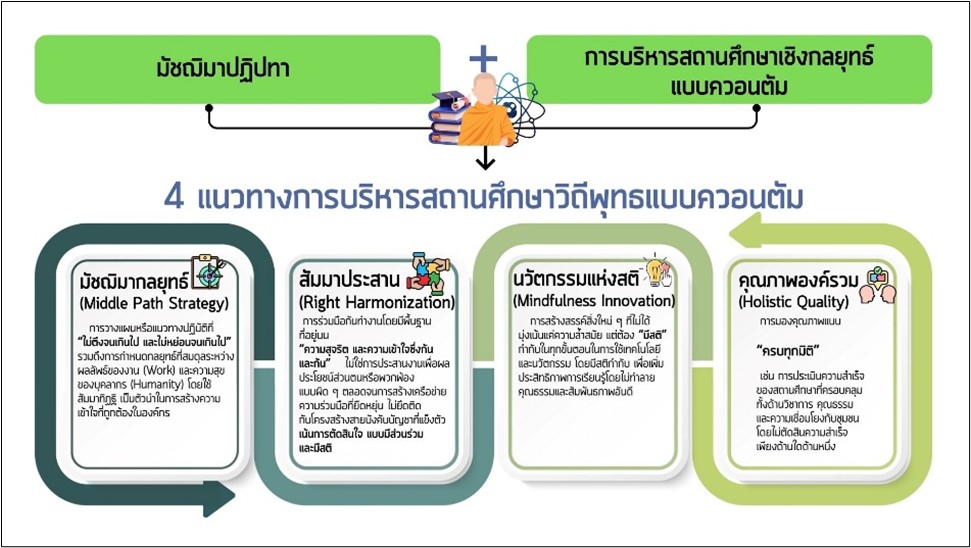
The purposes of this research were: 1) Study the application of the Middle Path (Majjhima patipada) in school administration; 2) Examine quantum strategic management within leading Buddhist-oriented schools; and 3) Synthesize guidelines for integrating the Middle Path into quantum strategic management for school administrators under the Secondary Educational Service Area Office Bangkok 1. This study employed a qualitative research methodology. Primary data were collected through semi-structured interviews with purposively selected administrators from five school “Leading Buddhist-Oriented Schools.” The research instruments included document analysis summaries and semi-structured interview guides. Data were analyzed using content analysis and presented through descriptive analysis. The research findings revealed that: 1) Regarding the application of the Middle Path, administrators prioritize management based on the foundation of “moderation and balance” by integrating the Noble Eightfold Path into four key dimensions: balancing organizational goals with personnel well-being, implementing innovation under the principle of Right Livelihood, balancing academic excellence with moral development, and employing Right View as a compass for organizational transformation. 2) In terms of quantum strategic management, administrators focus on managing under conditions of uncertainty by viewing the school as an interconnected ecosystem. This approach emphasizes organizational agility and the creation of synergy through the “Home-Temple-School” (Bovorn) network, driven by mindfulness and wisdom rather than quantitative metrics. 3) The synthesized guidelines resulted in the “Four Pillars of Modern Buddhist-Quantum School Administration Model,” which consists of: (1) Middle Path Strategy, creating a strategic balance between academic outcomes and organizational welfare; (2) Right Harmonization, establishing flexible collaborative networks and participatory decision-making; (3) Mindfulness Innovation, utilizing modern technology without compromising interpersonal relationships or morality; and (4) Holistic Quality, measuring success through spiritual, academic, and social dimensions to ensure organizational sustainability in the digital age.
References
กิจจ์พิภัช เกตุแก้ว. (2568). รูปแบบการบริหารแบบมีส่วนร่วมตามหลักมัชฌิมาปฏิปทา. วารสารพุทธสังคมวิทยาปริทรรศน์, 10(2), 27-42.
บัลลังก์ มงคลคำนวณเขตต์. (2566). กระบวนทัศน์ทางการบริหารการศึกษาในบริบทสังคมไทยยุคปกติใหม่. (ปรัชญาดุษฎีบัณฑิต, มหาวิทยาลัยศิลปากร).
วรกมล น้อยโสภณ, วรรณวิศา สืบนุสรณ์ คล้ายจำแลง และ สุชาดา นันทะไชย. (2568). อิทธิพลของวัจนภาษาและอวัจนภาษาของผู้บริหารสถานศึกษา เชิงกลยุทธ์แบบควอนตัมต่อวัฒนธรรมองค์กร. Journal of Education and Innovation, 27(3), 248–262.
วีระ สมบูรณ์. (2550). ควอนตัมกับการบริหารจัดการ. กรุงเทพฯ: โรงพิมพ์แห่งจุฬาลงกรณ์มหาวิทยาลัย.
สำนักงานเลขาธิการสภาการศึกษา. (2560). แผนการศึกษาแห่งชาติ พ.ศ. 2560 – 2579. กรุงเทพฯ: สำนักงานเลขาธิการสภาการศึกษา กระทรวงศึกษาธิการ.
Abangan, M. L. M. (2024). Quantum leadership, ethical climate and commitment of school administrators: A convergent design. EPRA International Journal of Multidisciplinary Research, 10, 561-577.
Braun, V., & Clarke, V. (2006). Using thematic analysis in psychology. Qualitative research in psychology, 3(2), 77-101.
Heisenberg, W. (1927). Über den anschaulichen Inhalt der quantentheoretischen Kinematik und Mechanik. Zeitschrift für Physik, 43(3-4), 172-198.
Lincoln, Y. S., & Guba, E. G. (1985). Naturalistic inquiry. Thousand Oaks: Sage Publications.
Marion, R., & Uhl-Bien, M. (2001). Leadership in complex organizations. The leadership quarterly, 12(4), 389-418.
Shelton, C. K. (2001). Quantum Leaps: 7 Skills for 21st Century Leaders. Oxford: Butterworth-Heinemann.
United Nations. (2015). THE 17 GOALS: Sustainable Development. Retrieved from https://sdgs.un.org/goals.
Wheatley, M. J. (2006). Leadership and the new science. (3rd ed.). San Francisco: Berrett-Koehler Publishers.
Zohar, E. (2022). Quantum simulation of lattice gauge theories in more than one space dimension—requirements, challenges and methods. Philosophical Transactions of the Royal Society A: Mathematical, Physical and Engineering Sciences, 380(2216), 20210069.
Downloads
Published
How to Cite
Issue
Section
License
Copyright (c) 2026 Journal of Social Science Panyapat

This work is licensed under a Creative Commons Attribution-NonCommercial-NoDerivatives 4.0 International License.


